


Tooth decay is the bacterial disease, while a cavity is the resulting hole.
In fact, most people are unaware that tooth decay and cavities are two very different things. A sudden and sharp pain after drinking cold water generally leads you to think that you have a cavity. However, according to the medical point of view, these words are very different from one another.
Imagine tooth decay as a silent illness that is attacking your teeth. A cavity is a physical hole that the illness leaves behind. For instance, when patients go to Turkey for dental treatment, the understanding of this simple difference helps them to figure out what is going on in their mouth.
Tooth Decay: The Silent Disease
Like an infection, tooth decay can be thought of as a process of decay. Whenever you eat sugary items, the oral bacteria will feed on the remnants of the food. After breaking down the molecules, they also release acids. Acids are, in fact, chemical solvents that slowly dissolve the hard enamel, the tooth’s outermost layer.
Professor Doctor Coşkun Yıldız says that the disease will not be painful at all; in fact, you will not even realize you have it. In addition to this, a black hole is hardly visible. At best, you may note a tiny chalky white spot on a tooth. Most importantly, the great thing about this stage is that it can help repair and treatment, so we should not waste this opportunity. Brushing well and using phosphate-containing fluoride will actually enable the tooth to rebuild its enamel even before a hole forms.s
Cavity: The Visible Hole
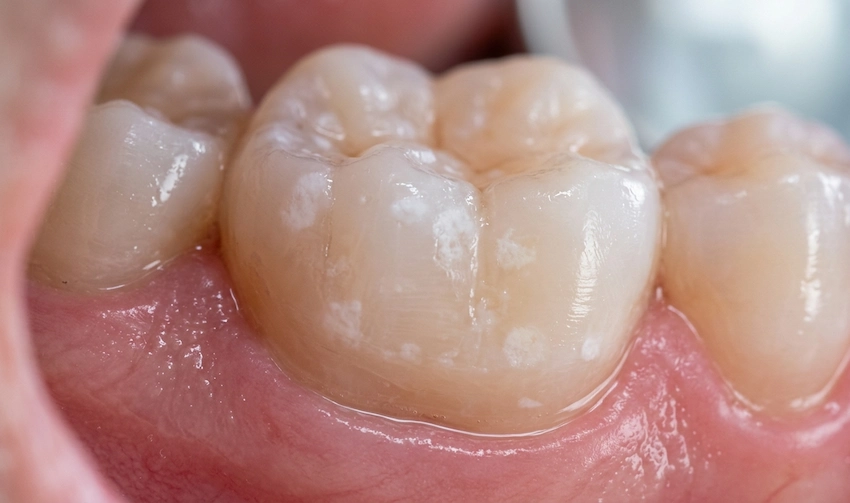
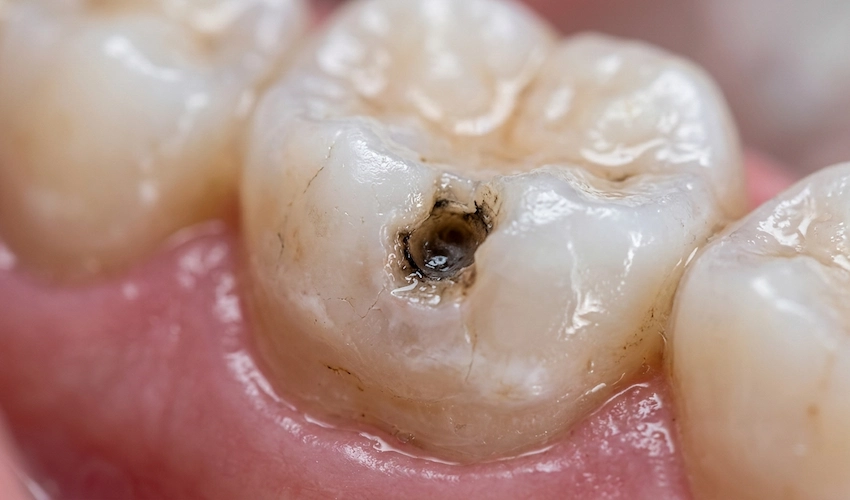
Now it is time to be more aware of what will happen if the acid attacks are not stopped. The protection of the enamel finally breaks down, and the tooth collapses,s resulting in the formation of a cavity.
This is the moment that we frequently see as the beginning of symptoms in patients at Lema Dental Clinic. With the disappearance of the enamel, bacteria can invade the soft, sensitive inner part of the tooth. It is this inner area that is responsible for such sharp sensations as, for example, pain after coffee or ice cream because of the presence of very fine nerve endings.
Solutions to the Problem
Experts say a cavity cannot be stopped or healed. Once a piece of the tooth is lost, it is lost for good. A dentist basically repairs the physical defect.
Still, Dentist Polen Akkılıç and her staff will select the appropriate treatment for the condition of the tooth, which is determined, of course,e by how deep the hole is.
- Early Decay (No Hole Yet): We use strong fluoride gels and teach better brushing habits to harden the tooth naturally.
- Small Cavities: We clean out the bad part of the tooth. Then, we fill the space with a white, tooth-colored filling.
- Large Cavities: A filling is not strong enough for a huge hole. It will break when you chew. Instead, we use a strong, custom porcelain crown to cover and protect the whole tooth like a helmet.
- Deep Nerve Infection: If the hole reaches the nerve deep inside the tooth, we must do a root canal to clean out the infection before putting a crown on top.
Quick Guide: Decay vs. Cavity
| Feature | Tooth Decay | Cavity |
| What is it? | A bacterial infection that weakens the tooth. | A permanent physical hole in the tooth. |
| Can you see it? | Usually invisible, or a tiny white spot. | Yes, you can see a dark pit or hole. |
| Does it hurt? | No, it is completely painless. | Yes, hot and cold foods cause sharp pain. |
| Can it heal naturally? | Yes. Fluoride and brushing can stop it. | No. A dentist must drill and fix it. |
| How we treat it | Fluoride therapy and better home cleaning. | White fillings or strong porcelain crowns. |
Frequently Asked Questions
If a small cavity at its very earliest stage – the appearance of a chalky white spot on the tooth – is the only damage incurred, then in that case, the cavity can actually be healed. Once a cavity is a physical hole, the body will not be able to replace the missing tooth structure, and the dentist will have to fill the tooth.
Here’s an average scene in our clinic. You suspect that the soft bread has somehow chipped your tooth. But actually, the deep decay over a long time has stealthily been hollowing out the inside of your tooth. The enamel has deteriorated and become so thin and fragile that even soft bread may cause the outer shell to give way.
Not at all . We anesthetize the area very thoroughly using top-quali, ty locally acting agents. The tooth is absolutely numb before we start treating it. You will be aware of some movements and pressure,e but there will not be pain of any kind.
A standard white filling is a very quick procedure. It lasts only 30 to 45 minutes during one appointment. But if your cavity is so extensive that you require a custom-made porcelain crown, we can create and fit your new crown within only a few days.
Yes, definitely. When you do not floss daily, bacteria will find their way under the old dental work and remain hidden. Under the filling, a fresh decay process will be launched. This is the main reason why dental X-rays are regularly very important.
- Featherstone, J. D. B. (2004). The continuum of dental caries—Evidence for a dynamic disease process. Journal of Dental Research, 83(1_suppl), C39-C42.
- Selwitz, R. H., Ismail, A. I., & Pitts, N. B. (2007). Dental caries. The Lancet, 369(9555), 51-59.
- Kidd, E. A. M., & Fejerskov, O. (2004). What constitutes dental caries? Histopathology of carious enamel and dentin related to the action of cariogenic biofilms. Journal of Dental Research, 83(1_suppl), C35-C38.
- Mount, G. J. (2003). Minimal intervention dentistry: rationale of cavity design. Operative Dentistry, 28(1), 92-99.
- Takahashi, N., & Nyvad, B. (2011). The role of bacteria in the caries process: ecological perspectives. Journal of Dental Research, 90(3), 294-303.

