


They often last a lifetime
In an era where porcelain and zirconia dominate the headlines of cosmetic dentistry, the mention of gold often feels like a nostalgic nod to the past. However, for those of us working daily in the operatory at Lema Dental Clinic in Turkey, gold remains the “undisputed king” of durability.
When a patient asks, “How long do gold teeth last?” the answer isn’t just a number—it’s a testament to one of the most biocompatible materials ever used in medicine. The reality is that while a high-end porcelain crown is a beautiful piece of art, a gold crown is a functional workhorse.
Professor Doctor Coşkun Yıldız often notes that gold is the only material that truly “respects” the opposing teeth. It’s a biological harmony that few other materials can mimic.
The Incredible Lifespan of Gold Restorations
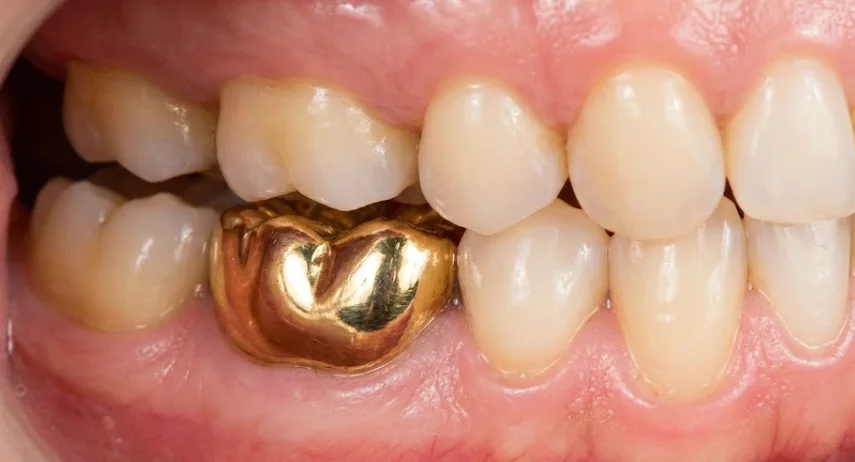
Let’s talk numbers. Our clinical experience at Lema Dental Clinic has shown that we often find gold restorations that had been done 30, 40 or even 50 years ago and are still working perfectly. While the average duration for most dental work lasts between 10 and 15 years, with gold it is often doubled or tripled.
The question remains: why does it last so long?
It comes down to physics and chemistry. Gold does not oxidize or corrode in the acidic environment of the mouth. But perhaps more importantly, gold has a “coefficient of thermal expansion” almost identical to natural tooth structure. Think of your tooth and the crown as a team; when you drink hot coffee or cold water, they expand and contract at the same rate. This prevents the microscopic “seam” between the tooth and crown from breaking, which is the primary reason most other crowns eventually fail due to secondary decay.
Why Gold is the “Shock Absorber” of Dentistry
Dentist Polen Akkılıç and her team often recommend gold for the back molars, especially for patients who grind their teeth (bruxism).
Here is a creative way to visualize it: imagine your jaw muscles are like the engine of a heavy-duty truck. When you chew, you exert hundreds of pounds of pressure. Porcelain, though hard, is brittle—like a glass plate hitting a stone floor. Gold, however, is malleable. It acts like the shock absorbers on a car, absorbing the force of the bite and slightly deforming rather than cracking.
Over years of use, gold actually “burnishes.” The edges of the gold crown are pressed closer to the tooth through the natural action of chewing, creating an even tighter seal over time. It is the only dental material that arguably gets better the more you use it.
Gold vs. The Modern Alternatives
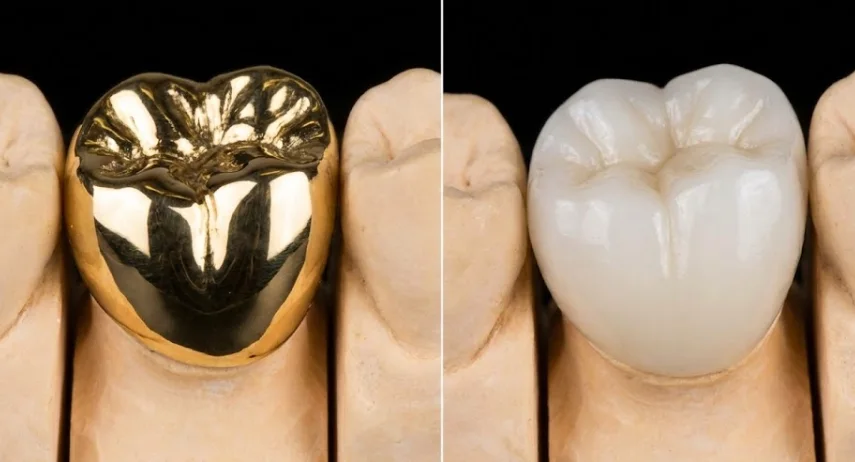
While we take great pride in our aesthetic zirconia work in Turkey, it’s important to compare the longevity objectively.
Material Comparison: Longevity and Performance
| Feature | Gold Alloy (High Noble) | Porcelain-fused-to-Metal | Zirconia / E-Max |
| Average Lifespan | 20–50+ Years | 10–15 Years | 12–20 Years |
| Wear on Opposing Teeth | Extremely Low (Like enamel) | High (Abrasive) | Moderate |
| Risk of Chipping | Zero | Moderate | Low |
| Biocompatibility | Excellent | Variable (Nickel risks) | Excellent |
| Aesthetics | Distinctive (Metal) | Good | Superior (Natural) |
The Clinical Reality: Why We Use It at Lema Dental Clinic
The reality is that gold isn’t for everyone, primarily due to the “glint” of metal in the smile. But let’s look closer at the clinical benefits. Because gold is so strong even in thin layers, Professor Doctor Coşkun Yıldız can be much more conservative during the preparation.
We compare the tooth structure to the foundation of a building. If we use porcelain, we often have to remove more of that foundation to make room for a thicker, stronger crown. With gold, we can keep more of your natural tooth intact. At Lema Dental Clinic, we believe the best dentistry is the kind that preserves as much of “you” as possible.
FAQ: Common Questions About Gold Teeth
The reality is that gold itself won’t fail, but the tooth underneath it still can. If you don’t maintain your gum health or if a new cavity starts at the very edge of the crown, we may have to replace it. But if you brush and floss, gold can quite literally last a lifetime.
Actually, no. Pure 24k gold is too soft for the intense pressure of chewing. We use ‘High Noble’ alloys, which blend gold with platinum, palladium, or silver. This creates a material that is bio-friendly but strong enough to handle a steak dinner.
This is a frequent worry for our international patients flying home from Turkey! The answer is no. Dental alloys do not have enough mass or the specific magnetic signature required to trigger standard security scanners.
In our clinical experience at Lema Dental Clinic, gold allergies are incredibly rare—far rarer than reactions to the base metals found in cheaper ‘PFM’ crowns. Gold is one of the most ‘ignored’ materials by the human immune system, which is exactly what you want.
The question remains about the commodity market. Unlike porcelain, which is fabricated from ceramic powders, gold has an intrinsic value. You are paying for the precious metal itself and the specialized laboratory work required to cast it. However, when you consider it might never need replacing, it is often the most cost-effective choice in the long run.
- Anusavice, K. J., Shen, C., & Rawls, H. R. (2012). Phillips’ Science of Dental Materials. Elsevier Health Sciences.
- Christensen, G. J. (2002). In pursuit of the “ultimate” restorative material. The Journal of the American Dental Association, 133(10), 1355-1357.
- Donovan, T., & Cho, G. C. (2003). Predictable outcomes with cast gold restorations. Journal of the California Dental Association, 31(11), 847-851.
- Kelly, J. R., & Nishimura, I. (2008). Science of dental materials: clinical requirements for dental ceramics and metals. Journal of Applied Oral Science, 16(3), 179-187.
- Studer, S., et al. (2000). Long-term survival rates of cast gold inlays and onlays: A 22-year clinical study. Journal of Oral Rehabilitation.

