


Gold crowns provide unmatched strength but sacrifice natural aesthetics.
Actually, dental care has evolved tremendously in the last two decades. When patients come to Turkey for a complete set of teeth, the main thing that they mostly want is a perfect white Hollywood-style smile.
Yet if we take a second look at an older material, gold has quietly kept on being the highest reference when it comes to pure mechanical power.
As a senior medical copywriter at Lema Dental Clinic, I frequently observe how patients get quite astonished when metal is mentioned. Since we exist in a time of transparent ceramics and dazzling white smiles. One query stays unanswered. However, why do top restorative dentists still put their faith in gold?
The Mechanical Marvel: Why Gold Works
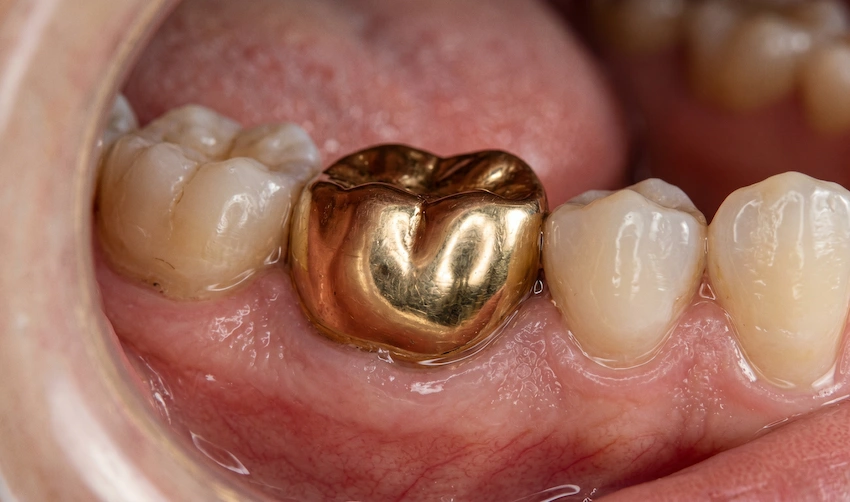
Professor Doctor Coşkun Yıldız regularly remarks on a simple clinical reality. In fact, if we were to evaluate dental materials solely from the point of view of engineering, gold would be almost always the winner.
You can compare a gold crown to a heavy steel security door of a bank vault. Even though it may not be the look of the rest of a modern, sleek building, the door is super strong and offers perfect protection to the inside.
Gold alloys have a characteristic that is quite special. They degrade at a rate that is identical to that of natural tooth enamel. So if you have a gold crown on a lower tooth, it will not wear out the upper teeth when you chew.
This is how we experience it at the dental practice. Patients who grind their teeth excessively are the ones who most often break the ceramic crowns. However, patients with gold dental restoration have been wearing it for forty years without the tiniest of chips.
The Pros of Gold Dental Crowns
Here are the main points on the clinical side that contribute to making gold a very good option:
- Lasting Forever: Research shows that gold crowns still work 96% of the time after 10 years. Many of them can quite comfortably last for a whole life.
- Less Tooth Drilling: Due to extreme strength even when very thin, Cast gold enables Dentist Polen Akkılıç and her team to save significantly more of your natural, healthy tooth structure.
- Gum Friendly: The use of top-notch gold alloys is not only very compatible with the gum but also very helpful for their health. Tight edging keeps the mouth closed to prevent bacteria from coming in.
- Won’t Break: There is no fracture to the gold. However, it is able to bend slightly under a high biting force, thereby absorbing the shock safely.
The Aesthetic Compromise: The Cons of Gold
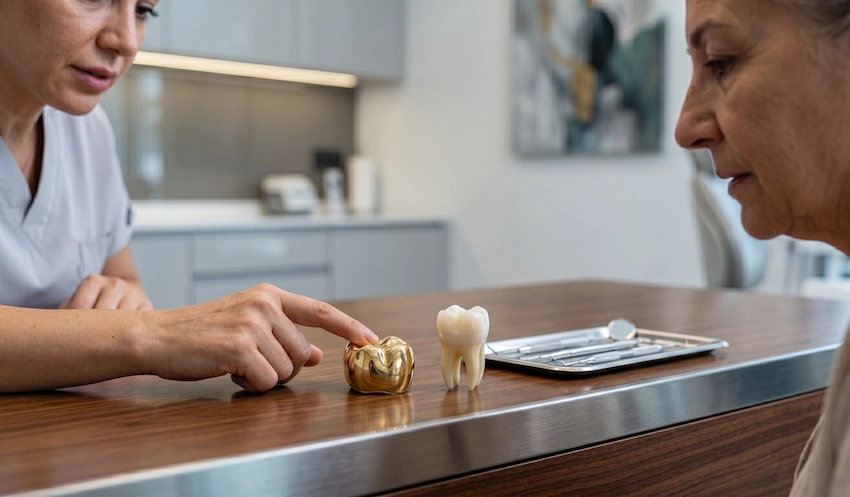
We cannot ignore this challenge. Creating a look matters a lot to the new dental patient. Here and there, a gold tooth could simply stick out. The majority of the patients who come to us in Istanbul are looking for teeth that are natural-looking and white only.
- Visual Appearance: A gold tooth contrasts significantly. More than anything else, patients coming to Istanbul want natural-looking white teeth.
- Temperature Sensitivity: Metal is a good conductor of cold and heat. Some patients experienced this sensation after a freshly fitted gold crown when they drink hot coffee or eat ice cream.
- Changing Costs: Gold, as a precious metal, undergoes variations in price on the global market. Therefore, gold crowns are very expensive compared to standard ceramics.
The Modern Alternative: Zirconia at Lema Dental Clinic
It was not that gold failed that dentists stopped using it. Actually, what happened is that modern ceramics finally gave us what we wanted.
Most of the time, we use solid zirconia for molar teeth only. Zirconia allows for very high fracture resistance on par with metal; at the same time, it can be very beautiful with bright, natural-looking enamel.
Material Comparison: Gold vs. Modern Ceramics
You can help yourself make a wise decision by comparing clinical evidence side-by-side.
| Feature | Gold Alloy Crowns | Monolithic Zirconia | Porcelain-Fused-to-Metal (PFM) |
| Aesthetics | Poor (Metallic) | Excellent (Tooth-colored) | Good (Can show a dark gum line) |
| Durability | 20 – 40+ Years | 15 – 25+ Years | 10 – 15 Years |
| Tooth Drilling Needed | Minimal | Moderate | Significant |
| Wear on Other Teeth | Very Low | Low to Moderate | High |
| Best Used For | Back Molars | Front or Back Teeth | Back Teeth |
Frequently Asked Questions
To put it simply, no. Fine gold alloys very rarely cause any health problems. Your gums may, in fact, be more comfortable around gold than with other materials, literally resulting in less swelling and a healthier smile for years to come.
If we are restoring a far back molar and you are a heavy grinder, I will always recommend gold first. However, our modern zirconia in Turkey is so strong now that we can usually give you the white teeth you want and still keep the strength you need.
To be honest, the perfect gold crown is a product of exceptional, old-school craftsmanship,p which is getting rarer. A lot of clinics favour machine-made ceramics because they can be done quickly. At Lema Dental Clinic, the experts of our laboratory are both digitally skilled in zirconia and excellent in gold manual work. We offer you options, not limits.
Not at all. Because gold, when thin, is still so strong, we do less tooth drilling. This means the whole procedure is smaller, and it is easier on your tooth nerve and also totally painless with the local anesthetic we use.
If you regularly brush and floss, the gold crown can actually last forever. I often meet patients who have had the same gold molar for more than 40 years. Just keep your gums clean, and it won’t let you down.
- Goodacre, C. J., Bernal, G., Rungcharassaeng, K., & Kan, J. Y. (2003). Clinical complications in fixed prosthodontics. The Journal of Prosthetic Dentistry, 90(1), 31-41.
- Pjetursson, B. E., Sailer, I., Makarov, N. A., Zwahlen, M., & Thoma, D. S. (2015). All-ceramic or metal-ceramic tooth-supported fixed dental prostheses (FDPs)? A systematic review of the survival and complication rates. Dental Materials, 31(6), 624-639.
- Raigrodski, A. J., Hillstead, M. B., Meng, G. K., & Chung, K. H. (2012). Survival and complications of zirconia-based fixed dental prostheses: a systematic review. The Journal of Prosthetic Dentistry, 107(3), 170-177.
- Sailer, I., Makarov, N. A., Thoma, D. S., Zwahlen, M., & Pjetursson, B. E. (2015). All-ceramic or metal-ceramic tooth-supported fixed dental prostheses (FDPs)? A systematic review of the survival and complication rates. Part I: Single crowns (SCs). Dental Materials, 31(6), 603-623.
- Walton, T. R. (2013). The up to 25-year survival and clinical performance of 2,340 high gold-based metal-ceramic single crowns. The International Journal of Prosthodontics, 26(2), 151-160.

