


No-drill diamond bonding is safe, painless, and enamel-friendly.
The Jewel in Your Smile: Safe, No-Drill Dental Diamond Application
People who visit Lema Dental Clinic to change their smile maybe just a little bit and add a literal sparkle to it are typically the same who cringe when they hear the sound of a dental handpiece. The fear is indeed justified. We all know that sacrificing healthy tooth structure just to have a nice accessory isn’t really worth it, right?
Luckily, cosmetic dentistry nowadays is very different from the old stereotype. In fact, you can have the whole package—a gorgeous smile and a tooth that is still healthy inside. At our clinic in Turkey, we offer a “No-Drill Bonding” technique that keeps the integrity of your tooth enamel intact. We focus less on changing the tooth and more on decorating the tooth.
It’s like your enamel is the glass of a luxury window. Conventional techniques might have scratched the glass to force something to stick. We don’t do that. We follow a unique adhesive protocol – very similar to orthodontic bracket bonding – which allows the jewel to sit beautifully on the surface and can be removed without causing any damage.
The Science of “No-Drill” Bonding
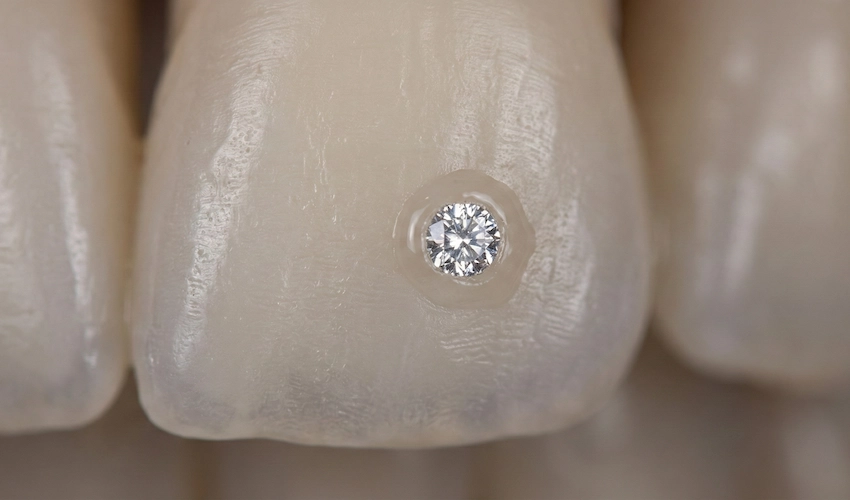
Preservation is the very first idea that pops into the head when Dentist Polen Akkılıç and the rest of the team are about to put a dental diamond. The procedure is so kind and harmless that it is mostly without even anaesthesia as we naturally avoid touching dentin or nerve endings.
Below is the chair-by-chair rundown:
- Surface Preparation: We clean the tooth thoroughly. Any plaque or biofilm is basically grease on a painting and it won’t allow the adhesion to work effectively.
- Etching (The Micro-Interlock): We spread a mild etching gel. This will make a microscopic texture on the surface of the enamel that no one can see with their naked eyes. It’s like lightly sanding a surface so that the paint will better stick but at the microscopic level, and the surface will re-mineralize later.
- Bonding: The glue is composite resin in a fluid form. Once the resin is cured with a certain light wavelength, the jewel is fixed in place.
Why We Don’t Drill: The Enamel Philosophy
According to Professor Doctor Coşkun Yıldız, enamel is the only tissue of a human that does not have self-regeneration capabilities. After the enamel is removed by drilling, it is gone forever. That is the very reason why we only allow non-invasive procedures when it comes to mainly cosmetic applications such as tooth gems (Skyce).
And if you were to think, a year later, that the diamond no longer matches your personality, we can just take it off and polish the tooth. Like it was never there. This undo-ability is the cornerstone of our philosophy here in Istanbul.
Comparison: No-Drill vs. Traditional Methods
We need to understand the importance of the particular technique used. Some dentists used to make a tiny hole to “seat” the stone. Here is why that method is not an option at Lema Dental Clinic for us.
| Feature | No-Drill Bonding (Our Standard) | Traditional Embedment (Drilling) |
| Enamel Impact | Enamel remains fully intact; the surface stays as good as new | Significant enamel loss; removal requires sealing the drilled area |
| Pain Level | Completely painless; no anesthesia needed | May cause sensitivity; local anesthesia is often required |
| Reversibility | Fully reversible | Permanent tooth alteration requires filling restoration |
| Hygiene | Easy to clean around the tooth and gem | Higher risk of bacterial buildup in the drilled cavity |
| Longevity | Six months to several years, depending on use and care | Permanent until the filling or restoration fails |
Hygiene and Safety: Living with the Sparkle
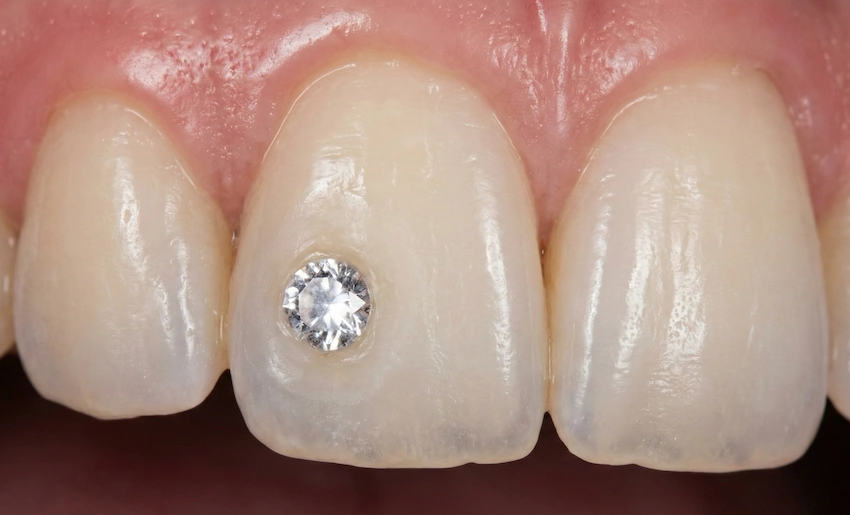
One concern we commonly hear is, “Will food get stuck?” “Will it hurt my lips?”
If the diamond is properly positioned, it will be both smooth and discreet. You shouldn’t feel like you are climbing a mountain just because of a rock on your tooth. And, we’ll ensure that the composite resin is such that your tongue doesn’t constantly get irritated from a rough corner. On the other hand, looking after your mouth and teeth will in fact be much more important. The jewel will create a little ledge that gives a place forthe plaque to hide. You need to brush that tooth as if you are actually polishing the diamond.
Frequently Asked Questions
No, it will not. The reason is that by design, we do not remove any tooth structure through drilling, and that implies no pain. Moreover, you will not even be instructed to get a shot of anesthesia. Actually, it is similar to getting a normal cleaning or having braces put on.
Definitely! It is, in fact, the best time to watch your brushing habits even more carefully. Either an electric or a manual toothbrush will do. No matter which one you use, it won’t matter because neither of them is going to dislodge the tooth gem if the bonding has been done correctly. Just remember not to use the plastic part on the back of your toothbrush head to hit the gem directly if anything, for the sake of avoiding the gem from getting chipped.
This is highly unlikely, but if the gem gets loose and you swallow it, stay calm. Dental diamonds used at Lema Dental Clinic are non-toxic and very small; they will go through your digestive system without causing any problems.
The answer to this question really depends on the consumption of food and the bite. In general, they can be in place for six months to a few years. So, if you often bite directly with that tooth on hard apples or crusty bread, the fracturing force may result in diamon getting off more quickly.
Evaluating whether to stay with us or not, you need a dentist, not your home. Doing so with tools or tweezers might break your tooth enamel. The next time you are back with us or any dental clinic, we can simply remove the adhesive with a unique polishing instrument without you having to worry at all about your enamel as it is under safe conditions.
- Al-Jazairy, Y. H. (2020). Bond strength of orthodontic brackets and dental jewelry: A comparative study of adhesive systems. Journal of Contemporary Dental Practice, 21(4), 412-418.
- Gordan, V. V., et al. (2018). Minimal intervention dentistry: Part of the future for dental practice. British Dental Journal, 224(12), 941-945.
- Khandelwal, P., & Nayak, U. A. (2019). Oral piercing and tooth gems: Risks and complications. International Journal of Clinical Pediatric Dentistry, 12(3), 226-231.
- Mulic, A., & Tveit, A. B. (2021). Enamel loss and bonding protocols: The importance of non-invasive aesthetic techniques. Operative Dentistry, 46(1), 12-20.
- Sardana, D., & Zhang, J. (2022). Fashion dentistry: Clinical considerations for tooth jewelry and grills. Australian Dental Journal, 67(S1), S34-S42.

