


Real diamond gems last longer and sparkle more than crystals.
That is a common scene at Lema Dental Clinic, Turkey. A patient sees his or her reflection after we have replaced a scuffed, cloudy piece of glass with an authentic VVS diamond, and he or she exhales deeply. Not only is it more brilliant. The way light interacts with the diamond is also different.
Tooth jewels were considered a retro trend of the 90s, but now they are a high-fashion must-have, yet a lot of confusion surrounds them. Are you buying a glorified sticker, or a jewel of medical grade? The difference is not only in the prices; it is in the physics of light and the chemistry of your teeth.
Here is what we encounter in our practice and why Dentist Polen Akkılıç and her staff want you to be aware of what the material is before putting it on your teeth.
The Physics of Shine: Refraction vs. Reflection
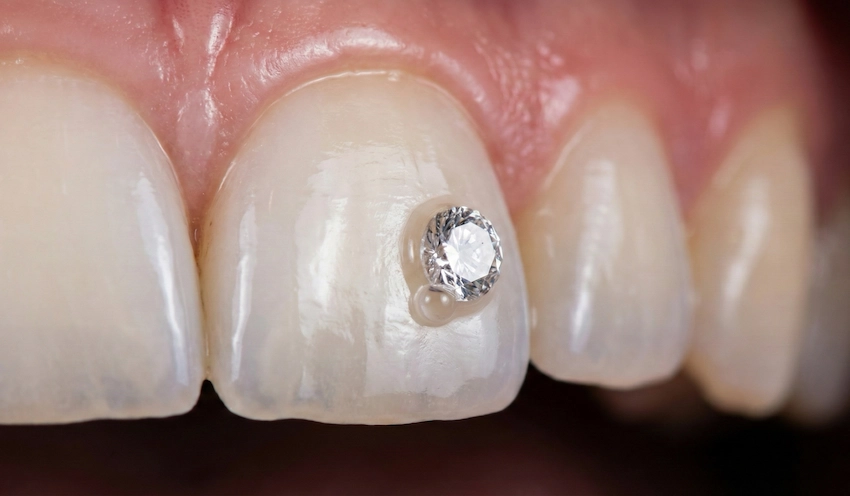
If you want to know why crystal (mostly lead glass or acrylic) looks different from a diamond, you have to study how they deal with light.
A crystal tooth jewel can be compared to a mirror. When the light hits it, it reflects. It is surface-level, shiny pretty much like the surface of a glass. Crystals’ foil backing, which serves as the mirror, can get worn out and the gem may become dark or gray.
Unlike a diamond which serves as a prism of light. A diamond has a very high refractive index. Light entering the stone is not just reflected when it hits a diamond. It enters the stone, gets bent, bounces off the internal surfaces, and emits the light in various colors.
At Lema Dental Clinic, they explain to their patients that a diamond doesn’t just lie on the tooth; instead, it is constantly interacting with the environment. Thus, it is still able to shine in the dark since it is capable of capturing and using even a very small amount of light.
The Biological Cost: Bonding Matters
The inevitable question would be which one is the stoner it to your tooth. That is where the medical expertise of Professor Doctor Coşkun Yıldız comes into play. The mouth is a hostile environment—it is wet, acidic, and constantly moving.
Cheap DIY or non-professional non-clinical providers use harsh superglues (cyanoacrylates) that are poisonous to the pulp of a tooth. They produce unstable bonding that breaks when biting the apple and the enamel chip gets stuck to the gem.
Having a trip to our clinic in Turkey gives you access to a distinct method. We use flowable composite resin which is the material for dental fillings that is totally compatible with the teeth.
Think about your tooth enamel as a window. Superglue is similar to covering it with a sticker that leaves a very stubborn stain. The composite bonding strategy that we apply can be compared to placing a clear protective cover that can hold the stone and does not damage the tooth structure.
Comparative Analysis: What Are You Really Getting?
Markets are full of “Swarovski” labels that are actually high-grade lead glass. The following clinical explanation shows their differences from the real thing.
| Feature | Real Diamond (0.01ct–0.05ct) | Crystal / Glass / Swarovski |
| Material Composition | 100% Carbon (Extremely durable natural material) | Leaded glass or acrylic |
| Light Behavior | Strong refraction (internal sparkle and fire) | Surface reflection (foil-backed shine) |
| Longevity | Unlimited (does not fade or lose brilliance) | 1–6 months (foil corrodes, surface scratches) |
| Hygiene Profile | Non-porous, plaque-resistant | Often porous, bacteria can accumulate |
| Enamel Risk | Minimal (with professional bonding technique) | High (due to acidic DIY adhesives) |
| Maintenance | Professionally cleaned without damage | May detach during scaling procedures |
The “Flat Back” Fallacy
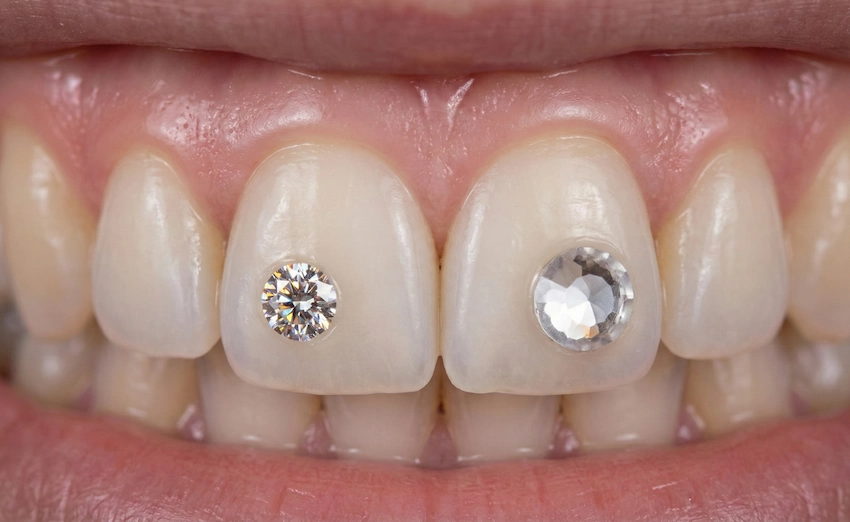
The common belief is that a sugarloaf-shaped diamond cannot be used on teeth because it may be too “pointy”. Nevertheless, dental diamonds, contrary to a typical engagement ring which features a deep “pavilion” (the lowest point), are specially designed to be used in the mouth.
Dentist Polen Akkılıç sees to it that diamonds procured at Lema are ground flat or slightly curved at the bottom to delicately conform to the convex surface of the tooth. It avoids the feeling of “bulky” which is the main cause of the irritation of the inner part of the lips. It is easy to produce crystals at a large scale because they are naturally flat-backed, however, they do not have that custom anatomical fit.
Frequently Asked Questions
“Of course not. It is a gentle treatment. We only use mild acid gel to etch the surface of the tooth–kind of like exfoliating your facial skin before you put on your cream–to help the crystal adhere tightly to the tooth surface. We do not drill healthy enamel simply for putting a gem on.”
“You have to! Actually, the gem has to be a source of motivation for you to do better around her. The diamond is resistant to damage from toothpaste abrasives, so there is no need to brush with care over it. However, to get rid of the plaque hiding software, a small amount of a soft-bristle brush is recommended.”
“Although we make the bonding very strong, sometimes it still happens. In the case of swallowing a genuine diamond tooth gem, it will be naturally expelled from your body without causing any harm. It’s being very small, non-toxic, and biologically inert, makes it pass through but unnoticed.”
“A diamond can be fixed for years or even stay indefinitely at Lema Dental Clinic before you decide to remove it by using the flowable composite bonding method. The crystals only last for a few months as their foil backing soon separates from the glass, so crystals usually fall off.”
“No pain at all. It is identical to the orthodontic bracket removal process. We just refine the surface by polishing the small composite bonding material that is left so that the tooth becomes intact and smooth. It is a matter of minutes only.”
- Donovan, T. E., et al. (2019). “Annual review of selected dental literature: Report of the Committee on Scientific Investigation of the American Academy of Restorative Dentistry.” The Journal of Prosthetic Dentistry, 122(3), 193-202.
- Kwon, S. R., & Wertz, P. W. (2015). “Review of the mechanism of tooth whitening.” Journal of Esthetic and Restorative Dentistry, 27(5), 240-257. (Discusses enamel permeability and bonding agents).
- Magne, P., & Belser, U. (2022). Bonded Porcelain Restorations in the Anterior Dentition: A Biomimetic Approach. Quintessence Publishing. (Fundamental principles of adhesion utilized in gem bonding).
- Sargison, A. E., et al. (2017). “The safety and efficacy of tooth jewelry: A clinical review.” British Dental Journal, 222(9), 675-678.
- Van Meerbeek, B., et al. (2020). “State of the art of self-etch adhesives.” Dental Materials, 27(1), 17-28.

