


Pacifiers are a typical soothing tool not only for infants but also for toddlers who are usually irritating and highly sentimental. That might be some of the pacifier teeth problems. They quench the soreness and at the same time play a preventive role in SIDS . Supported by research, these statistics are true. On the other hand, pacifiers in a long period of time or frequent utilization after the age of 2 can make ‘changes in a child’s oral development’ quite visible.
These changes mainly called “pacifier teeth problems” have the possibility of influencing the corrected position of the teeth, function of occlusion, growth of the jaw and even speech patterns. Parents and caretakers must know thoroughly the impact of pacifiers on the health of the mouth to be able to give the kids not only a children’s smile but also a smile full of the prospects of life.
What Are Problems with Pacifier Teeth?
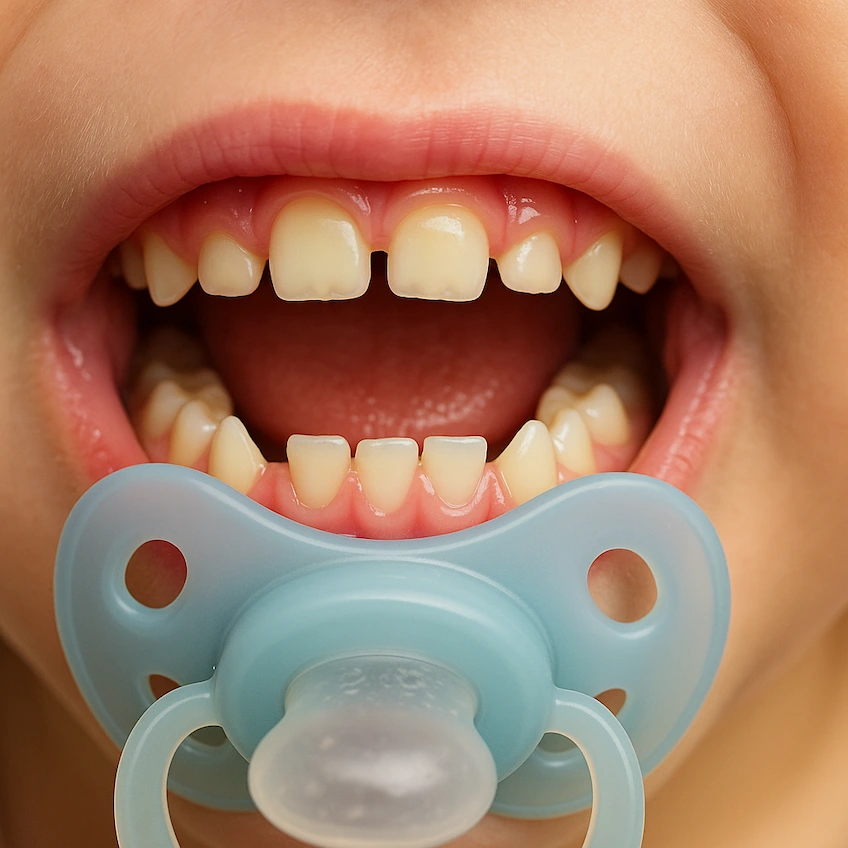
Pacifier teeth problems are the changes in the biologically normal relations caused by the mechanical force of pacifier sucking pressure that is repeated. Habit-related malocclusions is the technical name for such a condition. Among the commonly encountered problems are you are going to find Open Bite, Crossbite, Overjet or Protrusion, High-Arched Palate, Speech Development Challenges as follows:
- Open Bite: At the time when the mouth is closed the upper and lower front teeth do not come in contact hence it becomes hard to bite and cut food.
- Crossbite: The jaw works improperly because the upper teeth may be positioned inside the lower teeth on one or both sides of the mouth.
- Overjet or Protrusion: In case of relentless sucking, front teeth may lean outward or forward.
- High-Arched Palate: There is a possibility that the roof of the mouth which is the palate can be changed due to constant suction, however, sometimes the change of palate can also affect the position of the tongue and the coordination of the oral muscles.
- Speech Development Challenges: Hard to pronounce certain sounds and misaligned teeth and altered oral structures could be the reason that the child might need speech therapy.
These pacifier teeth problems are frequently noticeable only at the stage when the primary teeth fall out and the permanent teeth come in, thus the importance of monitoring and intervention at an early age is emphasized.
How Pacifier Use Affects Teeth and Jaw Growth?
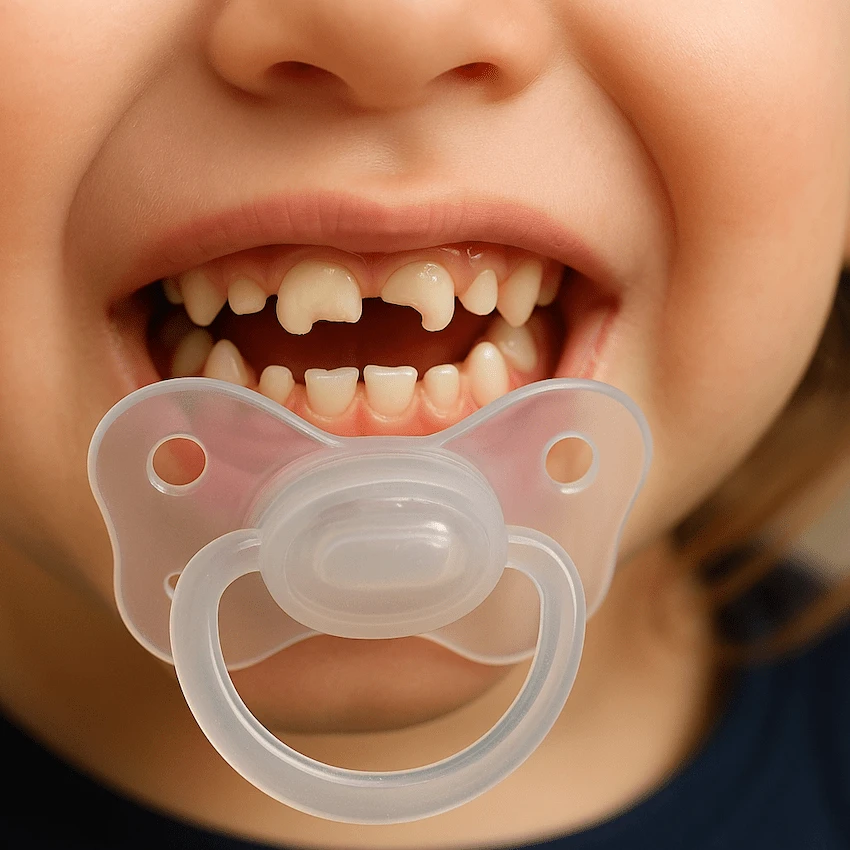
Pacifier teeth problems are the source of developing teeth and jaws, to which the pressure is applied. Such pressure may prevent the normal teeth eruption process and slowly make the teeth shift in a completely new orderly fashion.
Besides changing the patterns of the jaw growth, this phenomenon can also result in bite problems, which further lead to the decrease of the chewing process and oral health. In addition, the usage of a pacifier for a long time might have an effect on the tongue position, which is a vital part of speech and the function of the mouth in general.
The dental research shows that the frequency, intensity, and duration of pacifier use mainly determine how severe changes in dental will be. The children who are allowed to use their pacifiers only sometimes have lower chances of developing severe dental malocclusion in comparison to the ones who are given pacifiers constantly, especially if this use is prolonged beyond the age of two.
Preventing Pacifier Teeth Problems
- Limit Use Gradually: After the age of one count limiting pacifier use only to nap times and at bedtime.
- Encourage Early Weaning: To help the teeth grow normally, make it your aim to stop the use of pacifiers by the time your child is two.
- Alternative Comfort Measures: Provide the child with soft toys, blankets, or parental reassurance, which is gentle instead of a pacifier.
- Routine Dental Checkups: Regular visits to a pediatric dentist help monitor tooth alignment, bite, and jaw growth.
- Consult Professionals Early: Take the advice of the pediatric dentist if you find the teeth are misaligned, there are open bites, or the palate is unusually shaped.
Behavioral Strategies to Stop Pacifier Use and Pacifier Teeth Problems
- Positive Reinforcement: Give rewards to kids who manage to stay without the pacifier for a short time to motivate them to rely on themselves.
- Gradual Reduction: Before a total stop, cut down intervals of daily use to lower resistance.
- Cold Turkey Approach: A few parents who are able to completely remove the pacifier at a certain age, comfort, and diversion being used as a support, are the ones who get success with this method.
- Storytelling and Education: Telling older toddlers how adults don’t need pacifiers and having a party to celebrate each new milestone when they stop using them.
Dental and Orthodontic Management
Most pacifier teeth problems that have arisen due to the use of a pacifier are still correctable with professional dental care.
- Minor Misalignments: Through exercises instructing and close observation, pediatric dentists may help natural correction to be achieved.
- Orthodontic Appliances: Depending on the situation, tailored appliances might slowly move teeth to the right position and solve bite problems.
- Early Intervention: Malocclusions treatment before permanent teeth eruption is the most effective way to prevent orthodontic treatment for a long time in the future.
FAQ About Pacifier Teeth Problems
Yes. Use of a pacifier for a long time can lead to malocclusions like open bights, crossbites, and overjets, in particular, if the use has been going on after two years of age.
Experts recommend the discontinuation of pacifier usage by the time the child is two years old, as the dental structures are still developing, and stopping at an early stage aids in avoiding improper alignment.
Yes. Prolonged or frequent pacifier use in children, or those who mix it with thumb-sucking, will more likely have some dental changes.
Pacifier usage has most malocclusion, which along with proper orthodontic treatment at an early stage and help of a pediatric dentist are curable.
Yes, extended sucking might change the position of the tongue and affect some speech sounds so that a speech therapy becomes necessary.
References
- Warren, J.J., et al. (2000). Effects of pacifier use on occlusion. Pediatric Dentistry, 22(1), 36–41.
- Larsson, E., et al. (2014). Pacifier use and malocclusion in children. European Journal of Orthodontics, 36(1), 88–93.
- American Academy of Pediatric Dentistry. (2022). Policy on Early Childhood Caries and Habit Management. https://www.aapd.org

