


Mini implants suit limited bone; traditional implants provide stronger, permanent solutions.
You may have come across the phrase “dental implant” when people talk about the best choice for a lost tooth. Then you find out about “mini implants” and you get confused. Are they just smaller versions? Are they cheaper? Do they last as long?
Both of them aim to achieve the same end-point – tooth replacement, but they are clinical tools with different applications. You know how you wouldn’t use a steel beam for hanging a picture or a finishing nail for holding up a Prof. Dr. Coşkun Yıldız explains such a difference to the patients at Lema Dental Clinic in Turkey in terms of selecting the correct “hardware” for your biological “foundation” to get a lifetime smile.
The Architecture: Size and Structure Matter
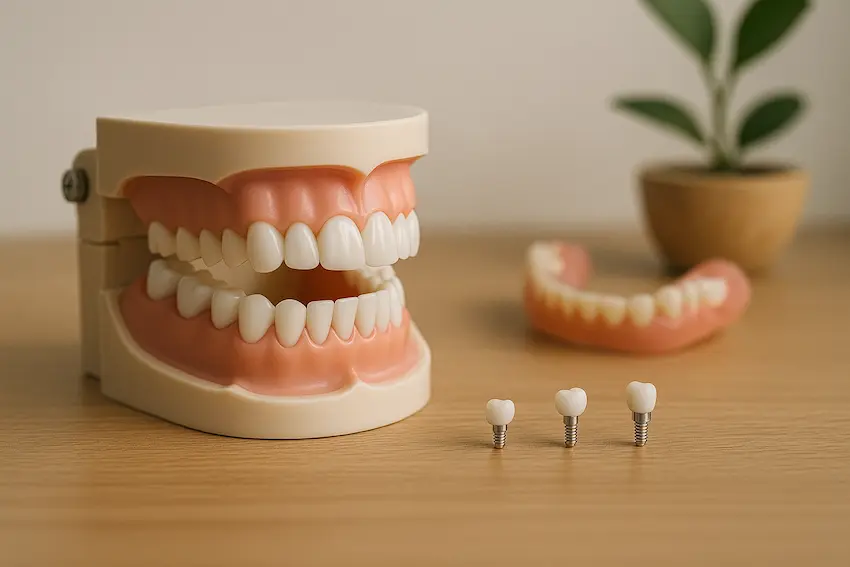
We can examine the engineering more thoroughly if we wish. A traditional dental implant generally consists of two or three parts: the implant screw (root of a tooth resembling), an abutment (connector), and a crown (visible tooth). Usually, they are between 3.0 and 6.0mm in diameter.
Mini dental implants (MDIs) are nearly always a one-piece solid unit. The screw and the connector are integrated. They are much thinner, typically less than 3.0mm in diameter, which is almost the size of a toothpick.
Professor Doctor Coşkun Yıldız very frequently points out to the patients that the difference in diameter technically is minimal, but practically, the mouth is such that each millimeter limits how much the bone has to be in order to support the load.
The “Home” Analogy
Consider that your jawbone is a piece of land on which you want to build a house.
Traditional Implants are the equivalent of a huge concrete slab foundation. They need wide, deep “soil” (bone) for stability. If the land has erosion problems (bone loss), we may have to do the restoration first.
Mini Implants resemble tent stakes that are very thin. In fact, they are similar to a nail that can only hold light weights and are only used at sites that are too small for a full slab foundation.
The Surgical Reality: Invasive vs. Minimally Invasive
We observed in practice that the majority of patients become afraid just by hearing the word “surgery.” The attraction of mini implants more often originates here.
Traditional implants are much wider compared to mini ones thus placing them probably involves making a gum incision, drilling the bone to prepare a socket, etc. If the bone is too thin, Dentist Polen Akkılıç and her team may also perform some auxiliary procedures, such as a graft or sinus lift. All these methods ensure that an adequate volume of bone is present. While this is a very solid, long-lasting solution that can function for years to come, one has to first endure the waiting period for osseointegration (healing of the bone) before a permanent tooth settlement.
Mini implants differ from this. Since they are very slim, they can be inserted using a “flapless” technique. Quite frequently, we can even simply push the implants directly through the gum without making an incision. It’s a much less major operation and therefore the patient experiences less post-operative pain, less swelling, and a quicker recovery.
When Do We Use Which?
The thing is, if it was so simple to work with mini implants, why can’t we do it with everyone then?
Simply, the mini implants don’t have the strength required for every single task. Conventional implants perform the function of heavy lifters. In fact, they are not only able to meet the strong chewing demands of molars but also support individual crowns and large bridges.
However, there are occasions when mini implants are more appropriate such as:
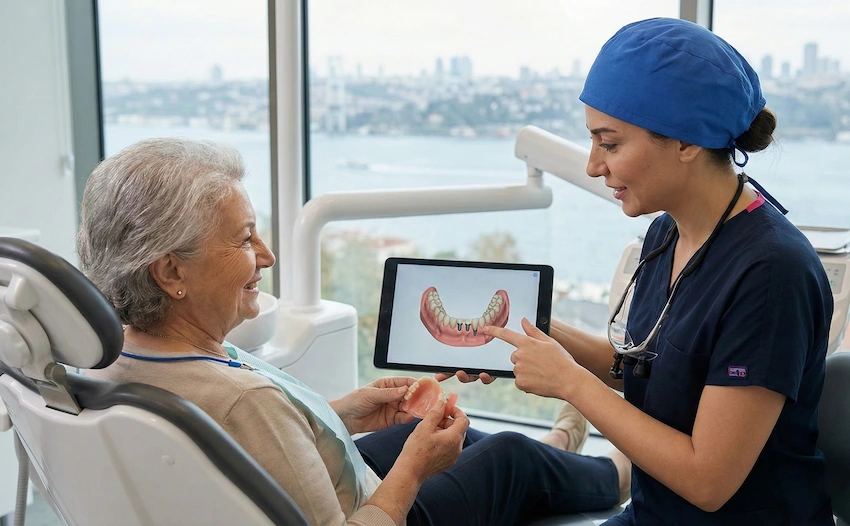
- Denture Stabilization: This is basically the primary use of these implants. In case you have a loose lower denture that moves around while talking, four mini implants will button it to your gums as if it was a jacket.
- Narrow Spaces: It happens that the only spot where a tooth can be put is too narrow to accommodate an implant (like lower incisors). Hence, a traditional implant is not feasible.
- Bone Atrophy: People who have undergone severe bone loss and are either unable or unwilling to have bone grafting done can still get an alternative solution through mini implants.
Comparing the Options
Look at this table to see the great differences between these alternative treatments:
| Feature | Traditional Dental Implants | Mini Dental Implants (MDIs) |
| Diameter | Standard (3.0 mm – 6.0 mm+) | Slim (< 3.0 mm) |
| Structure | Multi-piece (Implant + Abutment) | One-piece (Solid body) |
| Primary Use | Single crowns, bridges, All-on-4, full arches | Denture stabilization, narrow gaps, temporary anchorage |
| Bone Requirement | High bone volume required (grafting often needed) | Minimal bone volume required (grafting rarely needed) |
| Surgery Type | Standard surgical protocol (incisions and sutures) | Minimally invasive (often flapless) |
| Cost | Higher (due to complexity and materials) | Generally lower (simpler procedure) |
| Longevity | Permanent (25+ years with proper care) | Long-term, but historically considered less durable than traditional implants |
The Turkey Advantage
A choice between the options like that is not made by one person only. It depends on the 3D CBCT scan and clinical assessment as well. When it comes to Lema Dental Clinic, Turkey, we are aware that hundreds of international patients are keen to come to Turkey and they usually misdiagnose themselves as needing one option when, in fact, another one is biologically more suitable for them.
It does not matter whether it is a challenging surgical case where precision from Professor Doctor Coşkun Yıldız matters a lot or it is a case of major smile transformation that Dentist Polen Akkılıç handles. Our main purpose is never just to “fill the space.” It is to give back the possibility of function. We are not in the business of selling dental implants but in the business of engineering smiles.
Frequently Asked Questions
Rarely. Molars use the largest bite force. Therefore, mini implants will almost certainly not have enough surface area or volume to resist these forces without fracturing or becoming dislodged. As a rule of thumb, we advise traditional wide-platform implants for molars to ensure the longevity of the restoration.
The answer is yes, generally speaking. Since they are one-piece systems and the surgery is shorter and less complicated (more often than not, no bone graft needed), the overall implant mini price comes out less. However, one shouldn’t buy solely based on price but one should consider suitability as well. A cheap implant that fails because it was overloaded is not a bargain.
Whereas traditional implants are said to be lifelong, mini implants might be considered as something between temporary and long-term. However, if they are well-taken care of and placed properly, the patient might be enjoying their mini implants for many years. We have a few cases on record where mini implants have been stabilizing dentures well for over ten years.
Yes. Most patients respond to the “no stitches, no cuts” type of treatment by saying that they are back to normal within a couple of days. Traditional implants, on the other hand, are associated with three to six months of bone healing as well as a few days of tenderness.
Actually, this is mostly the type of patient for whom these are made. If you’ve been told that severe bone loss has rendered you unsuitable for conventional implants, mini implants might still be an option for you as they use less bone in terms of depth and width to secure themselves well.
- Javaid, M. A., & Khurshid, Z. (2021). Mini dental implants: A review of current clinical applications and outcomes. Journal of Oral Rehabilitation, 48(5), 623-632.
- Shatkin, T. E., & Petrotto, C. A. (2012). Mini dental implants: a retrospective analysis of 5640 implants placed over12 yearsd. Compendium of Continuing Education in Dentistry, 33(3), 2-9.
- Misch, C. E. (2008). Contemporary Implant Dentistry. Mosby Elsevier.
- Flanagan, D. (2018). Mini dental implants: The basics for the general practitioner. Journal of Oral Implantology, 44(4), 303-310.
- Bidra, A. S., & Almas, K. (2013). Mini implants for definitive prosthodontic treatment: a systematic review. The Journal of Prosthetic Dentistry, 109(3), 156-164.

