


Watch for spots and sensitivity.
The biggest misconception in dentistry is that a healthy tooth is a silent one. Most people believe that if there is no throbbing pain, everything is fine beneath the surface. The reality is that by the time a cavity starts to hurt, the “silent intruder” has already broken through your primary defenses.
In our clinical experience at Lema Dental Clinic, we find that the most successful treatments—the ones that save the most natural tooth structure—happen in the stages before a patient ever reaches for a painkiller. Waiting for pain is like waiting for the roof to collapse before checking for a leak.
The Enamel: Your Castle Wall
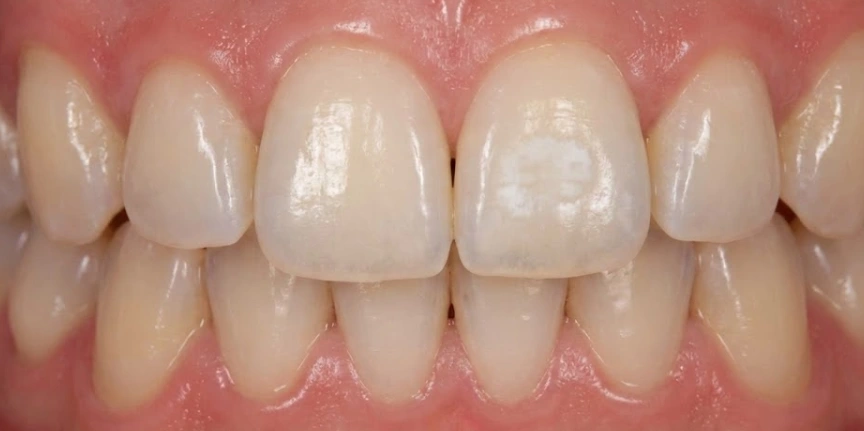
If you imagine it, the enamel of your teeth is like the protective walls of a castle. It is the hardest material in the human body and can be subjected to a great degree of force. Under that wall is the dentin, which is much less hard, almost like wood as compared to the stone enamel.
Prof. Dr. Coşkun Yıldız often points out that after a cavity breaks the enamel layer, it will easily spread through the dentin like a fire. Early diagnosis is to detect the enemy while it is still a “small hole in the shield.”
Subtle Visual Cues: What to Look For
But if we examine your reflection more closely, it is not necessary to have a dental degree to spot some of the early warning signs.
- Dry White Chalky Spot: The process of a tooth losing its minerals usually reveals itself before a hole appears. Most of the time, the spot looks like a very bright, white matte area that is dissimilar to the rest of the tooth which naturally has a translucency.
- Shadows Beneath the Surface: Once in a while, it is almost like the outer layer is fine, and a dark or greyish shadow under the enamel is what can be seen. Thus, the decay process, in essence is the tooth being “hollowed out” from the inside.”
- The Trouble Food Trap: Is there a particular place where you always seem to get a piece of meat or stringy vegetable stuck? So, when your dental floss suddenly keeps tearing in a certain spot, it means that a rough edge is most probably being formed by a cavity.
Early vs. Late Detection: What’s at Stake?
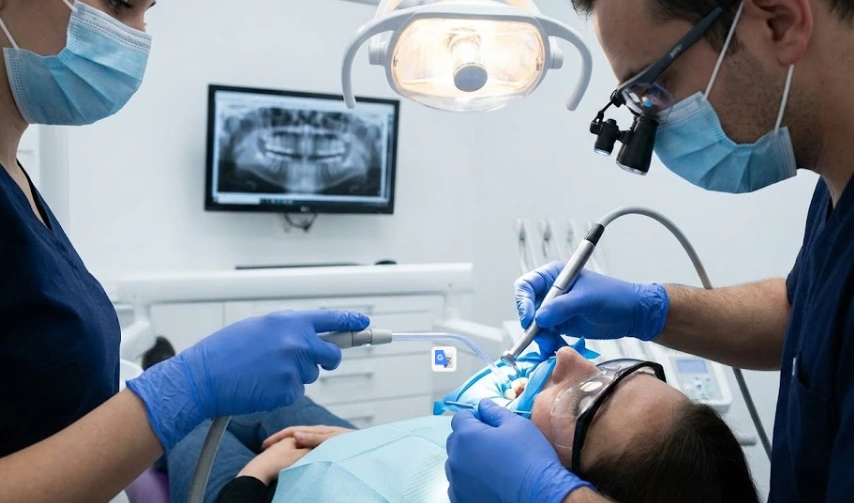
Visiting us in Turkey, Dentist Polen Akkılıç and her team employ high-definition intraoral cameras to demonstrate these phases to you live. This is how the timeline generally appears:
| Stage of Decay | Symptoms | Typical Treatment | Timeline at Lema |
| Incipient (White Spot) | None/Minor sensitivity to sweets. | Fluoride Therapy / Sealants | 30 Minutes |
| Enamel Breach | Roughness felt by the tongue. | Simple Composite Filling | 1 Visit |
| Dentin Invasion | Sharp pain with cold or heat. | Deep Filling or Inlay/Onlay | 1 – 2 Days |
| Pulpal Infection | Spontaneous, throbbing pain. | Root Canal Treatment | 1 – 3 Days |
Sensory Red Flags: Beyond the Ache
The question remains: if it doesn’t “hurt,” what does it feel like? Here is what we see in the clinic when patients describe the “pre-pain” stage:
- The “Sugar Sting”: A sudden, sharp tingle when eating something very sweet, like chocolate or honey, that disappears almost instantly.
- Rough Texture: Your tongue is an incredibly sensitive tool. If a tooth surface that used to feel like polished glass suddenly feels like a brick, the enamel is likely demineralizing.
- A “Ghost” Taste: Sometimes, bacteria trapped in an early cavity produce a faint, unpleasant taste or odor that persists even after brushing.
Why Expert Screening in Turkey Makes a Difference
At Lema Dental Clinic, we believe in “Minimum Intervention, Maximum Preservation.” Dentist Polen Akkılıç and her team utilize digital radiography and laser fluorescence to find cavities that are literally invisible to the naked eye.
The reality is that a tiny filling performed today prevents a crown or an implant five years from now. By traveling to Turkey for your regular check-ups or smile makeovers, you aren’t just getting a cosmetic upgrade; you are benefiting from a clinical philosophy that prioritizes the biological “wealth” of your natural teeth.
FAQ: Understanding Early Decay with Lema Clinic
If the cavity is in the ‘white spot’ stage—meaning the enamel is just weak but hasn’t broken yet—yes, we can often ‘remineralize’ it with professional-grade fluoride and improved hygiene. But once there is a physical hole, no amount of brushing will fix it.
Sugar is osmotic; it pulls fluid through the microscopic pores of your tooth. If you have an early cavity, that fluid movement irritates the nerve. It is often the very first warning sign your body gives you.
Absolutely. In fact, that is the best-case scenario. It means we caught them while they are small and easy to fix. If you wait until they hurt, the treatment becomes much more complex.
Yes. Factors like the depth of the grooves in your teeth (fissures) and the mineral content of your saliva play a huge role. This is why some people can eat sugar and stay cavity-free, while others struggle despite great hygiene.
We generally recommend a professional screening every six months. For our international patients visiting Turkey, we can perform a comprehensive ‘Dental Audit’ using our advanced 3D scanning technology to ensure no silent issues are developing.
- Featherstone, J. D. (2008). Dental caries: a dynamic disease process. Australian Dental Journal.
- Lussi, A. (2006). Dental Erosion: From Diagnosis to Therapy. Karger Medical and Scientific Publishers.
- Pitts, N. B. (2004). Modern concepts of caries measurement and epidemiology. Community Dentistry and Oral Epidemiology.
- Selwitz, R. H., et al. (2007). Dental caries. The Lancet.
- Yıldız, C. (2025). Diagnostic Innovations in Non-Invasive Operative Dentistry. Istanbul University Press.

