


By professional polishing or replacement if needed.
Gold has been the “gold standard” material for restorative dentistry for a lot of years. It is biocompatible, extremely durable, and its wear pattern mimics that of natural tooth enamel perfectly. However, it is quite common for patients to come to Lema Dental Clinic almost every day asking a question that puzzles us a bit: their beautiful, bright gold crowns have become dull, tarnished, or even worn down revealing a silvery metal underneath.
If you are seeing changes in your smile, you are definitely not alone. The truth is that even the best dental gold is subject to the aggressive environment of the mouth.
Why Do Gold Overlay or Gold Alloy Get Worn Out?
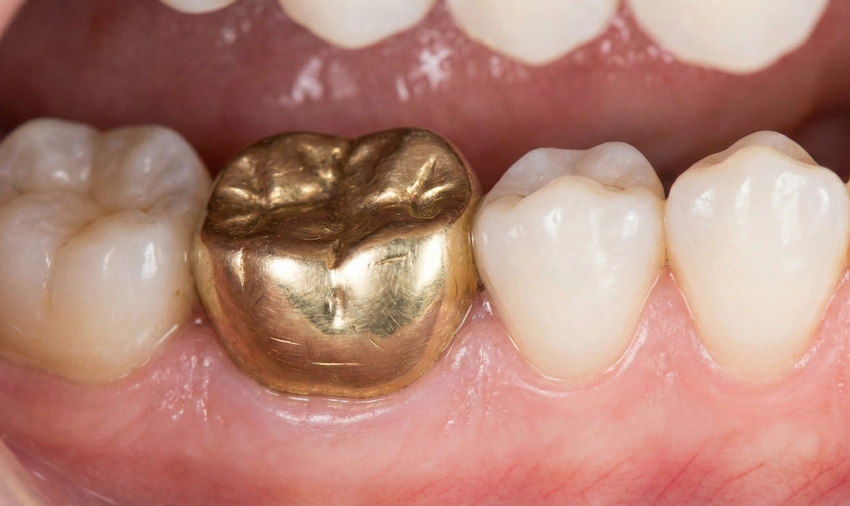
A gold dental crown can be well compared to a luxury watch. Although the material is durable, continuous friction and chemical exposure will gradually deteriorate it. Generally, “gold” dental work is either a high-noble alloy (solid gold mixed with metals like platinum or palladium) or gold-plated porcelain.
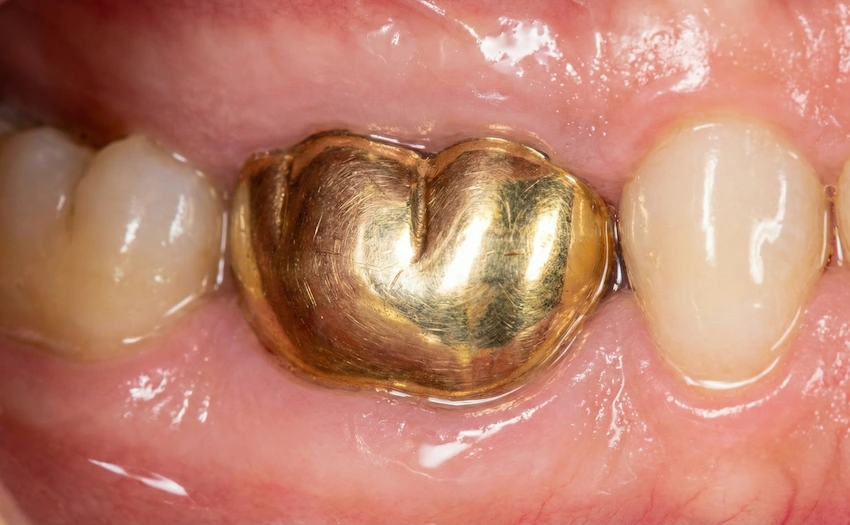
Professor Doctor Coşkun Yıldız mainly explains that the “discoloration” the patients are referring to is probably not the gold itself rusting. Gold doesn’t rust. Most times, it is a biofilm build-up, or in the case of plated crowns, the gold fine layer is being literally brushed away by years of brushing and chewing.
These are the reasons we encounter at our clinic the most:
- Abrasive Toothpastes: Whitening pastes on gold are a bit like sandpaper on a silk dress. It gently removes the surface.
- Galvanic Shock: A gold crown sometimes reacting with a silver amalgam filling in the neighborhood can lead to an electric current at a microscopic level, causing surface tarnish.
- Attrition: If you grind your teeth, it’s practically that you are “milling” the gold every night.
Can Worn Gold Be Restored Without Replacing the Crown?
We are left with this question: can we just “re-plate” a crown inside your mouth? Being fully aware, it is mostly a no. Professional gold plating requires a special electrolytic process that cannot be safely done intraorally.
Nevertheless, Dentist Polen Akkılıç and her team have put together a special strategy for patients who come to Turkey strictly for aesthetic and restorative procedures. If the wear is just on the surface, a professional polishing at our clinic can usually get rid of the surface oxidation and bring back that deep, buttery glow. But when there is no gold layer left, our eyes are set on a permanent solution.
Comparing Your Restoration Options
| Option | Restoration Method | Durability | Aesthetic Result |
| Professional Polishing | Clinical buffing and cleaning | Short-term | Restores shine, doesn’t fix “worn through” spots |
| Full Gold Replacement | New High-Noble 18k or 22k Alloy | 20+ Years | Classic, rich gold appearance |
| Zirconia with Gold Hue | Modern ceramic with internal tinting | 15+ Years | Matches the look without the wear issues |
| Porcelain Fused to Gold | Gold base with ceramic “window.” | 10-15 Years | Blends gold strength with tooth-colored beauty |
The Lema Method: Smile Makeover in Istanbul
Visiting us in Turkey means we don’t just examine the tooth alone; we analyze the chemistry of the entire mouth. If your gold is getting discoloured, we measure your saliva pH and also check your bite alignment.
It is a simple but thorough procedure. We are quite sure that replacing the old, worn-out plated crowns with full-contour gold alloys or maybe high-translucency Zirconia, if you like a natural look is what you will be delighted with. As we have our own state-of-the-art laboratory at Lema Dental Clinic, we can guarantee that the metal purity is exactly as instructed—something that is very important for avoiding discoloration in the future.
Five Common Questions About Gold Dental Wear
Well, not really. Mostly, it isn’t the gold that turns black but instead the metal base of the crown (which is usually made of a non-precious metal) gets exposed when the gums recede or when the gold layer gets chipped. So you get a “grey shadow” effect. At Lema, we change these to biocompatible noble metals so that the dark line problem becomes history.
Please don’t do that. Jewelry cleaners have toxic chemicals that are not safe for swallowing. If the crown looks a bit dull, just use a soft toothbrush and a non-abrasive gel. Let us do the deep polishing during your visit to Istanbul.
Gold is a less hard metal than porcelain. Use the example of an old leather shoe—it molds to your foot over time. If a gold crown is worn to a great extent, then it may cause jaw misalignment. In such cases, Prof. Dr. Coşkun Yıldız decides whether a harder alloy is required.
Quite a few of our customers link their restorations with holidays. Since the price of high-noble gold in Turkey is much lower thanks to our clinical efficiencies, a patient normally is given the higher quality of metal (the metal contains more actual gold) at a small fraction of the costs of the UK or the US.
We use a variety of gold shades. Some patients prefer the “rich” yellow of 22k gold, while others prefer a paler, more subtle 14k or 18k alloy. Dentist Polen Akkılıç will hold shade guides against your existing teeth to ensure the “new” gold doesn’t look out of place.
- Anusavice, K. J., Shen, C., & Rawls, R. R. (2012). Phillips’ Science of Dental Materials. Elsevier Health Sciences.
- Donovan, T. E., & Cho, G. C. (2004). Predictable aesthetics with metal-ceramic and all-ceramic crowns: The state of the art. Journal of the California Dental Association.
- Givan, D. A. (2002). Precious metals in dentistry. Dental Clinics of North America, 46(4), 659-674.
- Wataha, J. C. (2002). Alloys for prosthodontics. The Journal of Prosthetic Dentistry, 87(4), 351-363.
- Roberts, H. W., Berzins, D. W., Moore, B. K., & Charlton, D. G. (2009). Metal-ceramic alloys in dentistry: A review. Journal of Prosthodontics, 18(2), 188-194.

