


Brush gently with non-abrasive toothpaste, floss daily, and get regular professional cleanings.
A Real-World Guide to Caring for Your Gold Teeth
We understand your point—you’ve put your money into a gold restoration, and naturally, that brings you a little bit of pride. It doesn’t really matter if it’s a complete crown or a slight inlay, gold has a feeling that porcelain just can’t imitate. However, one of the common mistakes that we notice here at Lema Dental Clinic in Turkey is the “invincibility myth.” Patients generally assume that since gold doesn’t get corroded or decayed like a natural tooth, a restoration is completed when the cement sets.
In fact, your gold restoration can support you only if the living tissue surrounding it is healthy. If you compare a gold crown to a tailor-made, silk suit; it’s extremely tough and classy in appearance, but on the contrary, if you treat it with harsh chemicals and don’t take care of the seams, it won’t last.
The Foundation Matters Most

During our work at Lema Dental Clinic, Professor Doctor Coşkun Yıldız frequently tells patients that they shouldn’t think in terms of only one metal; it is a biological interface that we are dealing with. The place where gold and your gum line touch, i.e., the margin, is the “most human” aspect of the restoration. That is where bacteria try to colonize.
Once you let plaque settle at that margin, gold won’t be affected, but the tooth underneath it will get a cavity. After that, the foundation disintegrates, and even the most decorated gold work turns into a risk.
Tools of the Trade: Less is More
Meanwhile, let’s examine your actual brushing technique. You may think that to keep the metal shiny you have to “scrub”.
- The Brush: Choose the one with the softest bristles. Dentist Polen Akkılıç and her staff always advocate that “gentle persistence” will win over “aggressive scrubbing” every time.
- The Paste: Don’t use abrasive “whitening” pastes. Typically, they contain silica or calcium carbonate, which can cause micro-scratches on gold that eventually get dulled in this way. A simple, high-fluoride gel is just right.
Gold vs. The Rest: A Clinical Comparison
The question remains: why choose gold if it requires this level of specific care? It comes down to how it behaves under pressure. Here is how we break it down for our patients in Istanbul:
| Feature | Cast Gold Alloys | Zirconia / Ceramic |
| Wear on Neighbors | Mimics natural enamel; very kind. | It can be “sandpaper” to opposing teeth. |
| Edge Integrity | It can be burnished for a perfect seal. | Rigid; can have microscopic gaps. |
| Fracture Risk | Basically zero. | Low, but possible under high stress. |
| Clinical Longevity | 20 to 40 years (with care). | 10 to 15 years on average. |
| Gum Response | Highly biocompatible. | Good, but gold is often superior. |
The “Hidden” Cleaning Steps
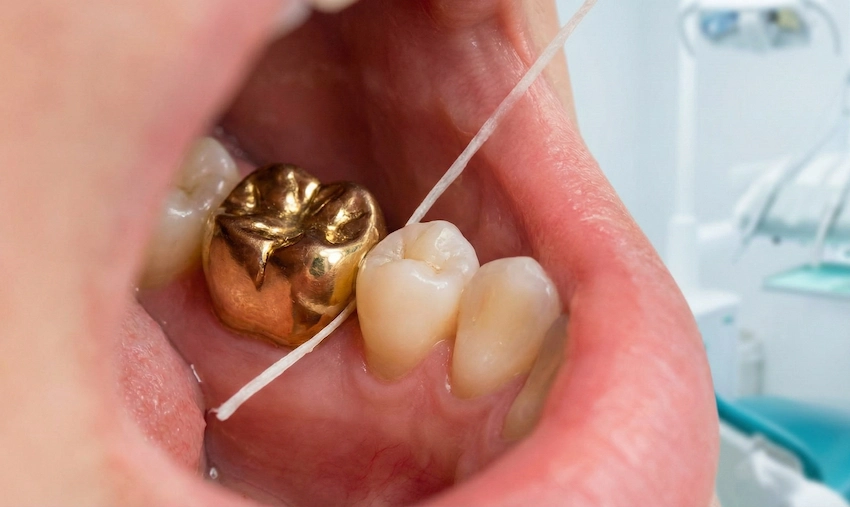
The truth is, your toothbrush is only half the story. If you have a gold bridge, you have a “nook and cranny” problem. Food debris loves to hide under the pontic (the fake tooth).
We often tell our patients: “If you wouldn’t leave a piece of food under your sofa for a week, don’t leave it under your bridge.” Using a water flosser or a dedicated bridge threader isn’t just a suggestion; it’s the insurance policy for your dental investment.
A Quick Chat with the Doctor: Gold Care FAQs
In the first few weeks, yes. Gold conducts temperature faster than natural tooth structure. However, if it’s a sharp pain that lingers, come see us. It might mean the seal needs a quick look.
This is one of the questions I hear quite often. Please, refrain from using “jewelry” polishes for this. They are poisonous if swallowed. Your gold will remain naturally radiant if you just keep it clean from biofilm. If it appears dull, it is most likely just a film of plaque that we can get rid of by polishing professionally within two minutes.
This is where gold shines—literally. Instead of cracking like porcelain, gold will slightly “deform” or wear down over decades, protecting your jaw joint. But, we’d still recommend a night guard to keep everything in place.
We love seeing our international patients once a year. It’s not just about the gold; it’s about ensuring Dentist Polen Akkılıç can check the health of the bone and gums supporting your smile.
In my professional opinion? Yes. For molars where the chewing forces are highest, nothing beats the longevity and “friendliness” of gold.
- Anusavice, K. J., Shen, C., & Rawls, H. R. (2012). Phillips’ Science of Dental Materials. Elsevier Health Sciences.
- Christensen, G. J. (2002). The rise and fall of gold restorations. The Journal of the American Dental Association, 133(8), 1131-1133.
- Donovan, T. E., & Tucker, R. V. (2001). The cast gold restoration. Journal of Esthetic and Restorative Dentistry, 13(3), 152-162.
- Pjetursson, B. E., et al. (2007). A systematic review of the survival and complication rates of fixed partial dentures (FPDs). Clinical Oral Implants Research.
- Schwartz, R. S., et al. (1996). Fundamentals of Operative Dentistry: A Contemporary Approach. Quintessence Publishing Company.

