


Gold offers unmatched strength, while porcelain provides natural beauty.
This is something we witness in the clinic almost daily. A patient takes a seat in the dental chair. They have either a fractured or weakened tooth. The person gets a little nervous and states a very simple query: Essentially, which crown material is actually good?
Saving a tooth does provide lots of options, and sometimes getting overwhelmed is easy. The two most popular alternatives in the world of dental restorations are gold alloy, a classic one, and porcelain crown, a modern one. Each one is a wonderful feat of medical science. Both have been instrumental in restoring millions of smiles.
From our perspective at Lema Dental Clinic in Turkey, a crown is not just decided by its price. Besides price, it depends on how your jaws move, how hard you bite, and how you want your teeth to look. So, let us see what the main differences are between these two materials.
Gold – Strength That Never Breaks
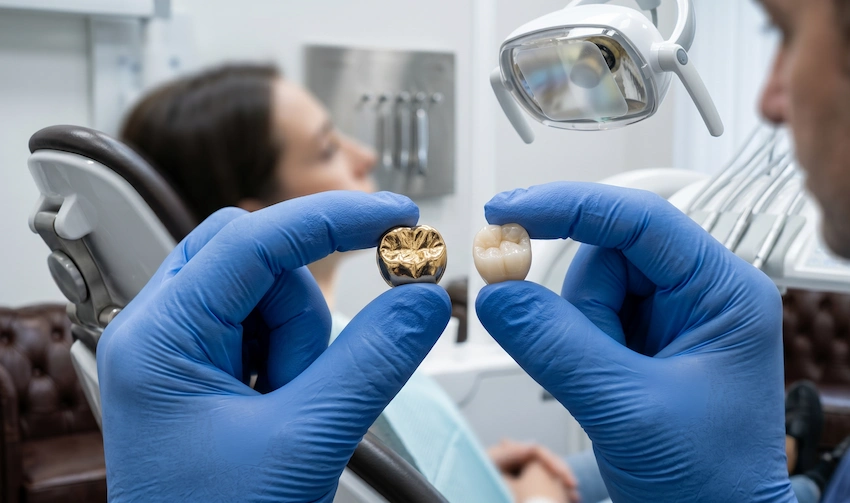
Gold is a protagonist in the field of dentistry since its inception till these days. The question is, why continue using it? Simply because it is the most compatible with the human body. Gold is strong, harmless, and durable.
You may compare a gold crown with the heavy steel frame of a skyscraper. This one bends only a little when the pressure is applied. Gold, being a little bit soft, is able to act as a very fine level of shock absorber. On chewing hard stuff, gold handles the force. This is what keeps the sensitive root from damage.
Professor Doctor Coşkun Yıldız argues that gold is perfection for tooth-grinders. According to him, gold has these amazing features:
- It can’t be broken. It retains its shape even when a heavy biting force is applied.
- It helps other teeth. Gold diminishes at the same rate as the natural enamel.
- It guards your tooth. We only need to remove the tiniest piece of your natural tooth to make room for a gold crown.
Porcelain – The Natural Charm
However, let us think about your teeth; gold is incredibly strong, but it also looks quite like metal. In case you require dental work at the front, it is better if the crown is absolutely invisible.
Porcelain is a perfect match for this.
Teeth are not white flats only. They are not opaque. Due to their outer layer, light goes through your teeth like a glass window and bounces around. A good porcelain can be a perfect imitation of light. Under the skillful hands of Dentist Polen Akkılıç and her team, porcelain dental crowns are done with the technique of hand-painting and layering. They mix with the teeth so well that no one can detect that it is a dental crown.
Actually, dental technology has evolved. There is no need to choose between a strong and a beautiful tooth. Modern ceramic crowns with a zirconia core are durable enough for chewing, and at the same time, they provide a perfect natural look.
Who Wins – You Decide
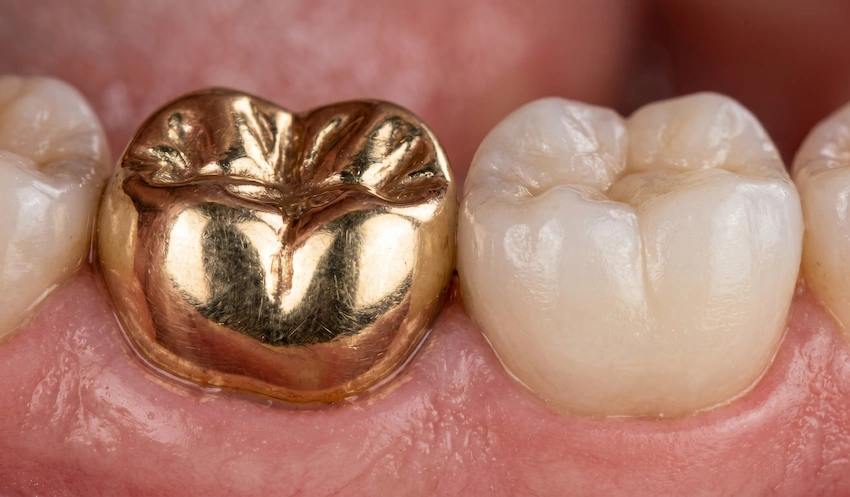
Every time you come to Turkey for a dental procedure, our team inspects your mouth thoroughly. Here is a gist of how these materials compete:
| Aspect | High-Noble Gold | All-Porcelain / Ceramic |
| Appearance and Touch | Metallic and lustrous | Resembles a natural tooth exactly |
| Durability | Deforms but does not break | Quite durable but susceptible to chipping if hit very sharply |
| Dental Health | Conserves most of the original tooth | Significantly more tooth removal is necessary |
| Preferred Position | Molars out of sight | Visible teeth, front and smile zones |
| Effect on Jaw | Kind to teeth on the opposite jaw | Reliable, but smooth surfaces need to be maintained |
Doctor Answers Patients’ Questions Sometimes Surprisingly
Absolutely not. We work with high-noble gold. This implies gold is mixed with other pure metals like platinum. It is completely resistant to rust and discoloration and won’t give you a metallic taste. Its surface stays entirely polished.
Certainly. Gold is technically the strongest, but zirconia bonded with porcelain, thus far, is the most enduring combination. Those who want a natural white tooth in the back can select the crown that is capable of withstanding the results of chewing hard foods, such as meat.
The question stands as a matter of combining outstanding quality and dedication. We use only the best quality materials worldwide, and your crowns are manufactured in state-of-the-art digital laboratories. You are also getting world-class experts who are devoted to these procedures every day and only these treatments.
A properly constructed gold crown might serve for 20 to 40 years. Even a lifetime, in some cases! Meanwhile, a very nice and fresh porcelain crown might remain in good condition for around 10 to 15 years before it will have to be re-polished or re-bonded. Nevertheless, it is important to note that the crown’s durability depends only on how well you care for it — rest assured, daily brushing and flossing around the crown are a must.
It’s very typical to experience a little sensitivity to cold or hot beverages for a few days, as the nerve inside your tooth is just waking up after the procedure. However, this discomfort is transient, and soon you’ll be enjoying a strong, pain-free bite.
- Donovan, T. E. (2004). Longevity of clinical success of dental restorations. American Journal of Dentistry, 17(3), 167-173.
- Goodacre, C. J., Bernal, G., Rungcharassaeng, K., & Kan, J. Y. (2003). Clinical complications in fixed prosthodontics. The Journal of Prosthetic Dentistry, 90(1), 31-41.
- Kelly, J. R., & Benetti, P. (2011). Ceramic materials in dentistry: historical evolution and current practice. Australian Dental Journal, 56(1), 84-96.
- Rekow, E. D., Silva, N. R., Coelho, P. G., Zhang, Y., Guess, P., & Thompson, V. P. (2011). Performance of dental ceramics: challenges for improvements. Journal of Dental Research, 90(8), 937-952.
- Rosenstiel, S. F., Land, M. F., & Fujimoto, J. (2015). Contemporary Fixed Prosthodontics (5th ed.). Mosby.

