


Natural perfection via custom design
Almost daily, we get the same doubts coming from patients. They come to us for a consultation in Istanbul, scroll through Instagram, and say to us: “I want a brighter smile, but I don’t want people to think I just banged my teeth on a keyboard.”
It’s a reasonable concern. We’ve all noticed those teeth that appear featureless, dull, and so brightly lit that the eyes don’t know where to focus. Those teeth literally look like the ones you’d stick on your fridge. First, a Hollywood Smile can indeed be just as fake-looking. However, this is only when a cosmetic dental procedure totally disregards facial biology.
At Lema Dental Clinic, we think that it shouldn’t be evident that a set of teeth is a Hollywood Smile. A great Hollywood Smile should simply be “born lucky,” which means it should be fabulous but natural.
The “Uncanny Valley” of Teeth
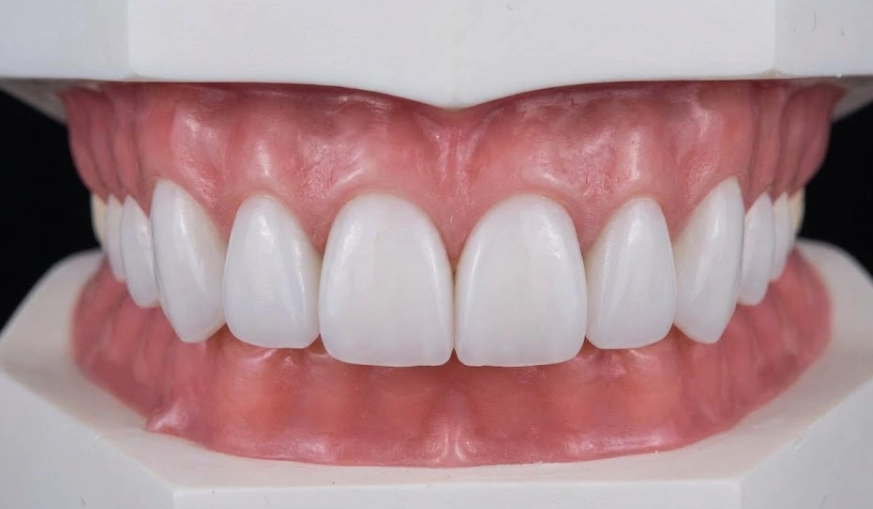
Veneers that are fake-like usually come down to, in the end, one thing: the light. Tooth enamel in a natural tooth is, more or less, a panel of color, not at all a solid color. It is a pearl-like or frosted-glass window. It has layers. The translucent part of your tooth lets in the light (translucency), and the light then comes out from the inner dentin. When the light is completely blocked using a thick and opaque porcelain layer, the tooth will look flat or “dead”.
Professor Doctor Coşkun Yıldız often tells the team by way of this metaphor: Consider your smile to be an expensive well-cut suit. If you go for an off-the-rack suit it can be technically quite “perfect“—neat, new, no rips. But if the shoulders are too wide and the sleeves are too long, the outfit will look ridiculous. Only when the suit is tailor-made will it look as if it belongs to you.
That is exactly what veneers are. When the addition of “fake” to the smile occurs, it is because the teeth are too big, too square, or too monochromatic for the patient’s face shape.
The Lema Approach: Designing “Imperfect” Perfection
We do not just press a pair of the same teeth into different mouths in our Turkey clinic. Dentist Polen Akkılıç with her team employ the technology of Digital Smile Design (DSD) to make sure they recreate the characteristics of a natural smile.
These are the three most important aspects we work on to achieve a natural finish:
- Surface texture: Teeth are never simply smooth; they have numerous ridges and tiny grooves. When viewed from a distance, a completely smooth veneer looks like a shiny surface of a tile in the bathroom, we achieve this natural optics by giving the surface textures, thus, the light will scatter.
- Translucency: At the biting edges of the veneers, there is a slightly sheer layer which is, of course, a part of natural enamel.
- Color Gradients: There is a difference in color in a natural tooth between the area closest to the gum and the outermost edge. The porcelain is made in layers so that it looks like it has a color gradient to it even at the whitest shade (e.g., BL1 or BL2).
Color Selection: Choosing Your Shade
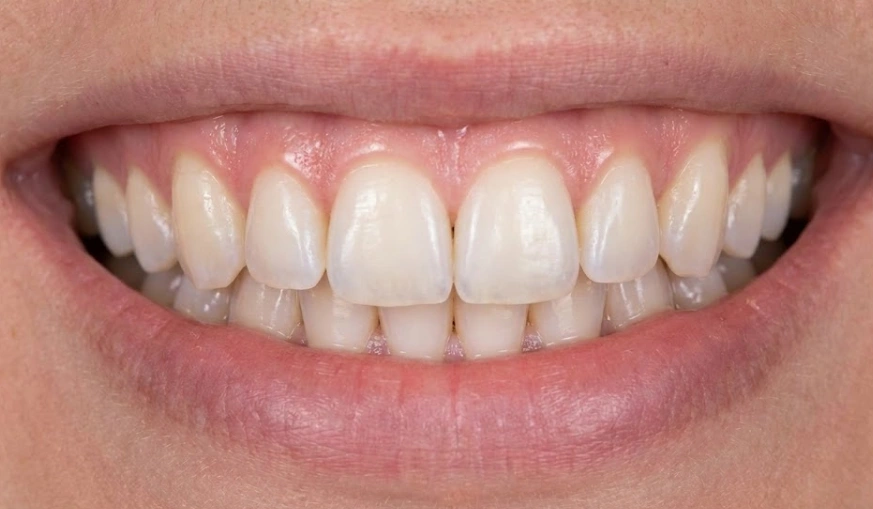
The biggest myth is that “white equals fake.” You can have a blindingly white smile that still looks natural if the shape and texture are correct. However, matching the shade to the whites of your eyes (the sclera) is a classic rule of thumb we often use to keep things grounded.
Here is a breakdown of how different factors influence the “naturalness” of the final result:
| Factor | The “Fake” Look | The “Natural” Hollywood Look |
| Opalescence | Solid, flat color (Monochromatic) | Light passes through edges (Polychromatic) |
| Shape | Bulky pushes the lips out | Rounded edges, varying lengths, masculine/feminine cues |
| Gum Line | Inflamed, red, or bulky margins | Pink, healthy, flush with the veneer |
| Thickness | Bulky, pushes the lips out | Ultra-thin (0.3mm – 0.5mm), flush with face |
| Symmetry | Perfectly symmetrical (Unnatural) | “Dynamic Symmetry” (Balanced but organic) |
The Material Matters
Porcelain products differ significantly in terms of quality. Historically, dentists used feldspathic porcelain that was aesthetically pleasing but fragile, or metal-fused crowns that were visually dull.
Nowadays, the main materials we use are E-max (Lithium Disilicate) or Zirconia. E-max is considered the best for achieving a “natural” appearance because it has the same light-reflecting features as enamel to an incredible degree. This means that we can produce that translucent beauty that makes a smile look vibrant.
FAQ: Straight Talk from the Clinic
Absolutely. There is a whole spectrum of white. We have “natural white” shades (like B1) and “bleach shades” (like BL1, BL2, BL3). During your consultation in Turkey, we hold these shade tabs up to your face so you can see exactly how they contrast with your skin tone.
This is a common fear caused by poor dentistry. “Horse teeth” happen when the veneers are too thick or too long for the patient’s lip line. We measure your bite and smile dynamics carefully. We aim for the “Golden Ratio” where the width and length of the teeth are in perfect harmony with your face.
Modern veneers are minimally invasive. We are not grinding your teeth down to tiny spikes (that is for crowns, not veneers). We often remove only a fraction of a millimeter of enamel—roughly the thickness of a contact lens—just to ensure the veneer sits flush and doesn’t look bulky.
We value your time. Typically, the entire transformation takes about 5 to 7 days. This includes the preparation, the digital design, the crafting of the porcelain in our lab, and the final bonding.
If we do our job right, they won’t say “Nice veneers.” They will say, “You look great, have you lost weight?” or “Your smile is amazing.” The goal is for the enhancement to blend so well that it improves your overall facial aesthetic, not just your mouth.
- Magne, P., & Belser, U. (2002). Bonded Porcelain Restorations in the Anterior Dentition: A Biomimetic Approach. Quintessence Publishing.
- Coachman, C., & Calamita, M. (2012). Digital Smile Design: A Tool for Treatment Planning and Communication in Esthetic Dentistry. Quintessence of Dental Technology, 35, 103-111.
- Layton, D. M., & Walton, T. R. (2013). The up to 21-year clinical outcome and survival of feldspathic porcelain veneers: Is poor performance related to existing evidence? Journal of Dentistry, 41(12), 1167-1178.
- Gurel, G. (2003). The Science and Art of Porcelain Laminate Veneers. Quintessence Publishing.
- Joiner, A. (2004). Tooth colour: a review of the literature. Journal of Dentistry, 32, 3-12.

