


No, dental diamonds do not require drilling when bonded safely to the tooth surface.
The trend is indeed unstoppable. Seeing from a fashion runway of a top brand to the streets of Istanbul, a slight twinkle in a smile has become the new signature accessory. However, one question that patients most often hesitate to ask when they are with us at Lema Dental Clinic is, “Does it mean that you have to drill a hole in my tooth if I want to get this look?”
The short answer? Almost certainly not.
But let’s talk more about the details because the health of your enamel is something that you cannot compromise.
The “Sticker on Glass” Analogy
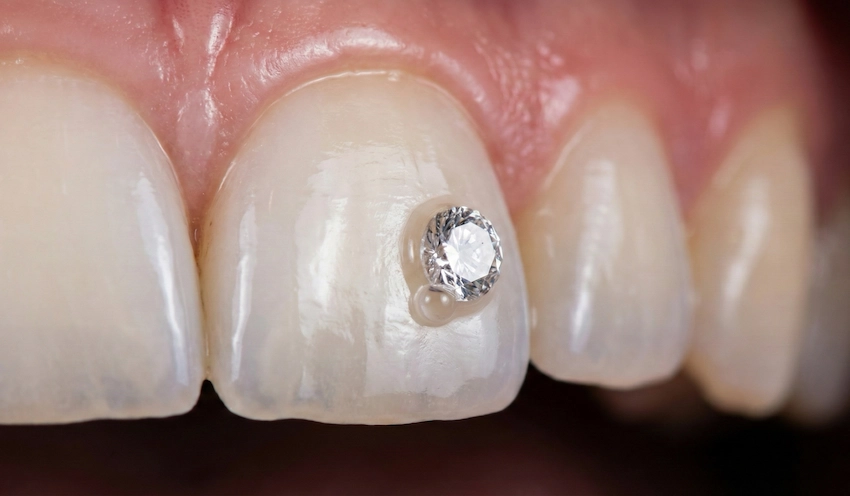
You can imagine tooth enamel as a clean and clear piece of glass. Dental jewels are mostly made of materials like Swarovski crystals or gold charms that cut no corners plastering the glass that is staple and tooth enamel. It is comparable to one dexterous up-to- a-sticker glued with cutting-edge strength vinaigrette.
When a dental practitioner drills a hole to “anchor” a crystal means that it is similar to smashing that window just to fit a sticker. Naturally, this will break the strong basement of the structure.
Our facility in Turkey, Dentist Polen Akkılıç and her team employ a bonding method just like the one used for braces. This being so, we do not disrupt the enamel but rather use a special glue that can hook up to the tiny pores of the enamel surface. Once you feel like removing the sparkle, all we have to do is take off the jewel and give the surface a little polishing. The glass remains intact.
The Exception: Diamonds
And this is where most of the time one stops stirring the pot. It is a matter of the gem’s winding structure, as opposed to a flat-backed crystal, a real diamond cut to a brilliant style.
- Flat-Backed Jewels (Crystal / Gold) are in direct contact with the tooth; hence, no drilling is required. Actually, this is 95% of the procedures we perform.
- Cone-Backed Stones (Real Diamonds): A genuine diamond is typically pointed at the bottom (the pavilion). To make it sit flat, technically a small circular space would have to be drilled in the tooth.
Nevertheless, Professor Doctor Coşkun Yıldız warns against drilling healthy enamel just for the purpose of having a fancy accessory. The risk of nnervesbeing irritated or bacteria getting trapped in the cavity is just extremely high.
At Lema Dental Clinic, if a patient demands a real stone, we may advise setting the diamond in a flat-backed gold casing (a bezel). By doing so, the pointed stone turns into a flat-surfaced gem, and hence, we can tightly bond it without any drilling.
The Bonding Process: A Clinical Perspective
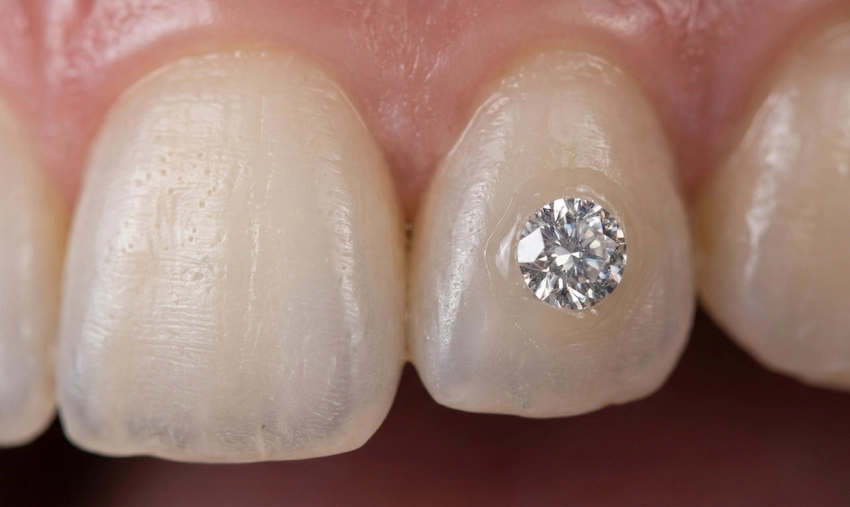
We don’t just “glue” it on. The entire bonding process is at least as much a medicine as it is a cosmetology.
- Etching: Etching is a process that includes applying a blue coloring gel to the tooth. It not only makes the surface clean but also creates a small-scale roughness for the adhesive to latch on nearly permanently.
- Bonding: A bonding agent (liquid resin) is applied.
- Placement: The jewel is positioned with precision.
- Curing: An intense UV light instantly hardens the glue.
Comparing the Techniques
To assist you in making a decision, here is our take on the two methods in Turkey.
| Feature | Surface Bonding (The Lema Standard) | Invasive Embedding (Drilling) |
| Drilling Required? | No. Completely non-invasive. | Yes. Enamel is removed. |
| Pain Level | None. No anesthesia needed. | Low to moderate. May require local anesthesia. |
| Reversibility | 100% reversible. | Permanent alteration of the tooth surface. |
| Risk of Decay | Low (with proper oral hygiene). | Higher (bacteria may accumulate in the drilled area). |
| Material | Flat-back crystals, gold, or bezel-set gems. | Pointed-back generic stones. |
Why “DIY” Kits Are a Danger
You may stumble upon kits on the net that promise you the same find at a fraction of the cost. But please, be safe. The glues in such kits might not only be poisonous but can also bind very tightly, something that can result in permanent damage to your teeth when you try to get rid of them.
There were instances when patients came to us with chemically injured gums because they had Super Glue (cyanoacrylate) at home. At Lema Dental Clinic, we use biocompatible flowable composites—materials designed to exist inside the human body.
FAQ: Your Questions Answered
Doing nothing with the tooth, there will be no pain and no needle. It just feels like teeth polishing when you go to a cleaning situation. So, all you have to do is relax, open your mouth, and it is done in no time.
Yes, you can, and you should because the jewel is actually creating a very small area where plaque can inhabit and we want you to be extra careful. You can also use an electric toothbrush but do not abrade the bristles unmercifully into the stone.
This is a widespread anxiety but it is rarely an incident. The crystals are very tiny and safe if ingested. It will simply be naturally eliminated through the digestive tract.
Do not do it with the help of a nail or a fork. Come back to see a local dentist. With a special polishing tool, we get rid of the adhesive by a slight vibration, and the teeth get smooth. It is a matter of seconds.
It depends on things like how you eat and your bite. Usually, it can last anywhere between 6 months and 2 years. You may lose it quickly if you happen to use that tooth for biting hard apples or crusty bread.
- Gordan, V. V., et al. (2018). Repair or replacement of restorations: A prospective cohort study by the National Dental PBRN. Journal of Dentistry, 74, 44-50.
- Van Meerbeek, B., et al. (2020). Adhesion to Enamel and Dentin: Current Status and Future Challenges. Operative Dentistry, 45(3), 237-260.
- Al-Diaj, I. S., & Al-Ahdal, K. (2022). Tooth Jewelry: A Simple Style or a Complex Concern? Open Access Macedonian Journal of Medical Sciences, 10(D), 112-116.
- Joiner, A., & Luo, W. (2017). Tooth Whitening: An Update. Springer International Publishing. (Context on enamel surface integrity).
- Schiopu, A. (2023). Cosmetic Dentistry and the Rise of Dental Jewelry: Clinical Protocols. International Journal of Esthetic Dentistry, 16(2), 198-205.

