


In short, dental treatment with dental prostheses in elderly patients should be adjusted to a detailed and thorough medical examination that is carried out while taking into account the functioning of the mouth, health condition, stability of tissues, and the patient’s adaptability. First of all, dentist Polen Akkılıç and her team check the anatomy of the residual ridge, mucosal resilience, salivary flow, and muscle coordination in every patient. All these factors determine denture retention and show whether patients will be more likely to obtain removable dentures or fixed prostheses, or implant–supported ones. Besides, the comprehensive examination includes the evaluation of the patient’s previous medical condition and the medication taken that affects bone metabolism, neuromuscular coordination, and oral moisture. All these factors facilitate the process of making safe decisions and thus help in ensuring that the prosthesis becomes the patient’s tool for chewing, speaking, and carrying out the daily routines comfortably and without being surprised.
Professor Doctor Coşkun Yıldız pinpoints that designing a prosthesis for an old person includes both functional and biological aspects. The changes like the muscles of the face, resorption of alveolar bone, and decrease in the elasticity of the soft tissues that come with age require prostheses that are able to spread the pressure equally and at the same time protect the delicate tissues. The clinicians follow the progress of the patient’s adaptation very closely since elderly patients’ oral anatomy may be changing gradually. They keep their patients comfortable by making necessary adjustments to the prosthesis and also by providing stable occlusion and effective mastication. The dental prostheses with proper planning and continuous check-ups become a source of lost qualities like self-confidence, good nutrition, and oral health in the lives of elderly people.
When Are Dentures Performed in the Elderly?
- Dentist Polen Akkılıç and her team make dentures as a way of restoring the function of the mouth when the elderly have lost multiple teeth and are unable to chew properly and stably.
- Periodontists decide on a denture when the periodontal disease has caused such a destruction of the supporting bone that the natural teeth cannot function anymore.
- Dentures are devices that replace teeth and become the only option when facial support is altered due to tooth loss and the vertical dimension is reduced.
- Chairman of the Department Professor Dr. Coşkun Yıldız determines the need for dentures if the elderly, due to missing teeth, have difficulty speaking.
- Dentures bring patients back to the normal oral structure when they have been suffering from malnutrition due to limited chewing ability.
- Periodontists fabricate dentures when the remaining teeth are not capable of providing safe support for fixed prosthetic treatments.
- Dentures allow the elderly to regain the pleasure of life when advanced decay or dental trauma has led to generalized tooth loss.
How Are Dentures Performed in the Elderly?
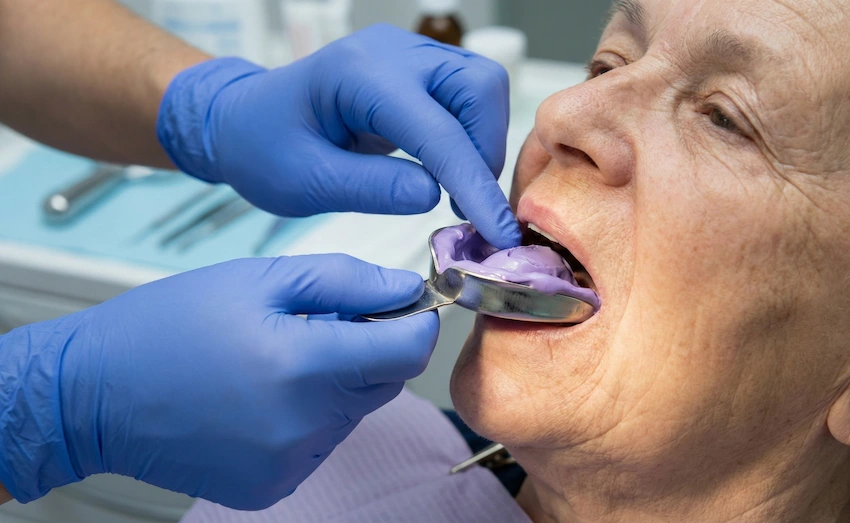
The denture experience commences with a comprehensive examination which checks oral tissues, residual ridge height, muscle tone, and prosthetic space. Dr. Polen Akkılıç and her team employ diagnostic impressions, occlusal measurements, and functional recordings in making dentures that are not only stable and comfortable but also help in the even distribution of pressure. They also evaluate the salivary flow because, if there is a lack of moisture, the denture adhesion will be greatly affected and, consequently, friction-caused soreness will be the result. The clinicians choose the most biocompatible materials that will both protect the mucosa and allow for a comfortable adaptation. Providing this kind of care is a safety assurance even to patients with sensitive tissues or less bone support.
Once the preliminary impressions and bite registration are done, the practitioners carry out numerous change sessions. Professor Doctor Coşkun Yıldız states that getting used to something new is a process that requires the pressure points, border extensions, and occlusal alignment to be refined. Such modifications avert irritation of the mucosa and improve the retention. The clinicians also instruct the patients in the performance of controlled chewing exercises as a means of neuromuscular coordination strengthening. Consistent follow-up makes sure that the denture is still stable as oral anatomy is changing gradually with age. Following this organized technique, clinicians will have predictable clinical results and patients will be satisfied to a great extent.
Is Aging a Significant Factor in Denture Treatment?
- Aging impacts alveolar bone resorption, which is the main reason for denture instability; thus denture treatment becomes less effective due to this change.
- Dental practitioner Polen Akkılıç and her staff modify denture patterns to cope with the fact that aging is accompanied by decreased salivary secretion and increased mucosal dryness.
- On account of aging, neuromuscular coordination becomes less efficient, so dental professionals have to prepare dentures that provide support for controlled chewing.
- Coşkun Yıldız, Ph.D., evaluates the effects of the medication because a lot of drugs that are used by elderly patients cause dryness of the mouth and make retention difficult.
- Aging transition is associated with the loss of soft tissue support; therefore, dental professionals fabricate dentures that not only lessen the pressure but also prevent the occurrence of mucosal injuries.
- Older people sometimes experience a loss of manual skill; hence dental professionals present them with ready-to-use cleaning methods that only require minimal effort.
- Dental professionals keep track of anatomical changes that result from aging since the fitting of a denture has to be changed when rugae remodel gradually.
What to Consider After Dentures in the Elderly
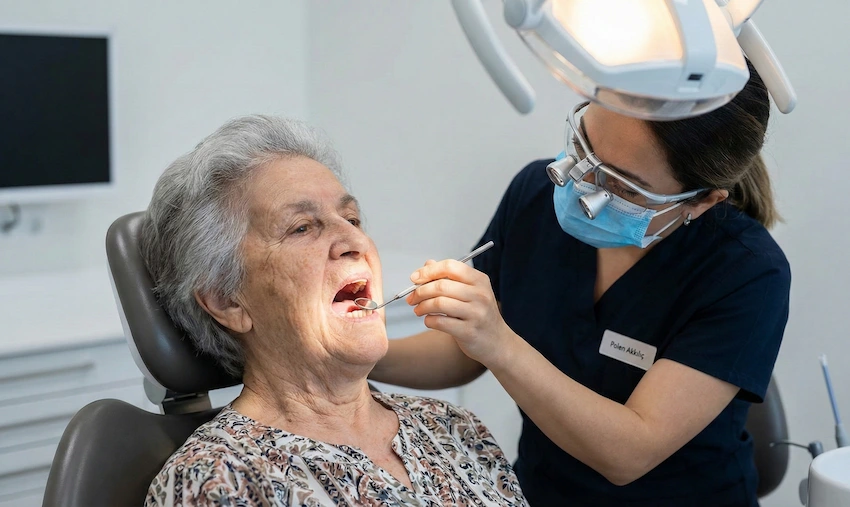
After elderly denture placement, they need follow-up care backed by a proper plan to keep their oral cavity comfortable, hygienic, and functioning safely. Dentist Polen Akkılıç and her team instruct patients on cleaning their dentures with gentle materials, handling storage in disinfecting solutions, and maintaining healthy mucosa. They recommend taking off dentures at night in order to prevent fungal overgrowth and give the tissues a rest. Patients are also instructed on the gradual transition to a balanced diet with textures suitable for their adaptation stage. Such a way of nutrition shields oral tissues and provides safe chewing.
Professor Doctor Coşkun Yıldız elucidates that elderly patients should be subject to the recall of routine adjustment check-ups. Even after the denture has been fabricated, oral tissues are still changing; therefore, dentures may detach or cause certain areas of the mouth there experience more pressure. At every visit to the patient’s home, clinicians trim the border extensions if necessary, reline the prostheses, and check the fit. Regular check-ups serve as a good preventive measure against mucosal inflammation, denture stomatitis, and nutritional decline. Proper aftercare is like the key by which dentures can be kept safe and comfortable in use for a long time.
Which Type of Dentures Are Best for the Elderly?
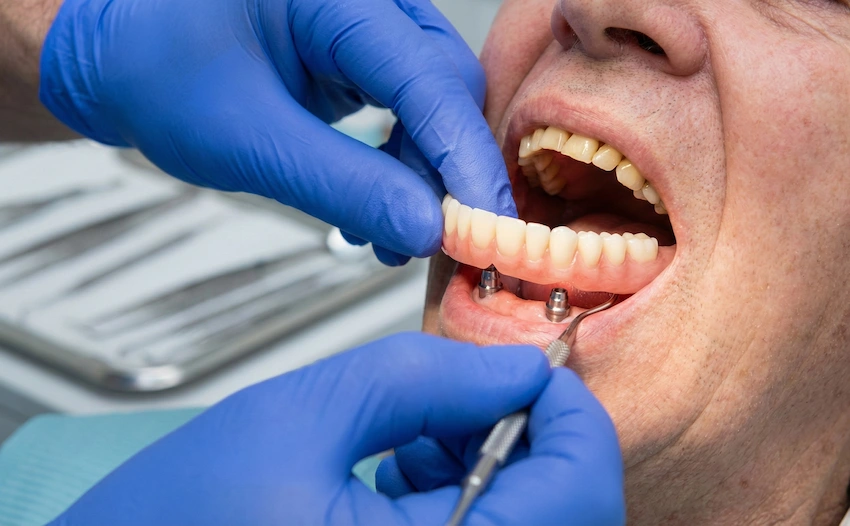
The dental professional will decide the type of dentures based on the patient’s oral structure, bone quality, and preference. Complete dentures are those that fit a patient’s mouth in which all the natural teeth have been lost, whereas partial dentures are those that support the existing teeth and restore occlusion. Besides, Dr. Polen Akkılıç and her team offer implant-supported dentures to the elderly with good bone quality. Implant-supported appliances bring retention, lessen the movement, and increase the masticatory force; therefore, they are appropriate for those who want more stability. Patients with sensitive tissues or uneven ridge anatomy may have flexible partials and soft-liner materials.
University Professor Doctor Coşkun Yıldız emphasizes that the prosthesis decision should take into account factors such as comfort, ease of cleaning, esthetics, and functionality over time. Those with uniform ridge anatomy can wear traditional complete dentures, whereas individuals with extreme bone resorption can receive supported prostheses through implants. In the case of implant support, zirconia-based fixed prostheses are not only highly durable but also have a very natural esthetic appearance. Medical professionals tailor the treatment plan based on the patient’s functional needs, oral biology, and expectations, hence, they are confident of the patient’s predictable satisfaction.
Types of Dentures and Their Clinical Advantages
| Denture Type | Ideal Patient Profile | Clinical Advantage |
| Complete Dentures | Fully edentulous elderly patients | Restores facial support and chewing function |
| Partial Dentures | Patients with remaining natural teeth | Maintains occlusion and stabilizes neighboring teeth |
| Implant-Supported Dentures | Patients with adequate bone density | Provides superior retention and chewing efficiency |
| Flexible Partials | Patients with soft-tissue sensitivity | Offers comfort and reduced pressure on the mucosa |
| Soft-Lined Dentures | Patients with thin or sensitive mucosa | Minimizes irritation and improves adaptability |
Frequently Asked Questions About Dental Prosthesis in the Elderly
If dentists use biocompatible materials and take accurate measurements, dentures are not harmful. Periodic adjustments provide comfort and keep the oral mucosa healthy.
Patients may experience a slight discomfort for a short period of time, however, the carefully planned check-ups eliminate the areas of pressure. The medical professionals make sure that the device is safely adjusted to the mucous membranes.
They usually go through a short period of adjustment in which the new method of chewing may seem inconvenient. In the beginning patients are recommended to take only soft foods until the strength of the chewing apparatus is re-established.
Implant-supported dentures are great, however, they still require bone density for support. Typically, they are employed to provide greater stability and to elevate the patient’s masticatory function to a level higher than that of normal dentures.
Dentures that are taken care of well and kept up with on a regular basis should serve for quite a long time. A change in the structure of the mouth may require a new fit or a reline of the dentures.
Diseases that interfere with the body’s tissues and their healing, e.g. diabetes or osteoporosis, and also those that affect the production of saliva. Medics assess those facets to ensure the therapy is safe.
The main way which prosthetic stability is kept is throughregular routine consultations every six months. Soft tissues are taken care of through continuous observation and comfort is guaranteed over time.
- Kalk, W., & de Baat, C. (2009). Treatment needs for elderly patients with removable dentures. Gerodontology, 26(3), 170–176.
- Carlsson, G. E. (2010). Clinical morbidity and sequelae of treatment with complete dentures. Journal of Prosthetic Dentistry, 104(1), 17–23.
- Muller, F., Duvernay, E., Loup, A., Vazquez, L., & Herrmann, F. R. (2012). Implant-supported overdentures in the elderly: Clinical outcomes and oral-health–related quality of life. Clinical Oral Implants Research, 23(5), 604–608.
- Thomason, J. M., Kelly, S. A., Bendkowski, A., & Ellis, S. (2012). Two implant–retained overdentures: A review of the literature with clinical considerations for the elderly patient. Gerodontology, 29(2), e114–e125.
- Wayler, A. H., & Chauncey, H. H. (1983). Impact of aging on dental health and the masticatory system. Journal of the American Geriatrics Society, 31(7), 405–409.

