


Salt water provides fast relief, but a permanent cure requires professional drainage.
A strong, constant ache might be what keeps you awake at night. A sudden, little bump may develop on your gums. A painful gum abscess is a problem that is hard to tolerate; it should not be ignored because it is a warning sign from your body. So, if you havea gum abscess, it’s like a pressure cooker buried underneath your smile. It is a small area filled with pus, resulting from a bacterial infection. The pressure and pain intensify, and by ignoring it, it is like leaving a house’s foundation exposed to water – eventually, the bone that supports the teeth gets destroyed.
This is the kind of thing that we face at the clinic: physical pain patients desire to be pain-free really quickly. We completely understand that impatience. Also, we know that real healing is a result of deeper changes, not only the surface ones.
The Tactics: Your Periodontal or Periapical Abscess?
Only after locating the problem can we set up the treatment.
Professor Doctor Coşkun Yıldız points out that patients almost always mistake a flush-level infection for an inner one. Periodontal abscesses mainly develop in the area between the tooth and the gum, and it is mostly a result of a gum infection. Bacteria are produced, and food traps the gingiva, which then becomes overgrown. On the other hand, periapical abscesses come from the inside of the tooth – decayed or injured tooth, usually – and break through the end of the root into the bone and gum around it.
But let’s see what you can do to get rid of this pain right now.
Initial Moves: Instant Self-Help Measures
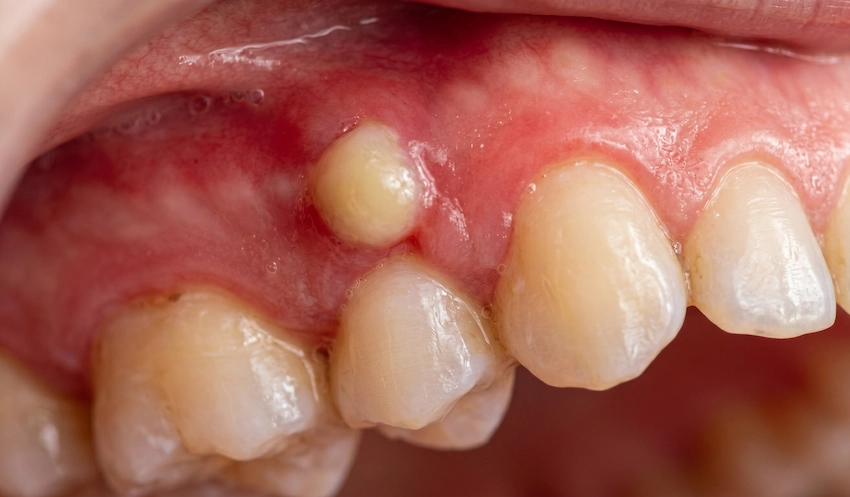
Picture this: It’s the dead of night, and the closest dental office to you is several miles away. What you are most likely to do at this moment is relieve the pain and minimize the pressure.
- Warm salt water rinses: Take half a teaspoon of salt and dissolve it in warm water. Take a gentle swish for a moment and then spit out. This is a mild antiseptic that also draws the fluid out from the tissue, which lowers the internal pressure to some extent.
- Cold compresses: Place an ice pack covered in a towel on your cheek area for 15 minutes. Doing this will narrow blood vessels, therefore doing away with pain and reducing swelling of the face at the same time.
- Over-the-Counter Analgesics: Non-steroidal anti-inflammatory drugs such as Ibuprofen are effective in dealing with the unbearable throbbing pain.
However, these are just temporary solutions. The virus still exists,s and the bacteria cause damage to the fragile tissues.
Professional Dental Treatment at Lema Dental Clinic
So, the question goes, will we ever be able to get rid of the infection for good? According to our experience at Lema Dental Clinic, getting rid of the infection completely needs an intensive, carefully planned procedure. Polen Akkılıç and her team have gained the trust and respect of their clients through their clinical precision and determination in utilizing the top and most up-to-date technologies to bring about the results you desire.
The clinical treatment looks like this:
- Incision and Drainage: It is like a pressure cooker. Making a small cut in the abscess and draining the pus is sure to give instant relief.
- Deep Cleaning (Scaling and Root Planing): In case of a periodontal abscess, we have to remove the plaque that has been accumulating and has hardened (calculus) below the gum line. In a way, it is like scraping the barnacles from a ship’s hull, and this will allow the gums to join again firmly with the clean teeth.
- Root Canal Therapy: If the infection is from the pulp of the tooth (periapical), it is necessary to get rid of, clean, and seal the dying tissues inside the tooth in order to preserve the natural tooth.
- Extraction: Removal of the tooth may be the safest option if the bone foundation is so compromised that a spread of the infection to the jaw or bloodstream cannot be prevented otherwise.
Treatment Options and Timelines

| Treatment Protocol | Primary Purpose | Estimated Recovery Time | Risk if Ignored |
| Incision & Drainage | Upon first contact with a patient, we prioritize the opening of the abscess and release of the pus for relief of painful symptoms. | 1-3 Days | Risk of infection spreading to surrounding tissues. |
| Deep Cleaning | After inflammation has been reduced, we thoroughly clean away pockets of bacteria lodged beneath the gums. | 3-5 Days | Bone loss leading to loosening of teeth. |
| Root Canal | Conservative treatment designed to preserve an infected tooth from necrosis. | 5-7 Days | Complete tooth loss, infection of the whole body. |
| Tooth Extraction | The removal of a severely damaged tooth that can no longer be restored. | 7-10 Days | Damage to neighboring healthy teeth and the jawbone. |
State-of-the-Art Dental Clinic in Turkey
Our Istanbul, Turkey location is widely recognized not only as a destination for advanced dental technology but also for the comprehensive patient-centered approach we have adopted as our philosophy. Dealing with an abscess is merely the beginning. The ultimate aim of our staff is to restore the aesthetic and functional aspects of your smile.
FAQ (Frequently Asked Questions)
In fact, it’s quite impossible. For a short while, pain may cease,e only to find out that the bacterial source is still present when the abscess bursts is the only thing that we are talking about. You see, professional cleaning is what is needed to get rid of the infection,n and without it, the infection will not only come back but will be more aggressive.
Never, I implore you, attempt this by yourself. It will, in fact, lead to the bacteria entering your bloodstream and the surrounding tissues deeper. We have seen patients who have caused a major secondary infection this way. Let us take care of it in a safe and sterile clinical environment.
That unbearable, pulsating pain will be instantly relieved the moment the abscess is drained. However, you may be experiencing mild soreness that will last for a couple of days at most. This can be taken care of efficiently with regular painkillers.
Not necessarily. Antibacterials may not be needed if the infection is confined and we fully and physically drain the abscess through the end of the treatment. On the other hand, antibiotic therapy may be needed when fever, facial swelling, or marked infection occurs.
Honestly, I completely empathize with you that you might get dental anxiety, especially if you are having a toothache. To start with, we administer the local anesthesia, which is very effective, and only after your getting numb, we begin the work. Whether it’s draining or cleaning, through the sensation of pressure, you will tell that we are working on your tooth, but you will not experience any pain. We put your comfort first of all.
- Herrera, D., Retamal-Valdes, B., Alonso, B., & Feres, M. (2018). Acute periodontal lesions (periodontal abscesses and necrotizing periodontal diseases) and endo-periodontal lesions. Journal of Clinical Periodontology, 45(Suppl 20), S78-S94.
- De Moor, R. J., & Hommez, G. M. (2000). The long-term success of root canal treatment. International Endodontic Journal, 33(5), 404-411.
- Jaramillo, A., Arce, R. M., Herrera, D., Betancourt, M., Botero, J. E., & Contreras, A. (2005). Clinical and microbiological characterization of periodontal abscesses. Journal of Clinical Periodontology, 32(12), 1213-1218.
- Pihlstrom, B. L., Michalowicz, B. S., & Johnson, N. W. (2005). Periodontal diseases. The Lancet, 366(9499), 1809-1820.
- Siqueira Jr. J. F., & Rôças, I. N. (2013). Microbiology and treatment of acute apical abscesses. Clinical Microbiology Reviews, 26(2), 255-273.

