


Dental gold is a durable, medical-grade alloy, unlike soft jewelry gold.
Take a walk along one of the busy streets in town. You are bound to spot sparkling gold on people’s wrists and necks. It remains the ultimate symbol of wealth. But let’s take a closer look.
Many times, the patients seated in our dental chairs request that we place a gold crown on their teeth. In most cases, they are under the impression that we are using the same material as jewelry stores. However, the truth is somewhat different.
The mouth is a very unfriendly place. It has to deal with the force of teeth biting together so hard. It gets exposed to very hot and very cold things almost every day. It is also continuously exposed to acidic substances. Plain gold jewelry will not last here for a moment.
Educating patients about their dental problems is our priority at Lema Dental Clinic in Turkey. Together, we must dig into the science of brilliance. This understanding will lead us to realize why genuine dental gold is truly exceptional.
Issue With Pure Gold
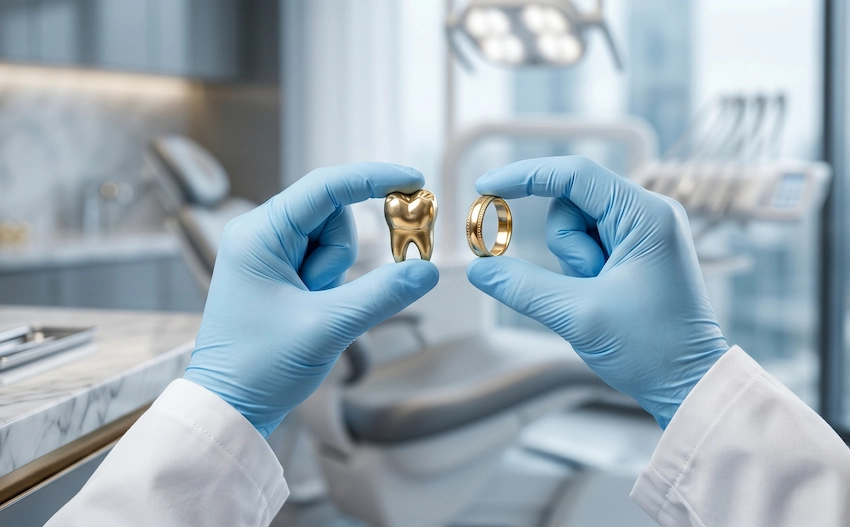
24-karat gold is extremely soft. To understand, picture a tall building being constructed on wet clay. Initially, it seems perfect. But once you bring in a heavy load, the structure will eventually collapse.
The jawbone is very sturdy. The act of chewing places a considerable force on teeth. Consequently, a crown that is made of pure gold would bend quite easily. Additionally, it can lead to the wearing down of teeth and cause malocclusion.
The answer lies in mixing gold with other metals. In fact, Professor Doctor Coşkun Yıldız asserts that the crown should be a copy of natural tooth enamel. Therefore, we introduce precious metals like platinum and palladium to the gold.
Metaphorically speaking, platinum is similar to reinforcing steel in a concrete bridge. It provides the crown with a great amount of strength and keeps it from fracturing. At the same time, gold is kind to the opposing teeth.
Biocompatibility: Does Not Harm the Body
It is still unclear: What is wrong with 14-karat gold jewelry? The point is, jewelers do mix the gold with copper or nickel to harden it.
This is what we witness in dental practice. Metals like nickel hurt the human body. It is hazardous to put them in the oral cavity. With the presence of saliva, these metals suffer corrosion and disintegration over time. Consequently, the patient develops inflamed gums, an allergic reaction, and toxicity due to leakage.
Material must be biocompatible. Besides, the gums should be able to join the material without showing any signs of rejection. Dentist Polen Akkılıç and her team have a policy of using only the high-noble dental alloys. These are the kinds of metals that are totally safe. They do not undergo corrosion. They coexist with the human body most harmoniously.
Comparison Table: Dental Gold Vs. Regular Gold
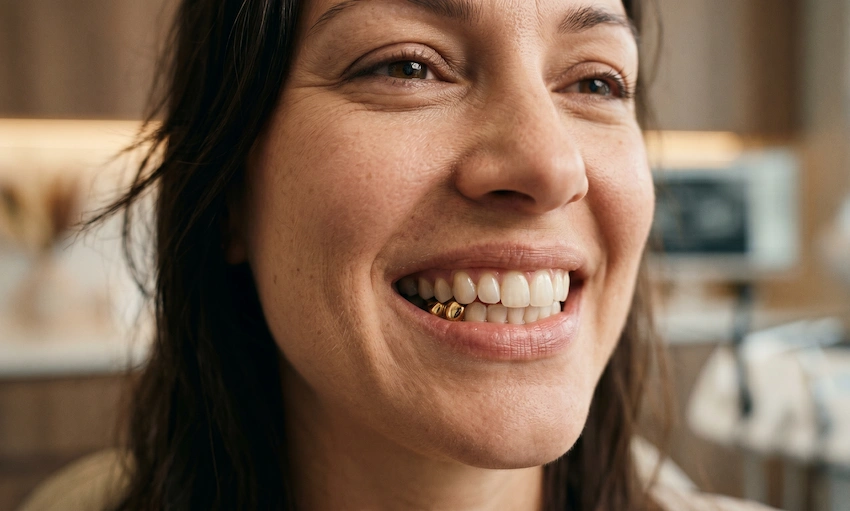
We can simply put these two substances side-by-side to highlight the medical differences.
| Feature | Regular Gold (Jewelry) | High-Noble Dental Gold |
| What is it mixed with? | Copper, zinc, or nickel | Platinum, palladium, and silver |
| Hardness | Very soft to medium | Matches natural human enamel |
| Body Safety | Low (high risk of metal allergies) | Very high (hypoallergenic and safe) |
| Rust Resistance | Tarnishes in acidic saliva | Completely resists oral acids |
| Main Purpose | Beauty and fashion | Heavy chewing and medical sealing |
Frequently Asked Questions
This is a very common question. However, it is quite risky, and therefore it should be avoided. Nickel is one of the metals present in the jewelry gold. They are toxic if put inside the mouth. The metals used in dental fillings are of medical standards, and so they are safe for your health.
Absolutely not. We combine dental gold with noble metals like platinum. This is what makes it resistant to rust. Even though the mouth is exposed to humidity and acid, the premium dental gold will keep its beautiful look for a long time.
Definitely not. The reason is that pure gold is simply not durable enough for chewing. We have a very accurate combination of the noble metals. The final product results in the crown, which is so hard that it is able to chew food, but at the same time, soft enough not to cause harm to the other teeth.
The answer lies in the platinum and palladium content of the mixture. These metals are very frequently of higher value than gold itself. Besides, you are also getting high-precision medical engineering, so the crown fits your tooth perfectly.
Definitely yes. Porcelain and zirconia are the first options for restoration of visible front teeth. Nevertheless, gold is still an excellent option for concealed back molars. It has been unmatched in terms of strength and perfect fit for a very long time.
- Anusavice, K. J., Shen, C., & Rawls, H. R. (2013). Phillips’ Science of Dental Materials (12th ed.). Saunders.
- Wataha, J. C. (2000). Biocompatibility of dental casting alloys: A review. The Journal of Prosthetic Dentistry, 83(2), 223-234.
- McCabe, J. F., & Walls, A. W. (2008). Applied Dental Materials (9th ed.). Blackwell Publishing Ltd.
- Craig, R. G., & Powers, J. M. (2002). Restorative Dental Materials (11th ed.). Mosby.
- O’Brien, W. J. (2002). Dental Materials and Their Selection (3rd ed.). Quintessence Publishing.

