


Crowns repair damaged teeth; bridges replace missing ones.
A missing or broken tooth may cause you to panic. You understand that a solution is necessary. But dental lingo can be tricky. Two words, “crown” and “bridge,” are frequently on the speaker’s lips.
Actually, these two treatments are very different. Selecting the correct one would safeguard your dental health. Also, it will give you a great smile. Let’s examine the clinical facts so that you will be fully aware of the situation.
Understanding the Foundations
To decide sensibly, first, we have to understand how your teeth operate. One way to get this is to consider your jawbone and teeth as the foundation of a building. If a building sustains damage, the method to repair it would depend on the nature of the problem.
The Dental Crown: A Protective Helmet
A dental crown is a customized cap. We use crowns for severely decayed or broken teeth. The main condition is that the natural root should still be very securely fitted in your jaw.
Consider a crown as a protective helmet for a weak tooth. It completely covers the visible part of a tooth. This brings back its state, size, and strength. Clinical data from Lema Dental Clinic states that we employ top-notch materials like zirconia. These materials perfectly replicate the natural appearance of your real enamel.
The Dental Bridge: Spanning the Gap
A dental bridge is a solution when teeth are missing entirely.
An illustration of a bridge across a river shows that it needs very strong support points at both ends to remain upright. In fact, a dental bridge operates in the same way. The healthy teeth that are positioned on either side of the space are the supporting ones. We put crowns on the healthy teeth. An artificial tooth is positioned between them to replace the missing one.
Making the Clinical Choice
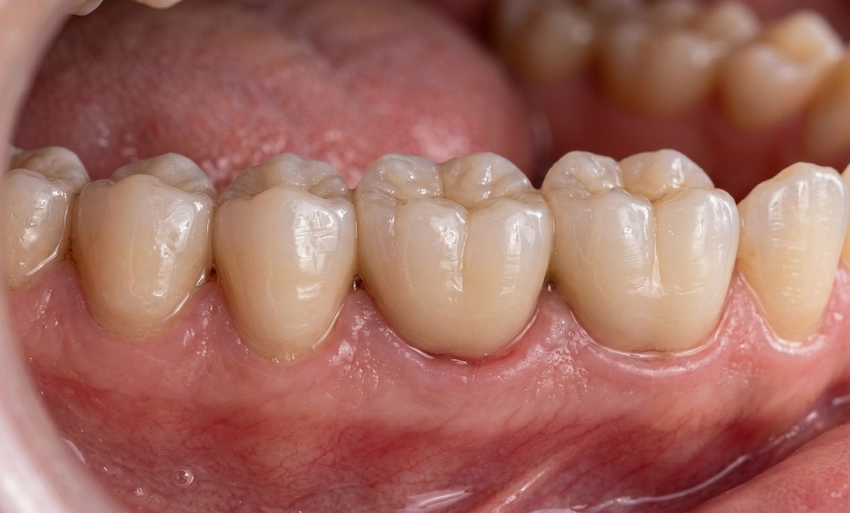
Below is what we observe in our clinics. The decision between a crown and a bridge is not a matter of personal choice. It is, in fact, dependent on the overall condition of your oral cavity.
One day, Prof. Dr. Coşkun Yıldız remarked that our priority is always to preserve as much of your natural tooth structure as possible. Saving a tooth is a priority for us if it is doable.
A Crown is suitable:
- When you have a very big hole in your tooth.
- When your tooth is fractured due to bruxism.
- When you have a root canal.
- When you want to restore a tooth that is severely discolored.
A Bridge is suitable:
- If you lost a tooth completely.
- If the teeth that are adjacent to the void are strong and healthy.
- If you want a permanent solution, but you cannot have dental implants.
So let us analyze their differences more closely.
Treatment Comparison at a Glance
| Feature | Dental Crown | Dental Bridge |
| Main Purpose | Restores and safeguards a damaged tooth. | Substitutes for a tooth that one has lost. |
| Teeth Involved | One single tooth only. | The space and the adjacent healthy teeth. |
| Length of Treatment | 2-3 visits, usually. | 2-3 visits, usually. |
| Maintenance | At-home care with normal brushing and flossing. | Cleaning with special tools is required to maintain comfort under the artificial tooth. |
| Bone Resilience | This supports the jawbone at the root. | Bone loss continues in the area of the gap. |
Why Material Matters
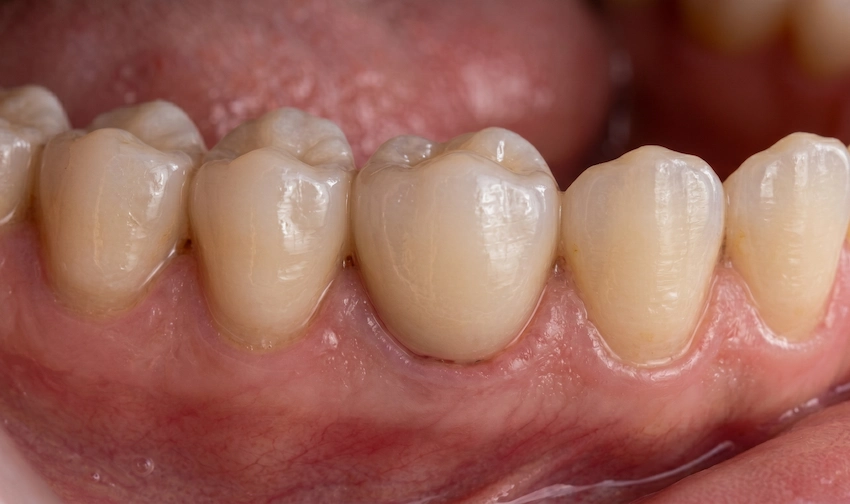
The material of your dental restoration largely influences the strength and aesthetics of your new smile. Dentist Polen Akkılıç and her team are capable of performing restorations that are not only extremely durable but also look very natural.
Zirconia is the material we work with the most. It is an extremely tough ceramic that hardly ever cracks. Zirconia gives us the opportunity to construct bridges that are capable of sustaining even the heaviest chewing forces. For the front teeth, we normally use very translucent porcelains. It is their light reflection that makes them almost indistinguishable from natural teeth.
The next step is a clinical consultation, right? We’ll employ leverage 3D imaging to closely examine your jaw. Doing so will provide us with clear insight into which treatment would be the strongest, healthiest for you.
Frequently Asked Questions
We give priority to your comfort. The tooth is prepared under local anesthesia via injection. Numbness and comfort are the feelings you will experience. Later, if you experience sensitivity to hot or cold, do not worry; this disappears quickly.
High-quality ceramic crowns and bridges have a lifespan of 10 to 15 years. Besides, some outliers last even longer than that. Partly, this is one of the outcomes of your daily brushing and it also depends on whether or not you grind your teeth at night.
Definitely, a bridge is a functional restoration of your chewing ability. However, during the first couple of weeks, you are advised to cut hard foods into smaller pieces. Also, ensure that you never use your teeth to open packages.
Indeed, they do. Especially, if they are produced by master technicians and are made from zirconia or porcelain, your new teeth will definitely look as if they are 100% natural. We always color-match the ceramic in such a way that it blends perfectly with the rest of your smile.
The global dental care leaders set up major centers in Turkey. Through the Lema Dental Clinic, you will be able to access the leading specialists, the most effective technologies, and the highest-grade materials available. It is a travel and access option that not only compares to the European or North American clinics but indeed surpasses them sometimes. You will receive world-class care without having to compromise anything.
- Goodacre, C. J., Bernal, G., Rungcharassaeng, K., & Kan, J. Y. (2003). Clinical complications in fixed prosthodontics. The Journal of Prosthetic Dentistry, 90(1), 31-41.
- Pjetursson, B. E., Sailer, I., Makarov, N. A., Zwahlen, M., & Thoma, D. S. (2015). All-ceramic or metal-ceramic tooth-supported fixed dental prostheses (FDPs)? A systematic review of the survival and complication rates. Dental Materials, 31(6), 603-623.
- Rekow, E. D., Silva, N. R., Coelho, P. G., Zhang, Y., Guess, P., & Thompson, V. P. (2011). Performance of dental ceramics: challenges for improvements. Journal of Dental Research, 90(8), 937-952.
- Sailer, I., Makarov, N. A., Thoma, D. S., Zwahlen, M., & Pjetursson, B. E. (2015). All-ceramic or metal-ceramic tooth-supported fixed dental prostheses (FDPs)? A systematic review of the survival and complication rates. Part I: Single crowns (SCs). Dental Materials, 31(6), 603-623.
- Zarone, F., Russo, S., & Sorrentino, R. (2011). From porcelain-fused-to-metal to zirconia: clinical and experimental considerations. Dental Materials, 27(1), 83-96.

