


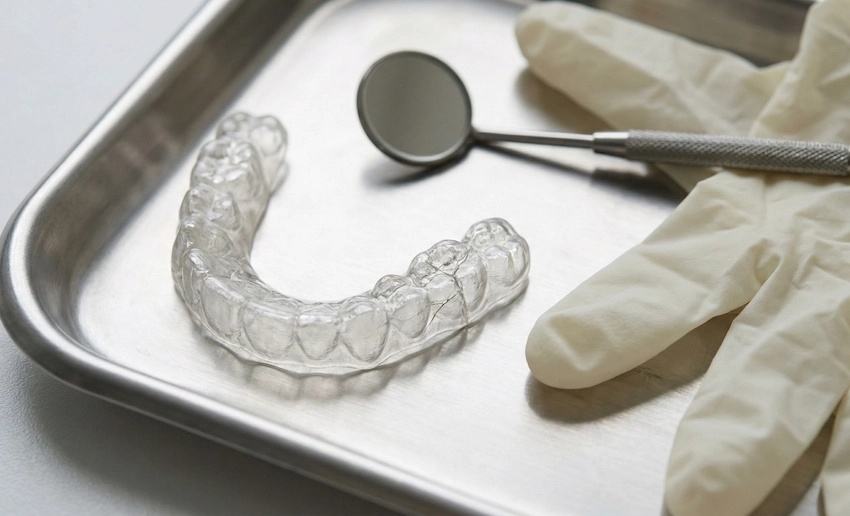
A cracked retainer cannot be safely fixed at home and needs professional repair or replacement.
Usually, it happens at the most inconvenient time – when you are going to bed or preparing for a holiday. You hear a faint “click” or notice that you are cutting your tongue on the sharp edge. You take out your retainer and discover that there is a hairline crack, or even worse, the plastic has snapped cleanly. Your first thought is superglue or a repair kit that you saw on the internet.
Actually, your retainer is a highly accurate tool. Imagine it as a custom-fitted architectural brace for a very tall building. If the brace is even a fraction of a millimeter off, the whole building will start to lean. AtLema Dental Clinic in Turkey, we have patients from time to time who have tried a “quick fix” at home and therefore end up with shifted teeth or irritated gums when they come to see us.
The Temptation of the Home Repair
We know that feeling of panic. You might have even spent years under the supervision of experts such as Professor Doctor Coşkun Yıldız, to get your teeth perfectly aligned. The anxiety of your teeth going back to the old positions, which is what orthodontic relapse is, is a genuine emotion.
However, let us examine more closely the typical “tricks” that people resort to:
- Superglue and Adhesives: Most household glues contain chemicals that are harmful and are not designed to be used in the mouth where it is a very humid environment. They will break down rapidly and might even cause chemical burns to your soft tissues.
- Filing Down Sharp Edges: According to Dr. Polen Akkılıç and her colleagues, filing the edges of your retainer to stop it from irritating your cheek is akin to damaging the device’s overall strength.
- DIY Plastic Welders: With these types of devices, you can very easily distort the whole retainer, thus it may become tighter in some areas and looser in others.
Dentist Polen Akkılıç and her team often emphasize that a retainer has a greater purpose than merely “fitting” in your mouth; it has to apply a certain, passive pressure to keep bone and ligament stable. Once a retainer is broken it immediately loses that fine holder of tension.
Home “Fixes” vs. Clinical Reality
| Method | Potential Risk | Effectiveness | Recommendation |
| Superglue | Toxicity; chemical burns, and bad taste. | Low (Breaks easily) | Never |
| Dental Wax | Choking hazard if the piece breaks off. | Medium (Temporary comfort only) | Emergency only |
| DIY Repair Kits | Warping; improper tooth alignment. | Low | Avoid |
| Professional Replacement | None. | High (Restores full retention) | The Gold Standard |
Why “Good Enough” Isn’t Enough for Your Smile
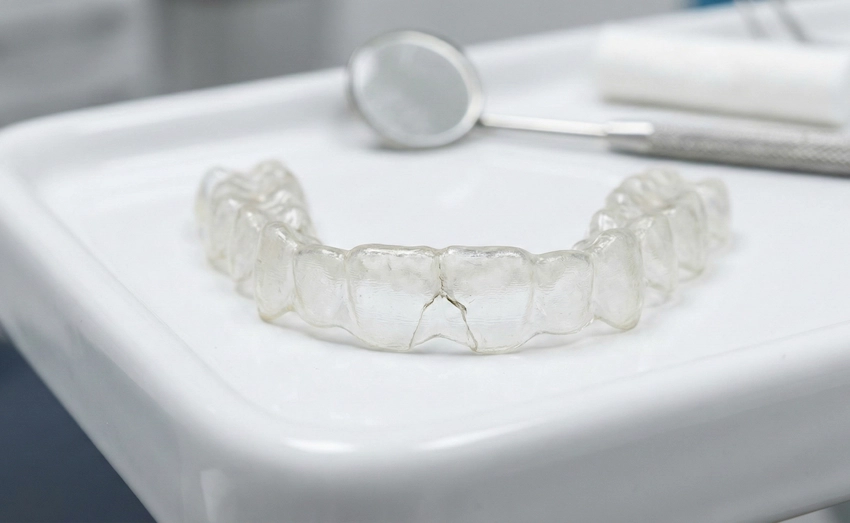
One major question remains: What if you continue wearing a retainer with a crack? Based on our clinical experience at Lema Dental Clinic, a broken retainer is like a broken steering wheel in a car. Although it may still be “attached”, it is no longer “steering” anything.
Periodontist Doctor Coşkun Yıldız frequently explains that the periodontal ligaments—the tiny fibers holding your teeth to the jawbone—are very tough but at the same time “forgetful.” When the teeth are not constantly and precisely kept in place by a professional retainer, the ligaments start to pull the teeth back to their original crooked positions. The most startling part is that the relapse can occur within just 48 hours.
The Right Solution
Should you be in Istanbul or planning to take a trip to Turkey, don’t just opt for a simple fix from a hardware store. To us, the safest route to follow is something we always tell our patients:
- If there is a Sharp Point, Then Stop Wearing It: If the crack has resulted in a sharp edge, stop wearing it immediately so that you do not hurt your tongue or gums.
- If You Need To Wear It For One Night Only, Use Dental Wax: Then please, place wax over the crack so that the wax acts as a shield and prevents the crack from hurting your mouth.
- Don’t Throw Them Away: Bring the halves to the clinic if even the retainer is broken into two halves. Such information helps us to identify the exact location of the stress point.
- Call Lema Dental Clinic: To replace your old retainer, we first scan your dental model very accurately with advanced 3D technology, then we create the new retainer to be perfectly fitted and longer-lasting than the original one using this data.
Frequently Asked Questions (FAQs)
My advice is definitely not to do this. Nail polish basically contains chemicals like formaldehyde and toluene, which are very harsh. It’s not ‘food-grade’ and will just flake, so you will be eating it eventually. Also, it adds thickness to the retainer which may lead to your teeth not fitting together properly.
It depends on the patient, but mainly, we see movement within 2-3 days. The bone around your teeth is a very slow-healing bone after braces. If you have a broken retainer, the need for a replacement is a priority.
Eventually, getting a new one will be a much cheaper and financially wise decision. A fixed retainer that no longer retains the teeth correctly can be the reason for you to wear braces again. We in our Turkey clinic provide you with quality yet very affordable replacements so that you don’t have to worry about having another orthodontic treatment in the future.
“Absolutely not! Retainers are made of thermoplastic materials. If heated excessively, the whole device will shrink and warp. After this, the retainer will be so distorted that it might even try to push your teeth in the wrong direction,” said Dr. Coşkun Yıldız.
Most likely, it’s a mix of ‘material fatigue’ and, for example, habits such as tooth grinding (bruxism) or removing the retainer by just pulling on one side. When you come to see us, my team and I will help you to check your bite which will let us know if it’s necessary to provide you with a thicker, more durable material for your replacement.
- Johnston, C. D., & Littlewood, S. J. (2015). Retention in orthodontics: A review of the current evidence. Journal of Orthodontics, 42(1), 25-34.
- Lyros, I., Tsolakis, A. I., & Maroulakos, M. (2023). Mechanical properties and clinical longevity of vacuum-formed retainers. European Journal of Dentistry, 17(2), 112-119.
- Manzon, L., Fratto, G., & Rossi, M. (2020). Assessment of the biocompatibility of dental adhesives and resins in oral environments. Materials in Stomatology, 13(4), 88-95.
- Nanda, R., & Burstone, C. J. (2018). Retention and Stability in Orthodontics. Saunders/Elsevier.
- Wong, P., & Akker, V. (2021). Orthodontic relapse: The role of patient compliance and retainer integrity. International Journal of Oral Science, 13(1), 14-22.

