


No, implants need special crowns for lasting support.
Numerous patients come through our doors with one common misunderstanding. Their idea is that placing the titanium screw in the jaw is the most difficult part. Most of them think that we can simply put a universal, factory-made tooth on top and be done with it.
However, the truth is quite the opposite. The implant will remain fully unseen once it is healed. It is the crown that is the visible piece of dental design that everyone is able to see. Besides, this is the surface that your opposite teeth come into contact with each time you chew.
Lema Dental Clinic in Turkey is a place where we meet regularly with patients who are in such a nightmare of restoration that even their expensive implants did not survive after they were fitted with a generic andcompletely mismatched crown. So, can the two be combined with just any crown? That definitely is not the correct answer.
In any case, let us analyze more deeply the reason why this particular decision affects your health for the years to come.
Building a House vs. Dental Restoration
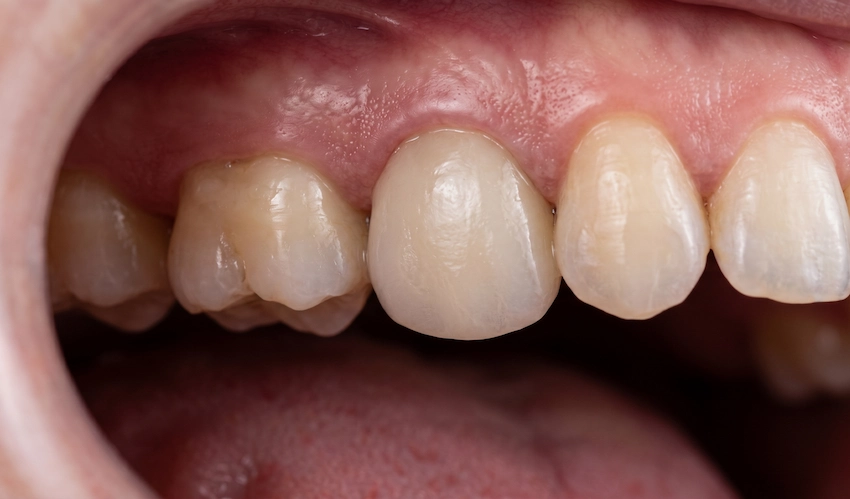
Imagine a dental implant restoration as building a luxury house. In each case, careful step-by-step engineering is necessary.
- Implant: It is the hard and deep foundation. It is fastened tightly to the jawbone.
- Abutment: Consider it as the skeleton of the building. It connects the foundation to the visible house.
- Crown: It is a house. It not only has to be pretty but also resist grinding and allow clear talking.
Most certainly, you will not set a heavy concrete house on a weak and unstable frame. Professor Doctor Coşkun Yıldız is reminding us all the time about an important clinical fact. An implant’s success is limited by its crown. Both must operate in complete harmony. They must safely carry bite forces all the way to the bones.
The Material with Which Crown is Made: What Happens in the Clinic
The mouth is one of the most powerful areas of your body. Natural teeth have a small shock absorber called a periodontal ligament. It allows the tooth to move a little when biting down.
Implants do not have this natural shock-absorbing feature. They are attached very firmly, without any flexibility, to your jawbone. Due to this inflexible bond, the crown material must be selected with great care. It should be able to withstand strong chewing without cracking or causing stress to the bone.
Materials of Implant Crowns Compared
| Material Type | Best Role | Strength | Look |
| Monolithic Zirconia | Full molars and heavy biting | Very Strong | Good (not transparent) |
| E-max (Lithium Disilicate) | Front teeth (incisors) | Less strong | Most beautiful (very translucent) |
| Zirconia with Porcelain | Visible part of the smile | Excellent | Very good |
| PFM (Porcelain Fused to Metal) | Bite parts with minimal budgets | Very good | Average (dark lines may show) |
The Skillful Gesture
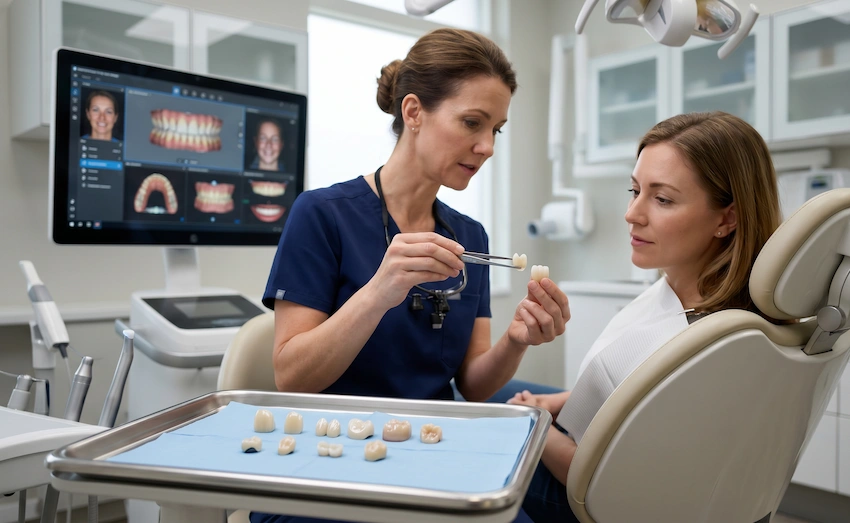
So, how does the crown get attached to the implant exactly?
The traditional crowns are placed on natural teeth,h which have been filed down by the dentist. But implant crowns are a very different ball game from the engineering perspective. Dentist Polen Akkılıç and her team prepare individualized abutments for each patient. We no longer rely on prefabricated components.
Personalizing your bonding will give your gums an amazing fit for your new tooth, and that will reduce food retention and bacteria buildup naturally. However, if you end up placing a generic crown on a precision implant, it will definitely give rise to microscopic, invisible gaps. These gaps, in turn, may result in peri-implantitis, which is a severe infection and could cause bone loss around the implant.
Frequently Asked Questions
Absolutely not, if done properly. We use digital shade matching and premium translucent materials like E-max. Our ultimate goal is simple. We want you to look in the mirror and forget which tooth is the implant.
No, this is impossible. A natural tooth crown has a hollow shape made specifically for a natural tooth stump. An implant needs a crown engineered to lock precisely onto a titanium or ceramic abutment.
It depends on the tooth’s place in the mouth. Screw-retained crowns can be safely removed for clinical cleaning. For front teeth, we sometimes use a special cement that can be taken off to hide the holes.
The titanium root can easily support you for decades. The crown, however, faces daily wear and tear. With excellent oral hygiene and a balanced bite, a high-quality zirconia crown usually lasts 15 to 20 years before needing replacement.
It comes down to premium care at a highly accessible point. Here at Lema Dental Clinic, we use the same top-tier European and American brands as clinics in London or Berlin. Our high-volume clinical expertise allows us to perform these complex restorations flawlessly and efficiently.
- Misch, C. E. (2014). Dental Implant Prosthetics (2nd ed.). Elsevier Mosby.
- Zitzmann, N. U., & Marinello, C. P. (1999). A review of clinical and technical considerations for fixed and removable implant prostheses. The Journal of Prosthetic Dentistry, 82(4), 412-420.
- Sailer, I., Mühlemann, S., Zwahlen, M., Hämmerle, C. H., & Schneider, D. (2012). Cemented and screw-retained implant reconstructions: a systematic review of the survival and complication rates. Clinical Oral Implants Research, 23(s6), 163-201.
- Pjetursson, B. E., Thoma, D., Jung, R., Zwahlen, M., & Zbinden, A. (2012). A systematic review of the survival and complication rates of implant-supported fixed dental prostheses (FDPs) after a mean observation period of at least 5 years. Clinical Oral Implants Research, 23(s6), 22-38.
- Linkevicius, T., & Vaitelis, J. (2015). The effect of zirconia or titanium as abutment material on soft peri-implant tissues: a systematic review and meta-analysis. Clinical Oral Implants Research, 26(S11), 139-147.

