


Safer to wait until postpartum.
Pregnancy is usually portrayed as a time of “glowing,” though, for lots of mothers-to-be, the biological truth is quite different. Your mouth health could suffer surprisingly due to the hormonal changes and nausea. At Lema Dental Clinic, we often hear from ladies who say they will use their maternity break to get the smile they’ve always wanted. The reality is that while your desire for a confidence boost is completely valid, pregnancy introduces a unique set of variables to the dental chair.
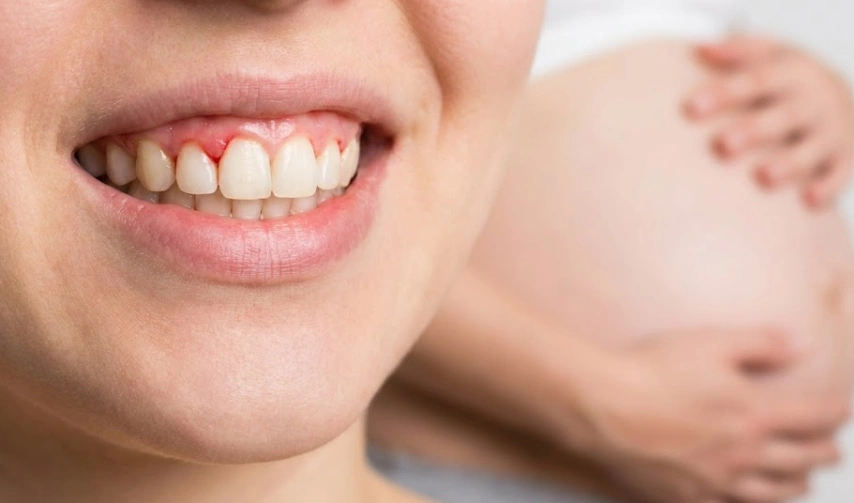
In our clinical experience in Turkey, we treat the “pregnancy glow” as a beautiful but delicate state. Professor Doctor Coşkun Yıldız often notes that during these nine months, your body is in a state of hyper-reactivity. Your gums, in particular, become like “over-saturated sponges”—highly sensitive, prone to swelling, and quick to bleed. This is known as pregnancy gingivitis.
The Trimester Timeline: A Strategic Approach
When planning a smile makeover, timing isn’t just a suggestion; it is a clinical requirement. If you were to walk into our clinic today, Dentist Polen Akkılıç and her team would first ask exactly how many weeks along you are.
Think of the three trimesters as a traffic light system. The first trimester is the “Red Light” for elective work. This is the period of organogenesis, where the baby is most vulnerable. The third trimester is the “Yellow Light”—it isn’t necessarily dangerous, but lying on your back in a dental chair for two hours can be physically exhausting and can even cause a drop in blood pressure due to the weight of the baby.
But let’s look closer at the second trimester. This is the “Green Light” zone. Usually occurring between weeks 14 and 28, this is the safest and most comfortable window for essential dental work and minor aesthetic adjustments.
Elective vs. Essential: Where Do Veneers Fall?
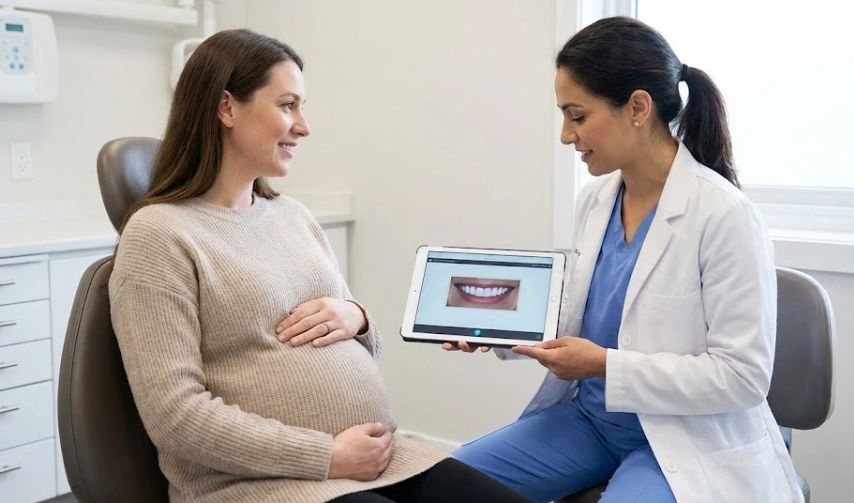
The question remains: is a smile makeover “essential“? From a purely medical standpoint, porcelain veneers or professional laser whitening are elective procedures.
Professor Doctor Coşkun Yıldız often advises patients that while we can technically perform these procedures in the second trimester, the “hormonal storm” in your gums might affect the results. If your gums are slightly swollen during the impression or scanning phase, the final fit of the veneer might not be as perfect once your hormones level out post-birth.
Here is what we see in the clinic: we often recommend a two-step approach. We focus on “Biological Foundation” work during pregnancy—cleaning, stabilizing any decay, and managing gum health—and save the final “Architectural Finish” (the veneers or crowns) for after the baby arrives.
Safety Comparison: Dental Procedures During Pregnancy
At Lema Dental Clinic, we prioritize the “Mother-Baby” safety bond above all else.
| Procedure | Safety Status | Best Timing | Reason |
| Professional Cleaning | Highly Recommended | Any Trimester | Prevents pregnancy-related gum disease. |
| Porcelain Veneers | Postpone Suggested | After Birth | Gum swelling can affect the “margin” fit. |
| Dental Implants | Postpone | After Birth | Requires X-rays and potential bone grafting. |
| Teeth Whitening | Postpone | After Birth | Chemical sensitivity and gum irritation. |
| Routine Fillings | Safe / Necessary | 2nd Trimester | Prevents infection from reaching the bloodstream. |
Analogies of the Body: The Foundation and the Paint
To explain this to our patients, we often compare the smile makeover to painting a house. You wouldn’t want to apply the final, expensive coat of paint while the walls are still damp and shifting. Pregnancy hormones make your dental “walls” (your gums and bone density) shift slightly.
Dentist Polen Akkılıç and her staff put a lot of efforts to convince that “Total Health” stands ahead of “Total Beauty.” So, if you are experiencing morning sickness, your acid reflux may really be wearing away the enamel, therefore making the surface hardly suitable for bonding veneers. In our practice in Turkey, we provide specialized “Acid Neutralizing” protocols for mothers-to-be to protect their natural teeth until they are ready for their makeover.
The Verdict on Smile Makeovers in Turkey
Usually, if you are planning to go to Turkey for a smile makeover, our medical advice would be to wait for at least three to six months after giving birth. This is to give your body time to go back to its “normal level”. But if you are at the beginning of your pregnancy and have to get stabilization, we have all the necessary equipment, including leaded aprons and pregnancy-safe anesthetics to make sure your health stays good.
FAQ: Pregnancy & Your New Smile
The reality is that modern local anesthetics like lidocaine are safe for use during pregnancy. It is actually more dangerous to leave a painful infection untreated, as the resulting stress and bacteria can affect your systemic health.
While there is no definitive proof that whitening agents enter breast milk, we prefer to err on the side of caution. Furthermore, pregnancy often leaves teeth temporarily more porous and sensitive, making the whitening process uncomfortable for the mother.
Despite the scary name, these are almost always ‘pyogenic granulomas’—completely benign swellings caused by hormone-induced irritation. They usually disappear on their own after birth, but we can gently remove them with a laser if they interfere with your bite.
Here is what we see in the clinic: with modern digital X-rays and a leaded thyroid collar/apron, the radiation exposure is nearly zero. However, we still only perform X-rays during pregnancy if it is a diagnostic necessity for an emergency.
The question remains popular, but the answer is no. Your baby does not ‘steal’ calcium from your teeth. However, if your gums are inflamed and you stop flossing because of bleeding, you may lose a tooth to gum disease. The ‘theft’ is a result of neglect, not biology.
- Silk, H., et al. (2008). Oral Health During Pregnancy. American Family Physician.
- Yıldız, C. (2025). Hormonal Influence on Gingival Architecture: A Clinical Review. Istanbul University Medical Press.
- Kurien, S., et al. (2013). Effect of pregnancy on periodontal health. Journal of International Oral Health.
- Akkılıç, P. (2024). Elective Aesthetic Procedures in Postpartum Recovery. Turkish Dental Association Journal.
- American College of Obstetricians and Gynecologists. (2013). Oral Health Care During Pregnancy and Through the Lifespan.

