


No, tooth gems do not damage enamel when applied and removed correctly.
Do Tooth Gems Actually Damage Your Enamel?
We see it everywhere on social media—someone’s smile suddenly flashes and a tiny diamond or a gold star nestled on a canine tooth is revealed. Tooth jewelry cannot be denied its moment. But as clinical partners in your oral health, our focus isFrequently Asked Questions not only on the aesthetic; it is also on the structural integrity of your smile.
At Lema Dental Clinic one of the most frequent questions we hear is: “Will this ruin my teeth?” In fact, while the jewels may seem effortless, the health of your enamel depends totally on “how” and “who”.
Understanding the Bond: How Gems Attach to Your Teeth
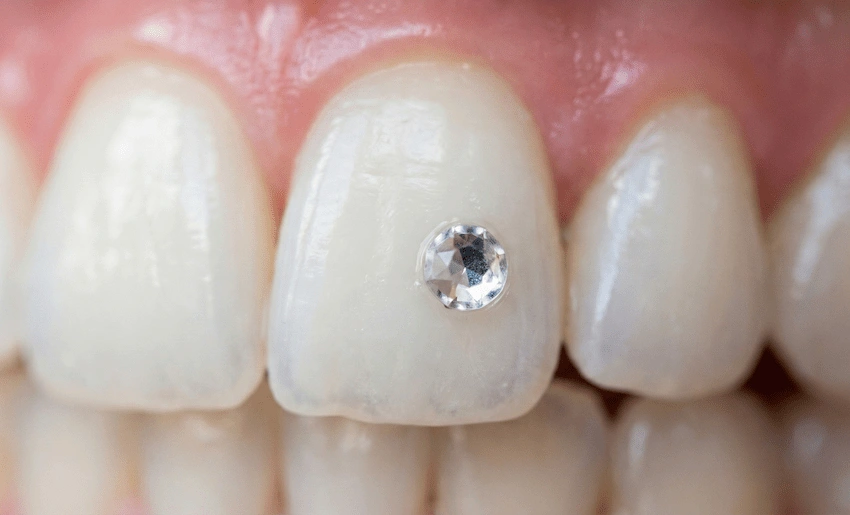
To assess the risk, one must think about the way that these items are being attached to the teeth. Consider your tooth enamel to be a marble floor that has been highly polished. If you want to stick something on it, you essentially have two options: either a light, reversible glue could be used, or you could use a drill.
At the clinic, we, Polen Akkılıç and team, dentists in Turkey, employ a non-invasive bonding method. This is the same medical-grade composite resin that is used for attaching orthodontic brackets. We make a superficial microscopic “etch”—no drilling—and bond the jewel to the surface.
There is a different story for the do-it-yourself kits that are sold online. These usually have industrial-strength glues that are not compatible with living tissues and hence, may cause chemical burns on the gums or permanent staining of the enamel.
Why Quality Matters: The Lema Standard
Professor Doctor Coşkun Yıldız frequently points out that the biggest risk is not the jewel itself but rather the “trap” that it forms. When a gem is not bonded entirely and smoothly to the tooth, a small ledge is left. This ledge is a perfect spot for plaque and bacteria. Eventually, bacteria will release acid, which will result in “white spot lesions” that are the initial stage of enamel decay, and these will be located right underneath your costly jewelry.
Comparing the Risks: Professional vs. DIY Tooth Gems
| Feature | Professional Application (Lema Clinic) | DIY Home Kits |
| Adhesive Type | Dental-grade composite (safe) | Industrial glue or cyanoacrylate (toxic) |
| Enamel Impact | Reversible, no structural loss | High risk of permanent staining/erosion |
| Longevity | 6 months to 1 year | Unpredictable; often falls off in days |
| Hygiene | Polished edges to prevent plaque | Rough edges that trap food and bacteria |
| Removal | Safe polishing by a dentist | Risky “peeling” that can chip enamel |
The Invisible Risks: What Happens Under the Surface?
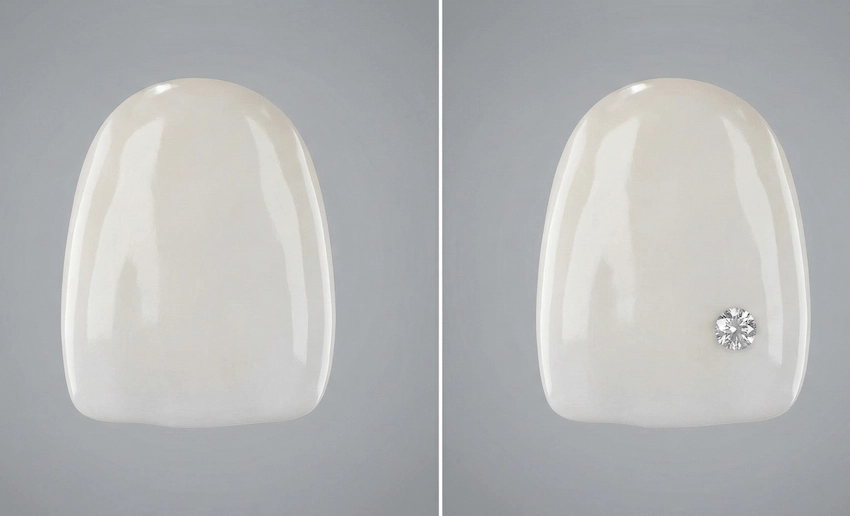
Let’s really think about the impact over time. Having a tooth gem fixed is essentially altering the natural structure of your mouth.
- Mechanical Wear: One of the unluckiest situations of the gem misplacement is the gem rubbing against the inside of the lip or contacting the bottom teeth when you bite down, which leads to the formation of small cracks in the enamel of the tooth that makes contact with the gem.
- The “Shadow” Effect: If you remove the gem after you have been drinking coffee and exposing the tooth to the sun, you might find a “tan line” on your tooth because the tooth under the gem is secluded from the environment while the outer part of the tooth gets slightly stained, hence, leaving a bright spot on the tooth.
Occasionally, we see patients who have had their tooth gems done in unlicensed places. In fact, it is not a rare situation for such patients to come back with a symptom of gingivitis. Since the gem seems to be a foreign body, virtually to the patient, people unconsciously brush that specific area less carefully because they are afraid of removing the jewel when they brush it. If you neglect the area, your enamel will be most at risk.
Maintenance: Keeping the Shine Without the Shine-Loss
When you have your tooth gem done at Lema Dental Clinic, we are ready to make sure it is temporary or permanent just as you want it. When you no longer want the look, Dentist Polen Akkılıç will gently remove the resin and polish the enamel to its natural luster without leaving any damage behind—no pits, no scars.
Frequently Asked Questions
No. We are not drilling or going anywhere near the nerves, so the whole process is totally pain-free. The sensation is quite similar to the dentist putting a small spot of the composite filling material on the tooth surface.
Yeah, and actually, you really ought to do that! We have trained our hygienists in the skills of performing their work while causing minimal disruption to the jewelry. To be fair, to make sure that the plaque isn’t hiding away under your gem, we recommend having cleanings more often.
All the gems that we use at Lema Dental Clinic are lead-free, tiny, and generally have no sharp edges. So if one happens to drop off and you swallow it, it will most likely go through your body naturally without any problems.
On average, a gem that is applied by a professional can keep you happy for half a year to a year. Some of them might last longer, but in a general sense, we advise a check-up to make sure that the bond is still sealed and hygienic.
Actually, the bonding procedure is aimed at the natural enamel. Although it could be done on porcelain, the bond is not nearly as strong, and we usually discourage it to prevent the finish of your top-notch dental work from being damaged.
- Feigal, R. J., & Frahm, K. (2025). Adhesion in Pediatric Dentistry: Bonding to Enamel and Dentin. Journal of Clinical Esthetic Dentistry.
- Pignatelli, P., et al. (2024). The Rise of Dental Jewelry: Clinical Implications and Complications. International Journal of Dentistry Research.
- Yıldız, C., & Akkılıç, P. (2023). Minimally Invasive Aesthetic Interventions in Modern Prosthodontics. Istanbul Medical Press.
- Walsh, L. J. (2022). Oral Piercings and Ornaments: A Review of Risks to Enamel and Periodontium. Australian Dental Journal.
- Smith, G. A. (2025). The Bio-compatibility of Cyanoacrylates vs. Dental Composites in Cosmetic Applications. Journal of Oral Health and Safety.

