


Safe luxury, years of shine
In the evolving world of cosmetic dentistry, we often see trends that prioritize “the look” over “the health.” However, one of the most frequent questions we receive at Lema Dental Clinic—especially from our younger patients visiting Turkey—is whether you can safely add a bit of luxury to your smile. The rise of diamond tooth gems has moved from niche fashion to a mainstream request, but as clinical professionals, we look beyond the sparkle to the science of the bond.
The question isn’t just about whether it looks good. It’s about preserving the “biological shield” of your enamel while achieving that signature glow.
The Reality of Professional vs. DIY Application
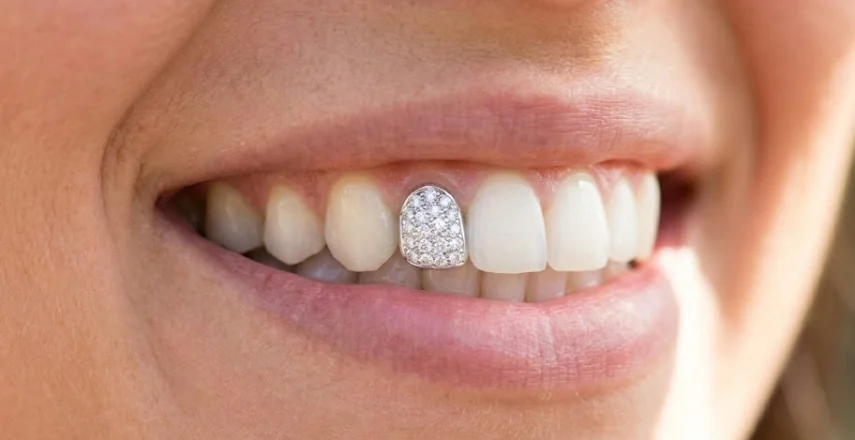
If you search the internet, you will find countless “at-home” kits. The reality is that these are the leading causes of enamel damage we see in the clinic. Applying a gem yourself is like trying to perform your own upholstery on a vintage velvet chair; without the right tools and adhesives, you are likely to leave a permanent scar.
Professor Doctor Coşkun Yıldız often notes that the primary difference at a professional clinic is the grade of the adhesive. Here is why choosing a clinical setting like Lema Dental Clinic matters for your safety:
- Medical-Grade Adhesives: Our team uses light-cured, biocompatible composites which are safe and toxic-free for the tooth but ensure a perfect bond.
- Enamel Preservation: We do not use a drill at any step of this procedure, so the natural tooth is 100% intact.
- Sterile Environment: We make sure that no germs get under the gem which could cause an infection later.
- Precision Placement: Dentist Polen Akkılıç and her team carefully position the dental jewel so that it neither interferes with your bite nor causes mouth irritation.
How the Procedure Works: A Step-by-Step Glow-Up
Most patients are really impressed by how the entire treatment was pretty much non-invasive. Think of a tooth surface as a shiny, polished mirror. If you are going to stick something on a mirror, do you not first have to make it “sticky” on a microscopic level?
Anyway, let’s get into the details of how we do it at our clinic in Turkey:
- Clinical Cleaning: We remove all surface plaque and “biofilm” to ensure a pure bonding surface.
- Micro-Etching: A gentle, medical-grade gel creates microscopic pores in the enamel—much like a primer prepares a luxury car’s frame.
- Bonding Agent: A thin layer of dental resin is applied to the back of the diamond.
- Curing: A specialized blue LED light “cures” the bond in seconds, locking the diamond in place.
- Final Polish: We ensure the edges are smooth so you don’t even feel the gem against your lip.
Maintenance: Keeping the Sparkle Clean
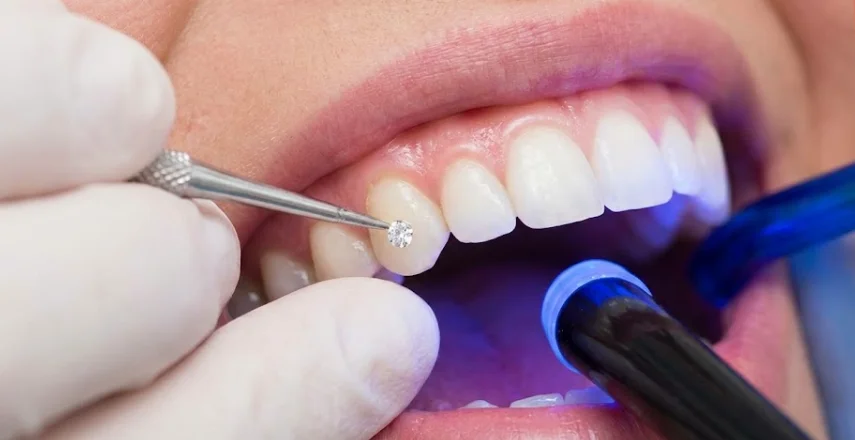
A tooth gem is essentially a tiny “speed bump” on the surface of your tooth. While it doesn’t hurt, it does change the way plaque moves across the enamel. Here is what we see in the clinic: if a patient brushes properly, the gem stays bright. If neglected, it can become a magnet for buildup.
Follow these essential care tips to protect your investment:
- Switch to a Soft Brush: Use gentle, circular motions to clean around the base of the gem.
- Avoid “Electric Scrubbing”: If using an electric brush, let the bristles do the work; don’t apply heavy pressure.
- Rinse After Meals: This prevents food particles from settling behind the “edge” of the diamond.
- Professional Checks: During your routine cleanings at Lema Dental Clinic, we check the integrity of the bond.
Comparing Tooth Gem Options and Longevity
| Feature | Real Diamond Gems | Swarovski/Crystal Gems | DIY Fashion Kits |
| Average Lifespan | 1 – 5 Years (Professional) | 6 Months – 2 Years | Days to Weeks |
| Enamel Safety | High (Non-invasive) | High (Non-invasive) | Low (Risk of damage) |
| Visual Depth | Maximum Brilliance | High Shine | Dull/Glassy |
| Bonding Agent | Medical-Grade Composite | Medical-Grade Composite | Often Toxic Glues |
| Removal Process | Simple Professional Buffing | Simple Professional Buffing | Risk of Staining |
Why Choose Lema Dental Clinic for Esthetics?
When you travel to Turkey for dental work, you are looking for an intersection of artistry and medical safety. Professor Doctor Coşkun Yıldız and Dentist Polen Akkılıç believe that even a procedure as small as a tooth gem deserves the highest clinical standard. We ensure the placement complements your smile’s natural symmetry and that your oral health remains the top priority.
FAQ: Your Questions Answered by Our Experts
Professor Doctor Coşkun Yıldız: It is best to whiten your teeth before placing the gem. Whitening gels cannot penetrate the diamond, so you might end up with a slightly darker spot underneath if you ever remove it.
Dentist Polen Akkılıç: Professional gems are only 0.5mm thick. Initially, your lip will feel a small “bump,” but your brain usually stops noticing it within 24 to 48 hours.
Removal is incredibly easy. We simply “pop” the gem off and buff away the remaining adhesive. Your enamel remains completely intact.
Professor Doctor Coşkun Yıldız: Yes, but we suggest avoiding biting directly into very hard apples or crusty bread with that specific tooth for the first 24 hours.
Dentist Polen Akkılıç: As long as it is applied professionally, there are no side effects. The only “risk” is localized plaque buildup if you stop brushing that area.
- Al-Shekhli, A. S. (2012). The trend of tooth jewelry and its clinical implications. Journal of Oral Health and Community Dentistry, 6(2), 95-98.
- Bhatia, R., & Sharma, A. (2015). Tooth jewellery: An emerging trend in cosmetic dentistry. International Journal of Scientific Research, 4(5), 12-14.
- Kaur, H., & Singh, S. (2014). Tooth jewellery: A new tradition in cosmetic dentistry. Journal of Clinical and Diagnostic Research, 8(2), 260.
- Peter, T., et al. (2013). Cosmetic dental gems: Aesthetics and safety protocols. International Journal of Contemporary Dentistry, 4(1), 45-50.
- Walsh, L. J. (2008). Clinical aspects of dental bleaching and decorative accessories. Australian Dental Journal, 53(s1), S15-S26.

