


Yes, early orthodontic exams can sometimes prevent braces.
As parents, watching the beaming faces of our children, no matter how big they get, is the main source of our happiness. However, we also tend to worry a little when we see their teeth: a crooked tooth here, and a gap there; the next logical query is usually: “Will my child require orthodontic braces?“
We often say it’s ideal not to start orthodontic therapy too early but we also know that the average age for all the permanent teeth to have erupted (12 or 13 years) is almost definitely too late. Based on our practice at Lema Dental Clinic in Turkey, we strongly recommend a first orthodontic appointment even before all the permanent teeth have erupted. It is not just about the teeth straightening; it is about nature-guided biological facial architecture development.
Imagine your child’s jaw as a young tree. While it is a sapling, the tree’s growing direction can still be influenced by a light touch. After that, if that tree has become a great oak (human jawbone at the adult stage), then one needs heavy machinery and a massive force to change the shape. This is the underlying concept of early orthodontic check-ups.
The “Wait and See” Myth vs. Early Orthodontic Treatment
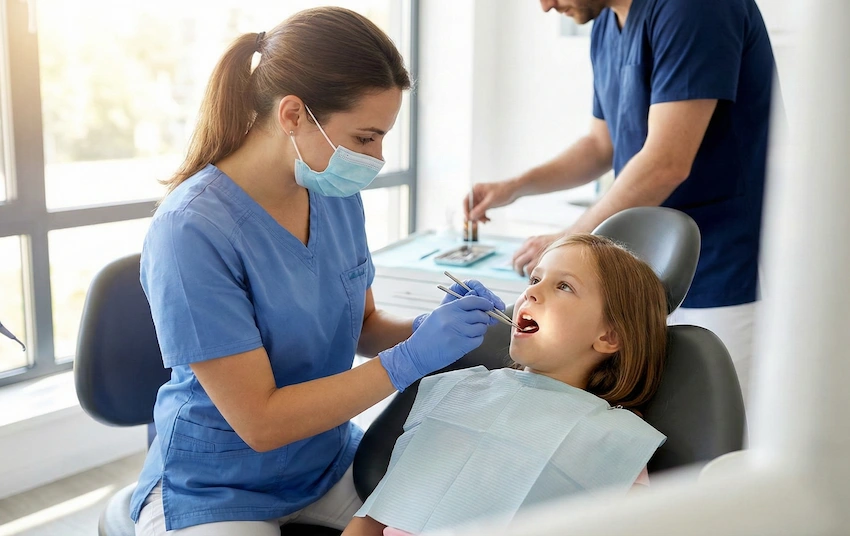
The standby for decades was to simply wait for the falling out of the “baby teeth” before starting treatment. It is only recently that dentists have become aware that the major problem of jaw/teeth misalignment (malocclusion) lies at the level of the facial skeleton and not merely the teeth as previously thought. Hence, Professor Doctor Coşkun Yıldız stresses, with his doctoral thesis, that if one needs to cure a skeletal deformity, in the case of a child with a growing skeleton one can repair it non-invasively to a great extent whereas a grown adult without being able to use the least invasive method first will ultimately be subjected to more invasive means.
“Phase 1” or interceptive orthodontics refers to the first part of orthodontic treatment, generally performed on patients between the ages of 6 and 10 to allow for the utilization of the maximum potential of natural growth correcting dental and skeletal discrepancies.
What Makes Us Decide to Recommend You an Early Intervention?
At the Lema Dental Clinic in Istanbul, when you entrust your child into the hands of Dentist Polen Akkılıç and her team, they do so much more than simply counting teeth. They are thoroughly checking the relationship between the maxilla (upper jaw) and mandible (lower jaw) which is of utmost importance because these two bones come together at the temporomandibular joint (TMJ) and the harmony of this joint is crucial for proper functioning.
On numerous occasions, these are some of the scenarios when we feel we should step in a little bit earlier:
- Crossbites: The upper teeth fit inside the lower teeth. This can be compared to a jar and a lid where the lid is too small; if crossbite is not treated, the lower jaw always shifts to one side and later on, asymmetry becomes inevitable.
- Severe Crowding: If the tooth “parking lot” is at its full capacity and the “cars” (teeth) cannot squeeze in, then the approach might be to find room for the cars by adding more parking space (time to scale up the jaw).
- Protruding Front Teeth: These upper front teeth look very much like an “invitation” for danger. They can be an easy target for injury in case of a fall or sports activities.
Is It Actually Possible to Prevent Braces?
This is a question of great interest. To state the clinical truth unreservedly, sometimes the need for braces can be avoided, while very often, the requirement for braces is oversimplified.
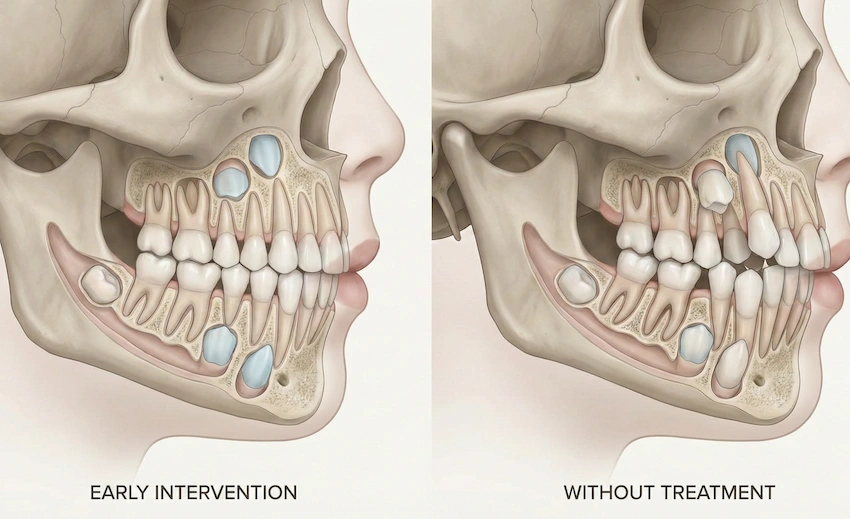
Imagine the possibility of using a simple device to open up a narrow upper jaw at the age of 8 years. Then the permanent canines coming at the age of 12 will have plenty of room to accommodate. That is what would be going on without Phase 1 intervention. Otherwise, these canines might just become impacted to a degree of requiring surgery and prolonged orthodontics to bring them down.
Hence, although we might not be able to prevent the need for braces altogether to just perfect the smile, initial braces examinations can avert entrance into:
- Any tooth extraction is needed to gain space.
- Major jaw surgeries in old age.
- Long, complicated orthodontic treatment plans.
Early Intervention vs. Traditional Braces: Which is Right?
In order to show you the contrast more vividly, here is a table comparing early intervention with a traditional one.
| Feature | Interceptive Orthodontics (Phase 1) | Traditional Late Treatment (Phase 2 Only) |
| Typical Age | 7–10 years old | 12–14+ years old |
| Primary Goal | Guide jaw growth and create space | Straighten permanent teeth |
| Complexity | Low to moderate (expanders, limited braces) | Moderate to high (full braces, possible extractions) |
| Impact on Growth | High uses natural growth spurts | Low, growth mostly complete |
| Airway Benefits | Can improve breathing and sleep | Limited airway impact |
| Surgery Risk | Significantly reduced | Higher risk in severe skeletal cases |
Why Turkey for Pediatric Orthodontics?
We are mainly used to the idea of traveling to Turkey for dental treatment equaling to getting a new smile, yet largely unrecognized is the fact that our pediatric and orthodontics departments also rival the best in the world. At Lema Dental Clinic, we nicely marry Turkish hospitality with high medical standards.
Polen Akkılıç, a dentist at the clinic, insists that the child’s first encounters with the dentist will profoundly affect how the child will approach taking care of his/her oral health throughout life. Thanks to the latest advancements in 3D scanning, children no longer have to undergo the unpleasant experience of traditional impressions that give them the gag reflex; therefore, we secure a quick and pleasant rapport of the dental arch without hassle.
Frequently Asked Questions
On the contrary, it is highly advisable to see an orthodontist by no later than age 7 according to the recommendation of the American Association of Orthodontists. Usually, by this age at least the first permanent molars and incisors have already come in and together determine a certain bite, which will allow us to identify whether there might be a crossbite, crowding, or other potentially serious skeletal problems and sort them out without them turning into permanent deformities.
The possibility exists and is very much real but then the follow-up treatment will be a lot less time-consuming and less demanding. By Phase 1, you can picture building a strong footing, while Phase 2 (braces) is merely applying the final touches and escaping the dust of a renovation. No proper footing, no stable house (smile)!
We carefully consider ensuring there is the least discomfort for our patients. Most early interventions, e.g., palate expanders rather than pulling force, push teeth gently thus only resulting in slight pain or discomfort. Children’s healing rate is incredible and their bones are less dense than adult bones; their teeth move with less resistance and less discomfort.
You could but that means you would be missing out on that great “growth window”. Right after the pubertal growth spurt comes to an end, the jaw sutures will have fused for good. A jaw expansion after that point frequently requires surgery. Doing it early will allow us to harness your child’s natural growth in order to sort out bite issues without surgical intervention.
Apart from the soft prices, you are tapping into the crème de la crème of expertise. Professor Doctor Coşkun Yıldız and our team are dealing with intricate cases daily. We consider the face as a whole, not just the teeth. A dental check-up trip to Istanbul can be turned into a family outing, and your kid will have a beautiful memory and a positive attitude toward dental visits.
- American Association of Orthodontists. (2023). The rationale for early orthodontic treatment: Clinical practice guidelines. AAO Clinical Standards.
- Bishara, S. E., & Burkey, P. S. (2021). Second molars: The forgotten teeth in early orthodontic diagnosis. American Journal of Orthodontics and Dentofacial Orthopedics, 159(3), 322-328.
- Keski-Nisula, K., et al. (2020). Occurrence of malocclusion and need for orthodontic treatment in early mixed dentition. European Journal of Orthodontics, 25(5), 453-459.
- McNamara, J. A. (2019). Early intervention in the transverse dimension: Micro-implants and rapid palatal expansion. Journal of Clinical Orthodontics, 53(4), 211-225.
- Proffit, W. R., Fields, H. W., & Sarver, D. M. (2018). Contemporary Orthodontics (6th ed.). Elsevier Health Sciences.

