


No, a properly bonded tooth gem will not be removed by an electric toothbrush.
You panic instantly. You are at the sink, looking at how your new tooth diamond reflects the light, then reaching for your electric toothbrush. You suddenly stop. Will the vibrations cause the jewel to fall off your enamel and drift down the drain?
This concern is very common. Patients of Lema Dental Clinic in Turkey, where aesthetic dentistry meets high-fashion personalization, often worry about the need to change their hygiene routine drastically after getting a “grill” or a single tooth gem.
Here is the truth: To a large extent, no. A properly fixed tooth diamond should not get dislodged by an electric toothbrush. However, there is a bit of a story here, and mastering the formula of how that gem gets bonded to your tooth is the secret of both sparkling and intact smiles.
Scientific Explanation of the Bond: Why It Works
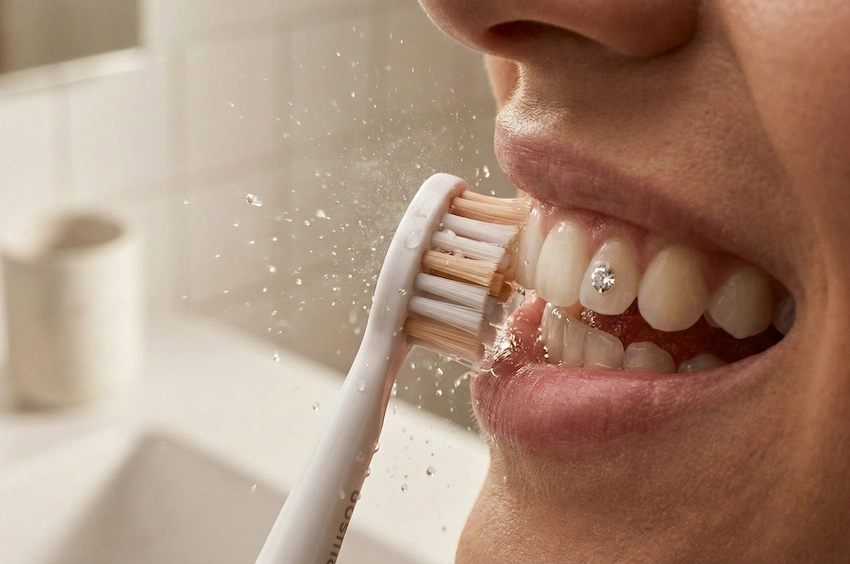
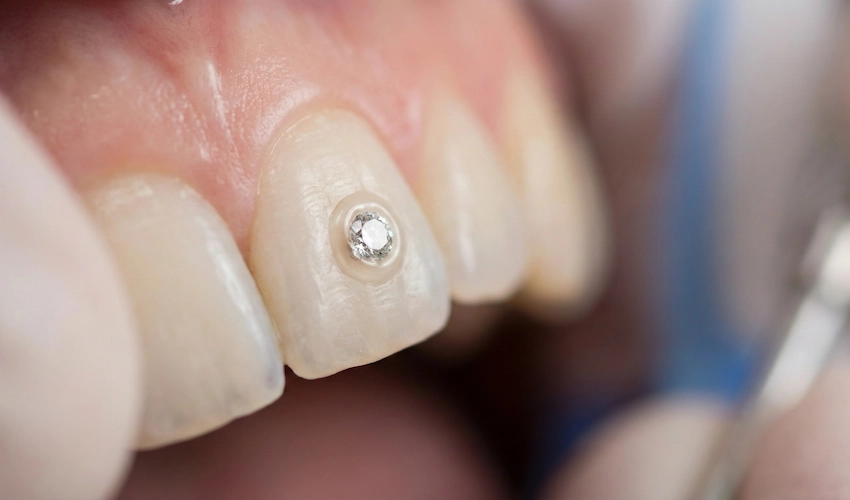
In order to appreciate why your toothbrush won’t be the reason for your lost gem, it is necessary to understand how we attach them. When Dentist Polen Akkılıç and her team place a tooth gem, they don’t just put the superglue on. They apply a flowable composite resin which is totally the same top-quality material used to attach orthodontic brackets (braces) to teeth.
Imagine your tooth enamel as a sleek glass panel. Trying to stick a sticker on it, you will see that it can be moved easily. In the dental office, however, we start by selectively etching the enamel surface with an acid. This causes the surface to appear “frosted,” and the adhesive can then hold firmly to that.
The Anchor Analogy: Think of rock climbing, if the wall is totally smooth, you wouldn’t have any handholds. The tiny etching creates “handholds” in the tooth surface. The bonding agent gets into the handholds and hardens. After a UV light cure, a bond is created that is not only strong but also resistant to the vibrations from a bristled brush.
Electric vs. Sonic: How Much Energy Do They Emit?
So, the question is, how much force can your toothbrush generate? Electric toothbrushes, both oscillating (rotating heads) and sonic (vibrating heads) types, apply a force. However, this force is intended to disrupt plaque biofilm rather than to remove a hardened composite resin.
At Lema Dental Clinic, as per our clinical experience, a tooth gem detaching during brushing can be attributed to two main causes and neither has anything to do with the toothbrush:
- Adhesive Failure – either the adhesive wasn’t cured properly or the tooth wasn’t kept dry during application.
- Physical Impact – biting an apple or getting a fork prong hitting the gem at an awkward angle.
If a toothbrush happens to remove a gem, most probably the gem was loose already and the brush just finished the job.
Comparing Hygiene Methods for Tooth Gem Wearers
We put together this table to help you decide the safest way to care for your smile.
| Hygiene Method | Safety for Tooth Gem | Cleaning Efficiency | Clinical Note |
| Manual Toothbrush | High | Moderate | Completely safe. However, plaque can easily accumulate around the base of the gem. |
| Oscillating Electric | High | High | Rotation is very effective. Be careful not to press the plastic head directly against the stone. |
| Sonic Toothbrush | Moderate to High | Very High | High-frequency vibrations are safe for the bond and generally comfortable, but noise may be unpleasant for sound-sensitive users or those with tooth sensitivity. |
| Water Flosser | High | Maximum | Highly recommended. Debris around the gem is removed without physical friction. |
When to Be Careful: The “Shear Force” Warning
It is often the case that the hard plastic of the electric toothbrush brush head, not the bristles, is mentioned by Professor Doctor Coşkun Yıldız as the biggest risk of electric toothbrushes.
If you are in a hurry and brush and at the same time the diamond is hit with a hard plastic brush head, then you create a “shear force”—a sudden, sharp impact from the side. The professional bond is very strong, but after a sudden lateral impact, the resin can get chipped, and in the rare case the gem can be popped off.
Why don’t you just treat the gem like a delicate antique and brush it? Allow the bristles to work; avoid scrubbing.
DIY Kits vs. Professional Application in Turkey
That is the big issue. If you got a tooth gem yourself by using an at-home kit from the internet, you cannot be sure of anything anymore.
A lot of times DIY kits come with pre-made glue that is highly sensitive to changes in moisture and temperature. Therefore, if the setting of your gem adhesion is not very strong, the vibratory movement of a sonic toothbrush could easily loosen your gem.
When we see you in Turkey, we use clinical etching gels and light-cured composites. The comparison is like a Post-it note and duct tape. So if someone has professionally fixed your gem, then your electric toothbrush is there for hygiene only, not demolition.
Frequently Asked Questions
Avoid the temptation to do so at all costs. Do not use the Superglue as it is very toxic, kills the nerve of your tooth, and will cause permanent damage to the enamel. So when your gem comes off, hold on to it and make an appointment. For rebonding, the enamel needs to be thoroughly cleaned.
If your diamond is real or you ahavea high-quality crystal (Swarovski, for example), then a toothbrush cannot cause any scratches at all. Tooth enamel and diamonds are two of the hardest materials in the human body and the natural world, respectively. Nylon bristles are very gentle and they cannot cause damage. If your stone is diminishing in luster, then the only logical explanation is that it is covered in plaque—just clean it more thoroughly!
Sure, it can. In fact, this is the precise reason why we really want you to use an electric toothbrush. The micro-vibrations are way more effective in removing the invisible gap between the tooth and the gem that even a manual brush can hardly reach.
You can proceed with that but I suggest you be really careful about the “spot” effect. A whitening toothpaste only works on the surface that it has covered. It cannot whiten the small circle of enamel under the diamond. When you take away the gem, there is a chance that you will have a small spot that is a bit discolored compared to the rest of your tooth.
We at Lema Dental Clinic have witnessed them from 6 months to 2 years and even longer. It really depends on your oral habits more than your brushing habits. The life expectancy gets reduced significantly if you grind or chew ice.
- Söderholm, K. J., & Mariotti, A. (1999). BIS-GMA-based resins in dentistry: Are they safe? Journal of the American Dental Association, 130(2), 201-209.
- Van Meerbeek, B., et al. (2011). State of the art of self-etch adhesives. Dental Materials, 27(1), 55-69.
- Kugel, G., & Ferrari, M. (2000). The science of bonding: From first to sixth generation. Journal of the American Dental Association, 131, 20S-25S.
- Cvikl, B., et al. (2016). Effects of different brushing times and forces on the cleaning efficiency of an electric toothbrush. Clinical Oral Investigations, 20(8), 2067-2073.
- Underwood, B. (2020). Aesthetic Dentistry: Materials and Techniques for the Modern Practitioner. Oxford University Press.

