


Comfort is a matter of fit and flexibility.
For a long time, the go-to solution for people with missing teeth was the conventional acrylic denture. It was the “old reliable” of dentistrystrong, functional, and predictable. However, for many patients at Lema Dental Clinic in Istanbul, “strong” usually means “stiff” and “heavy.” Thus, a growing number of patients are being attracted to flexible dentures, which are mostly made of a specially processed thermoplastic nylon.
The right choice of material alone will not suffice to answer. We also have to think about the material that will touch the living, moving tissues in our mouth. Professor Doctor Coşkun Yıldız often compares an acrylic denture to a well-made but stiff leather dress shoe, whereas a flexible denture is more like a perfectly fitted running shoe. Both of them have their benefits, but the sensation of using them is entirely different.
The Biomechanics of Comfort: Why Flexible Feels Different
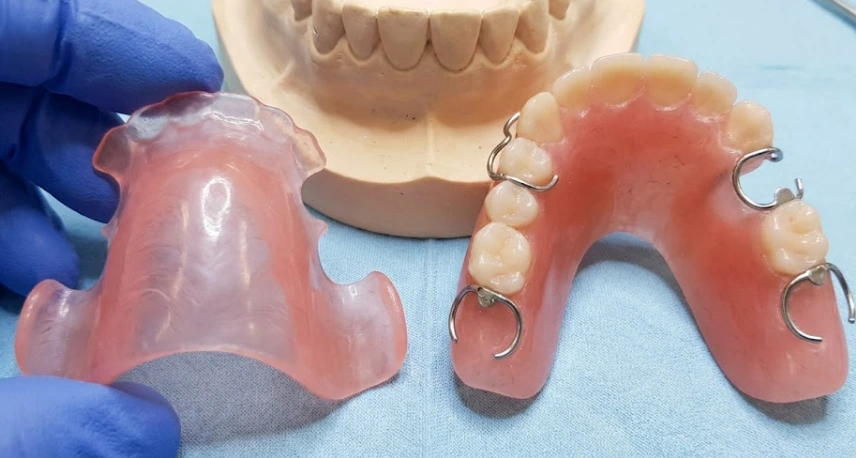
The reality is that our mouths are not static. Our gums and jawbones shift slightly as we chew and speak. Traditional acrylic is a rigid polymer; it doesn’t budge. This lack of “give” can lead to sore spots or the dreaded “rubbing” that makes many denture wearers miserable.
Flexible dentures, however, use a biocompatible nylon that adapts to the natural contours of your mouth.
- No Metal Clasps: Most acrylic partials commonly have visible metal hooks, but the flexible ones use extensions that are of the same color as the gums and blend perfectly.
- The “Snug” Factor: Due to the fact that the material is elastic, it softly holds the undercuts of the teeth and gums left, thus creating a suction-like fit without the presence of additional volume.
- Weightlessness: In our clinical experience at Lema Dental Clinic, patients often remark that flexible dentures feel significantly lighter, making them easier to wear for long durations.
But Let’s Look Closer: The Trade-offs of Softness
It sounds like a perfect solution, but there is a catch. Dentist Polen Akkılıç and her team always emphasize that “softer” doesn’t always mean “superior” for every patient.
Traditional acrylic dentures have one massive advantage: they are adjustable. When your bone structure is altered (which is a normal process), a dentist can “reline” an acrylic denture to make it fit again. Flexible dentures are, however, inherently hard and sometimes even impossible to reline or repair. If your mouth changes significantly, or if you break a tooth off the denture, you usually need an entirely new one.
What’s more, flexible dentures are almost exclusively used for partial replacements. For patients needing a full set of dentures, acrylic remains the gold standard in Turkey because it provides the structural rigidity needed to maintain the “bite height” of the face.
The Comparison: Flexible vs. Acrylic Dentures
| Feature | Flexible (Nylon) Dentures | Traditional Acrylic Dentures |
| Initial Comfort | High (Adapts to tissues) | Moderate (Requires “break-in” period) |
| Aesthetics | Superior (No metal clasps) | Good (But clasps may be visible) |
| Adjustability | Very Difficult | Easy to reline or repair |
| Durability | Shatter-resistant | Can crack if dropped |
| Best For | Partial tooth loss | Full tooth loss (Complete dentures) |
Expert Perspectives: 5 Common Questions Answered
The question remains one of stability,” says Professor Doctor Coşkun Yıldız. “While they are comfortable, they don’t always provide the same ‘grinding power’ as rigid acrylic. We usually suggest them for patients who prioritize comfort and aesthetics over heavy-duty chewing.
At Lema Dental Clinic, we use high-grade thermoplastics. With proper care, they can last 5 to 7 years. However, because they are porous, they require specialized cleaners to stay fresh. Regular toothpaste can actually scratch the surface and cause staining.
Absolutely,” notes Dentist Polen Akkılıç. “One of the primary reasons we recommend flexible dentures in Turkey is for patients with sensitivities to metal or the monomers found in traditional acrylic. They are hypoallergenic and very kind to the gum tissue.
The reality is that the laboratory process for flexible dentures is more complex, which often makes the initial cost slightly higher. However, for many of our patients, the lack of “sore spot” appointments and the natural look make it a worthy investment.
We strongly advise against it,” the team explains. “Your gums need to ‘breathe’ and recover from the pressure. Keeping any denture in 24/7—flexible or not—increases the risk of fungal infections and accelerated bone loss.
- Fueki, K., et al. (2014). Clinical applications of removable partial dentures using thermoplastic resin. Journal of Prosthodontic Research.
- Negrutiu, M., et al. (2005). Thermoplastic resins for flexible partial dentures. Timisoara Medical Journal.
- Phoenix, R. D., & Cagna, D. R. (2008). Stewart’s Clinical Removable Partial Prosthodontics. Quintessence Publishing.
- Kaplan, P. (2012). Flexible partial dentures: An alternative to traditional designs. Dental Clinics of North America.
- Zarb, G. A., & Hobkirk, J. (2012). Prosthodontic Treatment for Edentulous Patients. Elsevier.

