


Fixed stability vs. removable dentures.
The main difference between conventional removable dentures and the All-on-8 treatment is how the masticatory (chewing) forces are transmitted through the jaws. According to Professor Doctor Coşkun Yıldız, dentures are a tissue-borne prosthesis, whereas All-on-8 is an implant-borne, fixed restoration. For patients willing to have treatment in Turkey, it is crucial to comprehend the long-lasting biological effect of this difference that might impact the success of their rehabilitation.
Biomechanical Stability and Load Distribution
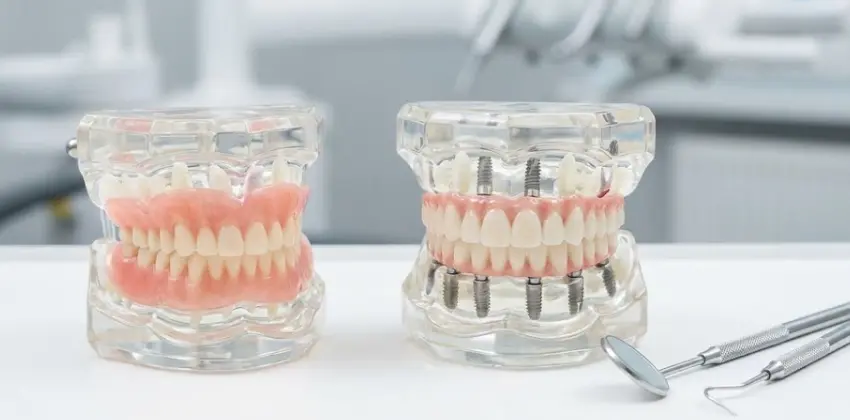
The “8” in the All-on-8 refers to the placement of eight dental implants that are evenly spread out over the dental arch.
- Load Distribution: Thanks to eight points of support, biting force is distributed over a large area of the alveolar bone evenly. This helps to avoid pressure spots that dentures cause and that often result in the formation of painful sores and mucosal irritation.
- Fixed vs. Removable: A permanent solution is offered with All-on-8, unlike suction or messy adhesives which are things that dentures depend on. Dentist Polen Akkılıç along with her team points out that this removes the social anxiety of prosthetics that aside from falling also make clicking noises when you talk.
- Masticatory Efficiency: By using only traditional dentures, the maximum restoring of the natural biting force is only up to 20-30%. On the other hand, All-on-8 restorations done in Turkey allow individuals to get back around 90-95% of their original chewing capacity thus they can enjoy a wide range of nutritious foods.
Prevention of Alveolar Bone Atrophy
The differences that are major but not very obvious, among others, are related to the effect on the health of the jawbone. Maintaining bone density needs the human body to receive stimulation from tooth roots.
- Dentures and Bone Loss: As dentures rest on top of the gums, they do not cause the bone underneath to be stimulated. Eventually, the bone-dissolving process (atrophy) occurs, which leads to the “sunken” look of the face that is the result of aging.
- Implant-Driven Preservation: The All-on-8 implants are essentially artificial roots and through the process of osseointegration, the bone is stimulated thus this way bone atrophy and preserving the natural facial contours. At Lema Dental Clinic, we highly value this “anti-aging” effect that we offer to all our patients having full-mouth restorations in Turkey.
Comparison Table: All-on-8 vs. Traditional Dentures
| Feature | All-on-8 Dental Implants | Traditional Dentures |
| Fixation | Permanently Fixed | Removable (Daily) |
| Stability | Exceptional (No Slipping) | Low (Requires Adhesives) |
| Bone Health | Prevents Bone Atrophy | Accelerates Bone Loss |
| Taste Sensation | Full (No Palate Covering) | Reduced (Palate Covered) |
| Maintenance | Brushing like natural teeth | Soaking and deep cleaning |
| Longevity | 20+ Years / Lifetime | 5 – 7 Years (Requires Relining) |
FAQ: Choosing the Right Solution in Turkey
Professor Doctor Coşkun Yıldız explains that All-on-8 provides superior stability in the upper jaw where the bone is naturally softer. However, the choice depends on your specific bone density measured via 3D tomography at Lema Dental Clinic.
Upper dentures cover the entire palate (roof of the mouth), which contains many taste receptors. All-on-8 uses a bridge design that leaves the palate open, restoring the full sensory experience of eating.
Yes. However, because dentures cause bone loss over time, patients who have worn them for years may require bone grafting or a sinus lift before the All-on-8 procedure can be performed in Turkey.
While All-on-8 involves surgery, it is performed under local anesthesia or sedation at Lema Dental Clinic. Most patients find the temporary discomfort of surgery well worth the decades of stability that follow, whereas dentures often cause chronic irritation.
Typically, the first stage (implant placement and temporary bridge) requires a 7-day stay. Dentist Polen Akkılıç and her team will then see you 3 to 6 months later for the final, permanent crown placement.
- Misch, C. E. (2007). Contemporary Implant Dentistry. Elsevier.
- Malo, P., et al. (2011). A Longitudinal Study of the All-on-4 Concept. Journal of Oral Implantology.
- Zarb, G. A., & Hobkirk, J. (2012). Prosthodontic Treatment for Edentulous Patients. Elsevier Health Sciences.

