


Pterygoid implants offer strong support without bone grafting.
The loss of teeth in the upper jaw region leads to a drastic decrease in the volume of the bone. For a long time, the only solution provided by medical professionals was a highly invasive bone grafting procedure. Patients coming to our clinic were often left feeling hopeless as they had been told that their jawbone was simply too thin for the insertion of implants.
However, the truth is… contempora ry dentistry has a significantly superior alternative.
At Lema Dental Clinic in Turkey, we have a lot of great stories to tell about our work with patients. One of them is the pterygoid implant. It is just like in the house-building analogy, where the house foundation is the jawbone. If the topsoil is eroded, one does not have to bring in new soil. Instead, one drives the support piles through the soft soil all the way down to the solid rock.
Below are the five definitive reasons why pterygoid dental implants are worth considering.
1. No Need for Sinus Lifts or Grafts
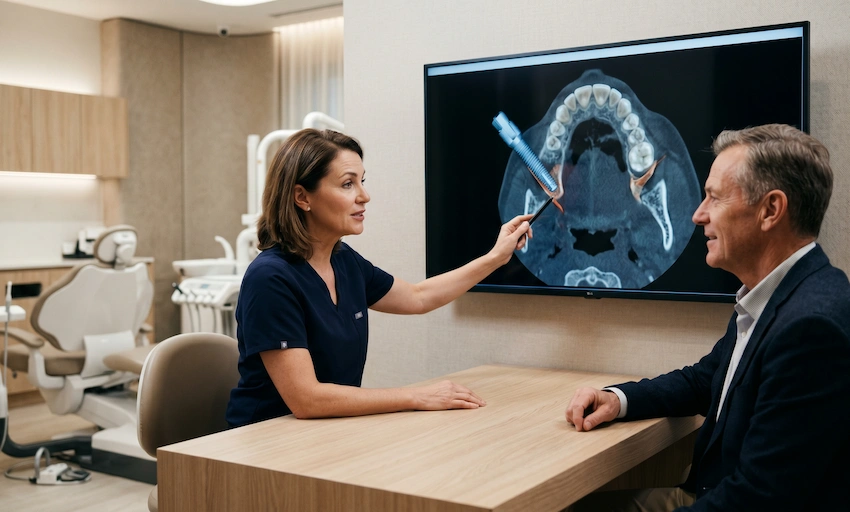
The exposure of the upper jaw to a standard implant is typically accompanied by a sinus lift. That is, the surgeon has to raise the sinus membrane, which is very thi,n similar to the skin of an eggshell, and then the bone graft material is packed under it.
However, the point is that pterygoid implants completely avoid going through the sinus. They are inserted at an angle pointing backward into the compact bone. This way, bone grafting is out of the question. Your surgery is greatly simplified, and the recovery time is greatly reduced.
2. Immediate Teeth and Quicker Results
Most people would not be happy to wait as long as a year before they can chew food properly. Traditional bone grafting requires a healing period of months. Moreover, the patients will have to use a temporary denture that is not comfortable.
Take a look at how it works from the inside. Pterygoid implants delve into the hard bone. They have excellent primary stability. Consequently, Dentist Polen Akkılıç, along with her dental team iableed to very often provide a fixed temporary tooth on the very same day as the implant installation. You come in without teeth, and you leave with a trusting smile.
3. Excellent Performance Even in the Worst Condition
Some implants may be unsuccessful in the soft and dwindling bone. When the jaw is extremely weak, placing an implant might be impossible. So, how are we going to make sure your implant will not get loose?
Professor Doctor Coşkun Yıldız is perpetually reminding us that pterygoid implants have a success rate that is over 95%. These implants are fixed in three different hard bone pillars located deep in the skull. This creates strong biomechanical fixation. The stability level of standard parallel implants does not even come close.
4. Dependence on Hard Cortical Bone
Bone is a tissue whose density varies between different parts. The bone at the front of the jaw resembles pine wood in terms of softness. The pterygoid area, on the other hand, is cortical bone, which is very hard and rigid, similar to oak wood.
Inserting a metal screw into the soft pine would do the damage easily. On the other hand, in the “oak” of the pterygoid region, the implant is set very firmly. Its immediate resistance to the chewing forces is quite sufficient in providing us with a sturdy and durable foundation.
5. The Recovery Experience is Much Painless

For the body to heal, each surgery is an opening ofthe wound to different degrees of the body. Conventional grafting is associated with several surgical sites, and it comes with higher risks of sinus infections and excessive swelling.
Placement in the pterygoid region completely takes the sinus floor out of the picture. What is more, the surgery is in many cases flapless. Therefore, the symptoms such as swelling and pain are minimal. Our patients who are coming from abroad to Turkey are always pleased with the comfort of their recovery and medical travel experience without unbearable pain.
Pterygoid Implants in Comparison to Traditional Procedures
| Feature | Pterygoid Implants | Traditional Bone Grafting |
| Treatment Time | 1 to 3 Days | 6 to 12 Months |
| Number of Surgeries | Single procedure | Multiple surgeries |
| Bone Graft Needed? | No | Yes |
| Sinus Risks | Very Low | High |
| Bone Used | Hard, dense bedrock | Soft or grafted bone |
FAQs
A pterygoid implant is an extra-long titanium implant with a special design. We do not insert it vertically into the soft jawbone but place it at an angle so that it reaches the hard bone behind your upper molars. Essentially, it works as a heavy-dutyload-bearingg beam.
We do everything we can to keep you comfortable. Either local anesthesia or sedation is used during the surgery. You will experience pressure but no sharp pain. Only a few people use painkillers at home to handle their minor soreness.
Absolutely. Implants of this type are the ones that are your very scenario the implant was designed to handle. So, if you were told by the other doctor that you don’t have enough bone for the conventional implant, here is your clinical solution. The bone is bypassed completely.
Here at Lema Dental Clinic, working with utmost precision is our habit and the aim of every session and appointment. Surgery is done in just a couple of hours. Normally, we fix your temporary prosthetic teeth in position straight away. You have approximately a week in Turke,y and you come back after a few months for the final set of teeth made of porcelain or zirconia.
Zygomatic implants are fixed in the cheekbones. They are the best choice for complete bone loss. But in many cases, pterygoid implants are less invasive in that they are going for the bone which is slightly lower. If we can rely on the pterygoid region, yowill u enjoy simpler surgery and quicker recovery.
- Balshi, T. J., Wolfinger, G. J., Slauch, R. W., & Balshi, S. F. (2013). A retrospective analysis of 356 pterygomaxillary implants in edentulous arches for fixed prosthesis anchorage. The International Journal of Oral & Maxillofacial Implants, 28(4), 1154–1159.
- Bidra, A. S., & Huynh-Ba, G. (2011). Implants in the pterygoid region: A systematic review of the literature. International Journal of Oral and Maxillofacial Surgery, 40(8), 773–781.
- Candel, E., Peñarrocha, D., & Peñarrocha, M. (2012). Rehabilitation of the atrophic posterior maxilla with pterygoid implants: A review. Journal of Oral Implantology, 38(S1), 461–466.
- Graves, S., Mahler, B. A., Javid, B., & Armellini, D. (2015). Maxillary rehabilitation using pterygoid implants. Oral and Maxillofacial Surgery Clinics of North America, 27(2), 297–307.
- Peñarrocha, M., Carrillo, C., Boronat, A., & Martí, E. (2010). Level of satisfaction in patients with maxillary full-arch fixed prostheses: Zygomatic versus conventional implants. The International Journal of Oral & Maxillofacial Implants, 25(3), 565–570.

