


Only if you want them to.
It is the most frequent question whispered to us almost every time behind the closed door in our consultation rooms. Patients fly to Turkey looking for a change, but at the same time, they are scared of the results. They desire a beautiful smile, but the thought of the “Hollywood Smile“—teeth so bright white, opaque, and perfectly symmetric, that they look like a set of dentures factory-made rather than a smile from nature—keeps tormenting them.
Here at Lema Dental Clinic, through our professional encounters, we have a clear understanding of such fears. Honestly, badly done work screams; well-done work whispers. We are therefore not simply planning to replace your teeth; instead, a smile will be given to you so personally it will look as if it has always been, even your closest friends will only see you as being “refreshed” and not “done.”
The “Uncanny Valley” of Dental Aesthetics
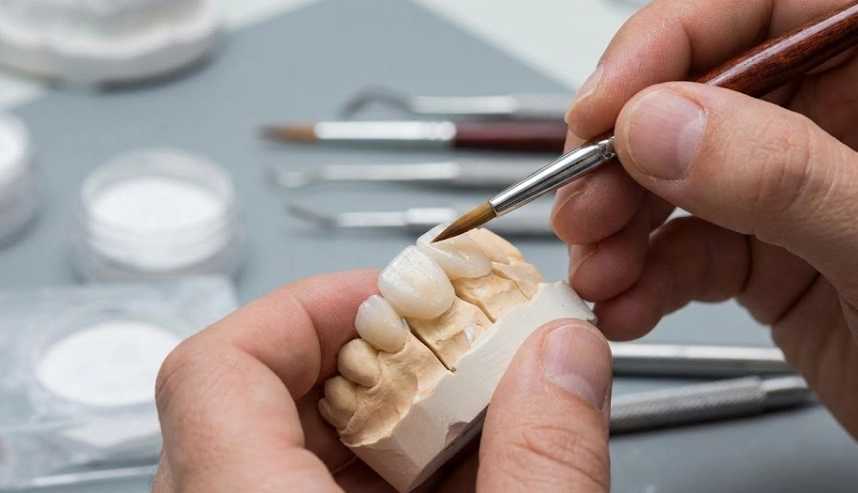
What causes some cosmetic dental work to look so extremely fake? It mostly signifies a failure to comprehend the manner in which natural teeth reflect light.
A natural tooth is more than just a block of a single color. Professor Doctor Coşkun Yıldız tends to explain natural enamel to patients as something akin to a precious pearl, not a bathroom wall tile. It consists of several layers. The outer enamel layer is comparable to frosted glass in that it is slightly translucent, especially at the biting edge. Beneath it is the dentin, which is responsible for the warmer, deeper color.
If natural teeth are exposed to light, the light will enter the tooth, be reflected internally and finally, the light will be reflected again. In addition to depth, this also gives a tooth a vibrant and lively appearance. On the other hand, cheap or ill-conceived veneers tend to be monolithic (comprising of a single layer only) and completely opaque. When light falls on their surface, it is immediately reflected, thus causing light to hit the surface and the light to be immediately reflected, giving a flat, lifeless, “plastic” look which everyone instantly recognizes as artificial.
How We Create “Undetectable” Teeth in Turkey
Achieving hyper-realistic results at Lema Dental Clinic is quite a disciplined art, led by Dentist Polen Akkılıç and her team of ceramic master artists. We don’t just take a white block and cut a tooth from it before sticking it in. We create it.
Here is what we observe in the clinic to explain the difference between “fake” and “flawless”:
- Translucency and Gradient: We imitate nature by making the biting edge of the veneer a little transparent and progressing to a warmer, deeper body color at the gumline. No natural tooth shows the same color at the top and the bottom.
- Surface Texture: Go ahead and run your tongue over your natural teeth. They aren’t perfect smooth glass; there must be tiny ridges and grooves representing the real texture that we use to scatter light. We incorporate this micro-texture on our ceramics by hand so that they glisten naturally instead of giving out the shine of plastic.
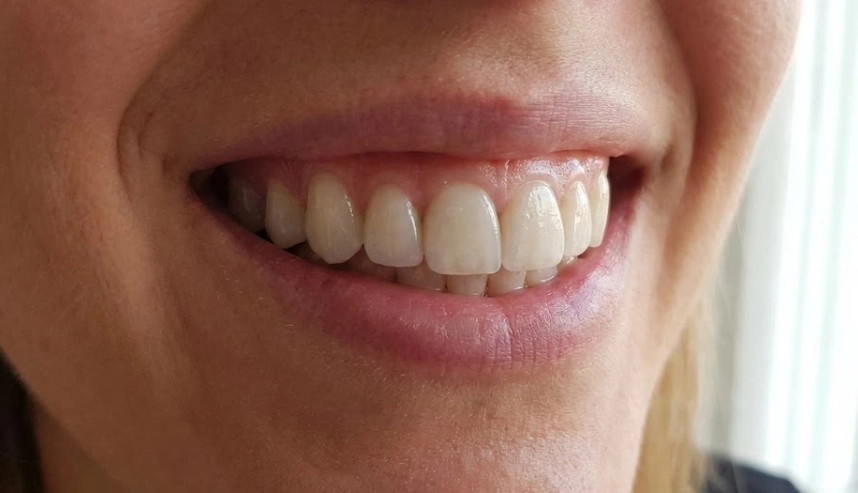
- Perfect Imperfection: Total symmetry hardly ever occurs in nature. We create smile designs that unite the shape of your lower lip and include microscopic deviations that suit your facial features. The “too perfect” smile is the fastest way to spot a prosthetic work.
Comparing Aesthetic Approaches: The “Chiclet” vs. The Natural
To give you an idea of the dissimilarity, here is a juxtaposition of the outdated method and our current techniques.
| Feature | The “Artificial” Look (Standard Approach) | The “Lema Natural” Look (Bespoke Approach) |
| Color | Monochromatic, flat, often excessively white (e.g., BL1 everywhere). | Polychromatic, with natural gradients from gum to tip. |
| Light Interaction | Opaque and highly reflective, like a glossy photo. | Translucent deep within, absorbing and scattering light like enamel. |
| Shape & Symmetry | perfectly square, uniform “piano keys.” | Organic shapes that fit the face; “symmetrical but distinct.” |
| Material | Often opaque zirconia or monochromatic feldspathic porcelain. | Layered E.max (lithium disilicate) or hand-layered zirconia. |
Critical Questions on Achieving a Natural Aesthetic
Yes, but it requires skill. You can have a bright “bleach” shade (like BL2 or BL1), but to keep it looking natural, we must add significant translucency and surface texture. Without these artistic elements, a bright white tooth will look like a piece of white plastic candy.
Generally, no. While we correct alignment issues, making every front tooth the exact same length creates a flat, aged appearance. A youthful, natural smile usually has central incisors that are slightly longer than the lateral incisors next to them. We follow the natural “smile arc.”
This was a common problem with old-fashioned porcelain-fused-to-metal crowns, where the metal underneath would show through as a dark line at the gum. At Lema Dental Clinic in Turkey, we use all-ceramic materials (like E.max and Zirconia) that are metal-free, ensuring your gums look pink and healthy right up to the tooth edge.
We don’t like surprises. Before we finalize anything, we use a process called a “mock-up” or “test drive.” We place temporary materials over your teeth shaped like the final design. You can look in the mirror, smile, talk, and see exactly how they will look in your face before we commit to the final ceramics.
Absolutely. Patients often report that within a few days, they forget which teeth are theirs and which are the veneers. The high-grade ceramic is polished to a smoothness that rivals natural enamel, and because they are bonded tightly to your tooth structure, they feel solid and integrated.
- Magne, P., & Belser, U. (2022). Bonded Porcelain Restorations in the Anterior Dentition: A Biomimetic Approach. Quintessence Publishing.
- Gürel, G. (2003). The Science and Art of Porcelain Laminate Veneers. Quintessence publishing.
- Joiner, A. (2004). Tooth colour: a review of the literature. Journal of Dentistry, 32, 3-12.
- Coachman, C., Van Dooren, E., Gürel, G., Landsberg, C. J., Calamita, M. A., & Bichacho, N. (2012). Smile design: From digital virtual plan to esthetic reality. Interdisciplinary Treatment Planning, Volume II: Comprehensive Case Studies, 319-342.
- Rufenacht, C. R. (2000). Principles of Esthetic Integration. Quintessence Publishing Company.

