


Modern ceramics prevent dark gums.
Initially, when a patient hears they need a dental crown, the room often fills with a very specific, somewhat silent fear. They imagine an elderly family member or a workmate who has a very distinct, unattractive black ring surrounding their artificial tooth. It resembles a permanent shadow, which immediately reveals that the tooth is not real.
However, the truth is, this aesthetic problem is a leftover of older dental technologies. There is no need for you to consider a dark gum line as the unavoidable consequence of saving a tooth.
The question still stands: what exactly is causing that dark line to come from, and how do the new clinical methods totally get rid of the risk of this happening?
The Anatomy of the Dark Shadow
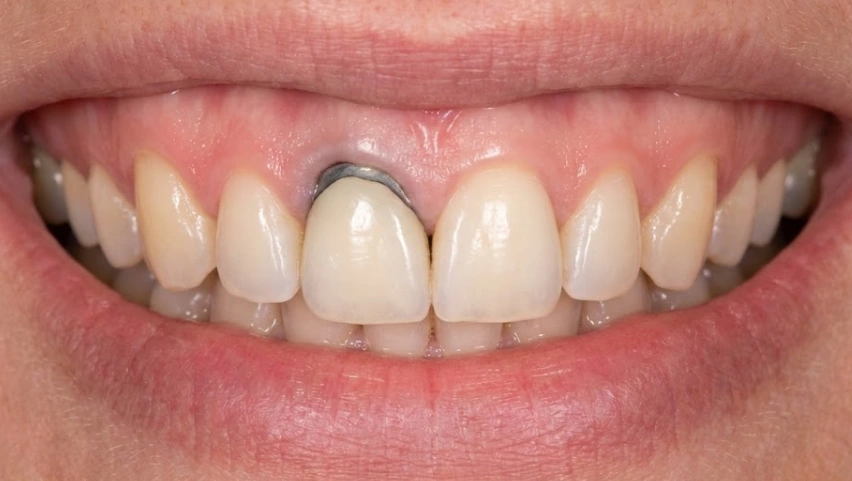
Understanding the issue requires you to picture a very old window frame where the outer layer of white paint has slowly peeled off, showing the dark, oxidized metal underneath. A PFM crown—Porcelain Fused to Metal—was the gold standard in dentistry for many years. These crowns had a robust metal alloy core covered with a layer of tooth-colored porcelain.
Professor Doctor Coşkun Yıldız regularly points out that although PFM crowns were functionally very durable, they had a major aesthetic drawback. The metal edge of the crown was frequently hidden just below the gum line. Over time, as natural aging or harsh brushing slightly revealed the gums, that dark metal margin was exposed to the spotlight.
Sometimes, exposure is not the only problem. Some metal alloys may literally oxidize, and the microscopic particles leach out of the metal into the nearby pink tissue, resulting in a permanent “amalgam tattoo” that stains the gums internally.
The Modern Ceramic Shift in Turkey
This is what we observe at the clinic. Patients come in extremely upset because of these old, deteriorating pieces and are very much looking forward to a fully natural smile. If you are planning to travel to Turkey for advanced dental care, you will be welcomed into a clinic where the metal-based crowns have been almost entirely phased out.
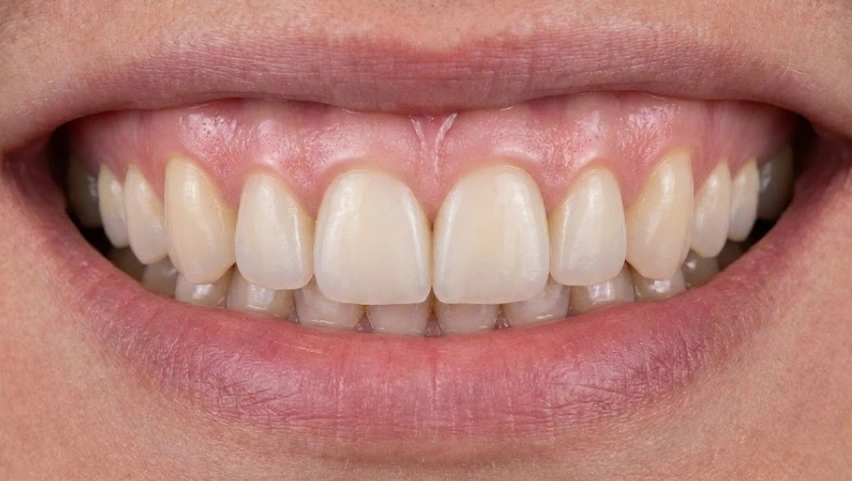
At Lema Dental Clinic, our clinical experience tells us that the most effective method of preventing a black gum line is simply to remove the metal from the picture completely. Dentist Polen Akkılıç and her team work with top-level, biocompatible materials like pure Zirconia and lithium disilicate (E.max). The reason being that these are strictly ceramic materials and white or translucent throughout; therefore, even if the shape of your gums were to change many years from now, there would still be no dark core to expose.
However, let us focus more closely on the tissue. The material only solves half of the problem. In case of the biological width is getting violated by an incorrectly placed crown—this being the natural moat of space that the gums require for attachment to a tooth—the tissue will be in a state of chronic inflammation. It will get darker, turning a very deep red or purple and will eventually detach from the tooth. You will find that the highest level of precision in milling and the most skillful placement are just as important as the material that you opt for.
Comparing Crown Materials and Gum Line Risks
A king- the crown has different effects on your biology. Here is a summary of the clinical aspects of your choices:
| Crown Material | Internal Core | Risk of Dark Gum Line | Tissue Biocompatibility |
| PFM (Porcelain Fused to Metal) | Dark metal alloy | High (especially with age/recession) | Moderate (Risk of oxidation/allergies) |
| Full Zirconia | White/Tooth-colored | Zero | Exceptional (Highly tissue-friendly) |
| E.max (Lithium Disilicate) | Translucent glass-ceramic | Zero | Exceptional (Best for front teeth) |
| Gold Alloy | Gold | Low (No black oxidation, but gold is visible) | Excellent (Rarely causes inflammation) |
Essential Queries on Dental Crowns and Gum Line Aesthetics
Gum recession is the most common culprit. As we age, or if we brush with too much force, the delicate gingival tissue can pull back. If you have an older PFM crown, this recession exposes the hidden metal collar at the base of the restoration.
Unfortunately, no. If the dark line is caused by exposed metal, the only way to correct the aesthetic is to remove the old PFM crown entirely and replace it with a modern, all-ceramic alternative like Zirconia or E.max.
Zirconia cannot cause a metallic gray or black line because it contains no dark metals. However, if any crown is poorly fitted or trap bacteria, the resulting gum disease can cause the tissue to look dark red, inflamed, or unhealthy. Proper fit and daily hygiene remain essential.
Dentist Polen Akkılıç and her team use highly precise 3D digital scanners to ensure the margins of your new crown fit flawlessly against your natural tooth structure. We also design the crown to respect your biological width, preventing chronic inflammation and ensuring the pink tissue drapes beautifully around the white ceramic.
Yes. Turkey has become a global hub for world-class dental tourism. At Lema Dental Clinic, we utilize the exact same elite materials (like Ivoclar E.max and premium Zirconia) found in top-tier clinics in London or New York, but combined with our specialized expertise in high-volume, full-mouth aesthetic rehabilitations.
- Donovan, T. E., & Cho, G. C. (2003). Diagnostic parameters for predictable esthetic and functional restorative dentistry. The Journal of Prosthetic Dentistry, 89(3), 223-231.
- Gargari, M., Ceruso, F. M., Pujia, A., & Prete, V. (2010). Zirconia: the aesthetic evolution in dentistry. Oral & Implantology, 3(3), 16-21.
- Goodson, J. M. (2003). Gingival crevice fluid flow. Periodontology 2000, 31(1), 43-54.
- Kois, J. C. (1996). The restorative-periodontal interface: biological parameters. Periodontology 2000, 11(1), 29-38.
- Larsson, C., & Wennerberg, A. (2014). The clinical success of zirconia-based crowns: a systematic review. International Journal of Prosthodontics, 27(1), 33-43.

