


Yes, restoring your smile and facial support makes you look years younger.
We spend a lot of money on skin creams. Purchasing serums and even going for fillers is not uncommon for most of us. Trying to look young is probably the hobby most of us engage in. However, on some level, we completely forget that one of the leading causes of the aging of the face is our bite.
While working, here’s what we see. At Lema Dental Clinic in Turkey, patients are seated in our consultation chairs. They pull at their cheeks. They point to the topic of their discussion as deep wrinkles around their mouths. Their first thought is facelifts. However, until they speak, the real problem is their dental condition, although to them, it seems like the shape of their face has changed without them even realizing it.
Therefore, the real question is: can correcting your teeth make you look younger? The response involves us looking at the face beyond the teeth and grasping the facial anatomy.
Your Face as a Building
Normally, in writing, bones and teeth are metaphorically used to mean the main structural support of a body, like the frame of a house. Likewise, skin, lips, and cheeks are likened to the roof, which is sheltering and protecting the frame. A young and firm body suggests that the frame is solid and the roof is very tightly and evenly placed on the frame.
Like other parts of the body, teeth get worn out by the chewing and grinding process. Hence, they become shorter. Plus, the bone underneath the tooth also gets reduced if the tooth is lost. Just like a muscle that is not exercised, bones will also become weak. When the main supporting bones reduce in size, the ‘roof’ breaks down. This is how thin lips, deep smile lines, and a sunken, hollow look around the mouth come about.
Prof. Dr. Coşkun Yıldız stresses the fact that “When we treat patients, we find out that the dental part is only a very small piece of the puzzle. We have to reconstruct the face’s frame. After we have restored a patient’s bite to the original height, the skin is supported in a way that it has been deprived of for a very long time,” he explains.
Color, Shape, and the Illusion of Youth
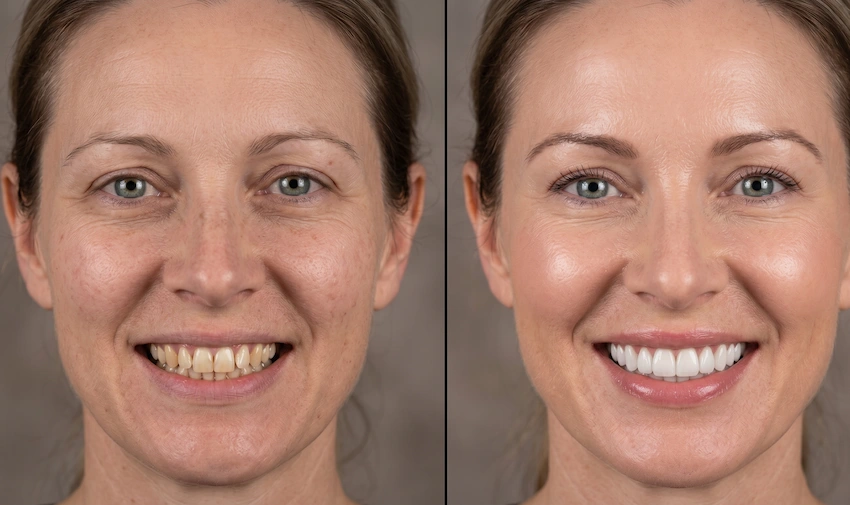
The first sign of the young that is most visible at a glance is the tooth’s surface indentations. They are characterized by rounded and soft edges. As a matter of fact, they go even further and allow light to pass through them.
You may compare tooth enamel with a thick frosted glass window, which is bright and white in youth. With aging, the glass becomes thin,r allowing the yellow layer of the tooth to be seen. Teeth become stained by coffee, tea, and other colored drinks. Tooth edges get broken and become completely flat. Flat, dark edges are what our eyes recognize as a sign of ‘old’.
Lema Dental Clinic views the smile as a work of art, and therefore, they treat it with the level of care that one would give to a masterpiece. They employ a very thin layer of porcelain veneers to restore the youthful ‘frosted glass’ appearance. They also serve to attenuate the sharp angles. By tracing the shape of the lip, they instantly have the effect of softening the wholeface.
Anti-Aging Dental Treatments: Your Options
How can these aging signs be fixed? It is a matter of determining your specific needs. The following is a brief overview of how our procedures in Turkey can assist you in turning back the aging clock.
| Treatment Option | Primary Anti-Aging Benefit | Visual Impact on Face | Average Timeline in Turkey |
| Porcelain Veneers | Restores lost enamel thickness and brightens color. | Plumps the upper lip and softens facial expressions. | 5–7 Days |
| Full Arch Implants | Stops bone loss; replaces missing facial “support beams.” | Fills out sunken cheeks and lifts sagging jowls. | 2 Trips (3-6 months apart) |
| Zirconia Crowns | Rebuilds severely ground-down teeth and bite height. | Smooths out deep wrinkles near the mouth corners. | 5–7 Days |
| Gum Contouring | Fixes receding gums that show dark tooth roots. | Cures the “long in the tooth” aged look. | 1–3 Days |
The Reality of Expert Care in Turkey

Indeed, a lot of people are hesitant about dental tourism. They imagine themselves getting fake, blocky, super white teeth. To a certain extent, this will happen in cheap budget clinics, but expert dentistry is not about this appearance.
Going to Turkey for treatment at Lema Dental Clinic means precision at a world-class level. Your face is digitally mapped using 3D scanners before we even consider touching a tooth. We watch how your lips move when you laugh. Proper anti-aging dentistry does not look like obvious dental work. It just looks like the real you, fifteen years ago.
Frequently Asked Questions
Absolutely not. Our goal is to copy nature. If a tooth looks thick or bulky, it means the design was bad. We use layered materials that reflect light exactly like real young teeth. Your new smile will fit your face perfectly.
It depends on how much tooth height you have lost over the years. For patients with severely worn teeth, restoring that lost height smooths wrinkles and lifts the lower face. Patients often tell us they look ten to fifteen years younger.
We are actually giving your lips internal support. When we design your new smile, we angle the veneers to gently push the lip outward. This gives you a natural plumping effect that lip fillers cannot achieve on their own.
Modern dentistry is very gentle. We use local numbing so you feel no pain during the work. You might feel a little sensitive for a few days after, but it is very mild and goes away fast.
If you really brush thoroughly and regularly go for dental check-ups, the high-quality veneer and crown restorations can be expected to last for 15-20 years. Besides implants, which are attached straight to your jawbone, they are made to be in the mouth for a lifetime.
- Fradeani, M. (2004). Esthetic Rehabilitation in Fixed Prosthodontics: Esthetic Analysis: A Systematic Approach to Prosthetic Treatment (Vol. 1). Quintessence Publishing.
- Magne, P., & Belser, U. (2002). Biomimetic Restorative Dentistry. Quintessence Publishing.
- Morley, J., & Eubank, J. (2001). Macroesthetic elements of smile design. The Journal of the American Dental Association, 132(1), 39-45.
- Sarver, D. M. (2001). The importance of incisor positioning in the esthetic smile: the smile arc. American Journal of Orthodontics and Dentofacial Orthopedics, 120(2), 98-111.
- Tjan, A. H., Miller, G. D., & The, J. G. (1984). Some aesthetic factors in a smile. The Journal of Prosthetic Dentistry, 51(1), 24-28.

