


Unregulated, highly acidic at-home whitening strips dissolve your protective tooth enamel.
Everybody dreams of a dazzling, white smile. A radiant smile is a sign of good health, youth, and self-assurance. Quite a few people just pick up cheap whitening strips from the nearest drugstore. These whitening kits promise you the results of a professional treatment in just a couple of weeks. It seems like a no-brainer, doesn’t it? You just get the strip, stick it on, and wait.
Unfortunately, the reality is quite the opposite. The bright advertising is hiding a silent crisis. This is a crisis that we encounter and treat in our clinic almost every single day.
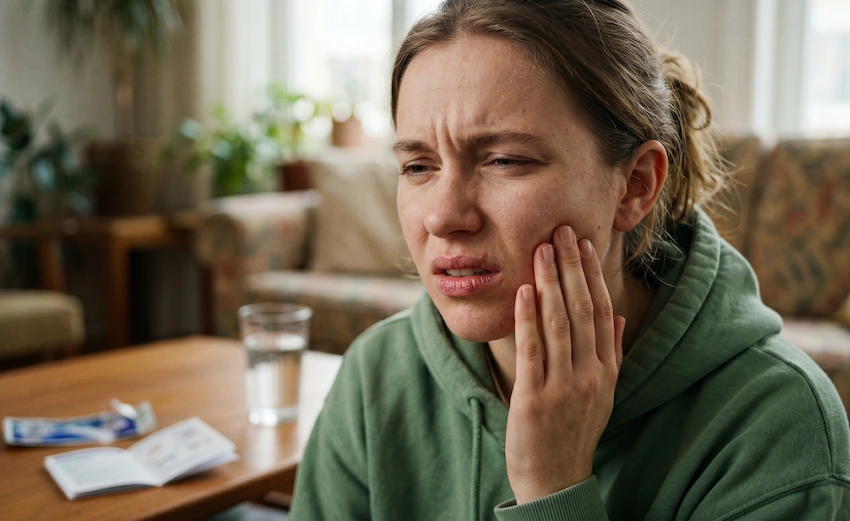
Some of them come to the clinic in tears; they are in pain. They are cringing as they tell us about the incredibly severe tooth sensitivity they are experiencing. Their front teeth look so thin that you can almost see right through the edges. Their gums are sore and swollen. All of these are the side effects of having a DIY dental makeover.
Our practice, Lema Dental Clinic, located in Turkey, is capable of treating the entire tooth. We not only focus on getting you a whiter shade on the color chart. Let’s find out what really goes on in your mouth when you’re using whitening strips by yourself. Ultimately, your enamel will bear the brunt.
How It Hurts: Exploring the Porcelain Glaze Analogy
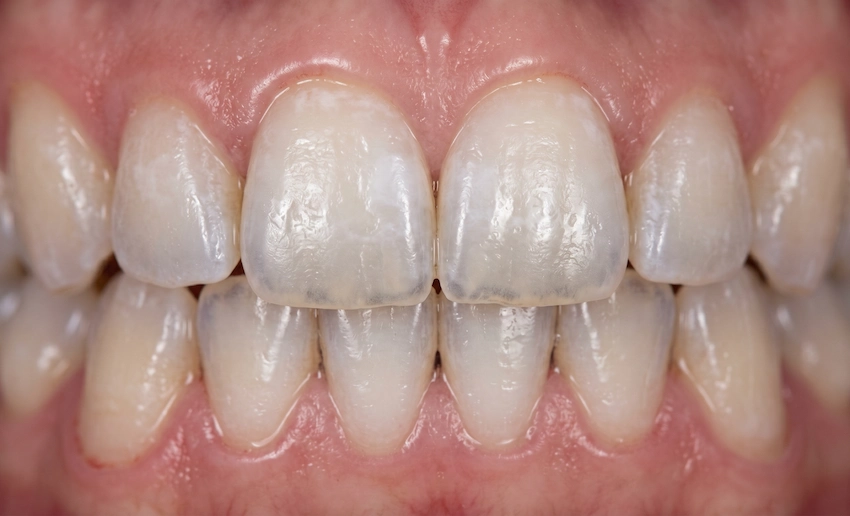
First of all, to figure out how it harms you, it is crucial to understand what your teeth are made of. If you can probably picture the enamel of the tooth as the clear, protective glaze on a piece of fine porcelain pottery. And, enamel is the most durable substance found in the human body. The job of enamel is to protect the soft and sensitive layer underneath, known as dentin.
Bright and healthy enamel works great with light; it reflects it like a mirror. It also serves as a barrier to the inner tooth, which can be affected by the temperature of hot or cold substances and harmful bacteria. However, to understand better, let us analyze what particularly happens after having a regular whitening strip.
The majority of the whitening strips that you can get from the pharmacy contain hydrogen peroxide or carbamide peroxide. These are strong bleaching agents. At the dentist’s office, the exact mode of interaction of these chemicals with your teeth is very closely monitored. However, when the box contains just a random strip, the concentration of the chemical is just pure luck.
The use of these highly acidic bleaching gels, which are not controlled, results in the staining of the surface being lifted. Besides this, it also causes the enamel layer to be actively decalcified. The acid etches the tooth surface at a microscopic level, making the smooth porcelain glaze a porous and vulnerable sponge.
Our Usual Observations That Are Spot On
This is what happens. Professor Doctor Coşkun Yıldız, from time to time, points out that the chemical injury is going beyond only the teeth.
“The use of a one-size-fits-all strip inevitably leads to the overlapping of the bleaching agent on the delicate gingival tissue,” he says. “We see cases of chemical burns on the gums regularly. Such tissue damage can eventually result in gum recession. Once the gums retract, the root of the tooth is fully exposed. It is important to note here that the root is devoid of any protective enamel layer.”
The “One-Size-Fits-All” Fact or Fiction
Smiles are as unique as the people themselves; nobody has two structurally identical smiles. Your dental arch is uniquely yours. The form of your teeth is unique. Just as your fingerprints, the shape of your gum line is also very distinctive.
Dentist Polen Akkılıç, together with her team, extended this information to patients many times. The truth is that the flat, rectangular whitening strips are practically a defect from the very start. A flat plastic strip is pressed against a curved jawline; this is going to fold. It will crease. It will leave huge gaps.
This is where three separate hazards are born:
- Uneven Whitening: The active chemical ingredient pools in the creases. This causes bright white spots on the enamel. Meanwhile, it misses the spaces between the teeth entirely.
- Saliva Washout: Your mouth lacks a custom-fitted barrier during DIY whitening. Your saliva instantly begins diluting the peroxide. Manufacturers know this. They often make the gel highly acidic to compensate. This high acidity rapidly accelerates enamel erosion.
- Micro-fracture Infiltration: Most adults have microscopic cracks in their enamel. Unmonitored liquid peroxide seeps directly through these cracks. It travels into the nerve center of the tooth. This causes agonizing, shooting pain.
Different Whitening Methods: At-Home Strips vs. Lema Dental Clinic
When you come for a cosmetic dentistry procedure at our clinic in Turkey, we take accurate measurements. We take care of your soft tissue. We are with you during the whole procedure. The difference between the methods of DIY and clinical care is gigantic.
| Characteristic | Non-prescription Strips | Professional Whitening at Lema Dental Clinic |
| Chemical Concentration | Globally reduced strength but significantly more acidic to fight against saliva dilution. | High-grade, perfectly pH-balanced gel activated by specific light. |
| Enamel Protection | No protection. Surface demineralization is a very common phenomenon. | Fluoride and calcium remineralizing agents are applied immediately following the treatment. |
| Gum Protection | Unregulated chemical spillage causes gingival tissue burns. | We use a liquid barrier that completely isolates and protects the gums. |
| Physical Customization | Flat, generic plastic strips that constantly crease and fold. | Precisely designed and fitted to your unique dental anatomy. |
| Sensitivity Risk | Extremely high. Continuous acid exposure causes the enamel pores to open wide. | Almost no. Closely supervised by dental professionals step by step. |
Frequently Asked Questions
Whenever you are in my clinic,c and I have had a chance to really study your teeth, I will keep reminding you that that is the dose as well as the frequency which determines the poison. Just having a mild strip once may not lead to immediate tooth destruction. However, using it continuously without a dental exam is just a great risk. You may unknowingly apply a strong acid to a cavity that you do not know about. That is very dangerous for the root of the tooth.
The first indicators are normally the sensory ones. A sip of water at a cold temperature stings you sharply, doesn’t it? The cold winter air hurts your teeth, right? So this means that you have exposed your dentin. You could see that the edges of the front teeth,h when looked at from below,w start to look gray or translucent. They may even look like frosted glass.
Briefly, no. Enamel is without any living cells. That means that despite its great toughness,s it cannot grow back the way skin can. What is done in reality is that the damage is arrested and the affected enamel is strengthened by applying fluoride varnishes. Further erosion can be masked by custom-made porcelain veneers.
Providing you with physical ease is always our main focus. We take measures to protect your gums. We apply special desensitizing agents before and after the dental procedure. Many of our clients, in fact, report having zero to very mild, temporary sensitivity. This is a totally different experience from the raw, aching pain that is associated with chemical strip burns.
Turkey has become one of the major dental tourism destinations in the world. This is the new home of a modern luxury dental care system that is still quite affordable. Here at Lema Dental Clinic, world-class care is provided as standard. It is delivered by highly qualified and expert personnel. While experiencing the incredible warmth of Istanbul, you get to use the same modern European and American equipment that you can find in top world clinics.
- Azrak, B., Callaway, A., & Willershausen, B. (2010). Erosive potential of tooth whitening products. Journal of Clinical Dentistry, 21(3), 64-68.
- Carey, C. M. (2014). Tooth whitening: what we now know. Journal of Evidence-Based Dental Practice, 14, 70-76.
- Goldberg, M., Grootveld, M., & Lynch, E. (2010). Undesirable and adverse effects of tooth-whitening products: a review. Clinical Oral Investigations, 14(1), 1-10.
- Majeed, A., Grobler, S. R., & Moola, M. H. (2015). Hydrogen peroxide degradation of dental enamel and its prevention. Journal of Dentistry, 43(12), 1433-1439.
Sulieman, M., Addy, M., Macdonald, E., & Rees, J. S. (2004). The bleaching of root-filled teeth: A review of the literature. Journal of Dentistry, 32(8), 569-577.

