


Because medical alloys make gold veneers strong, safe, and durable.
Why Gold Veneers Need Medical Alloys?
When patients first step in at Lema Dental Clinic in Istanbul, they usually have a picture in their head of a brilliantly shining, golden smile that is both classy and eternal. For a long time, gold remained the “gold standard” in the world of restorative dentistry but the general public tends to think that those veneers or crowns are made from 24-karat pure gold.
It’s not like that at all. Gold in its purest form is really soft- almost like lead or aluminum foil that is really thin. If we got a pure gold veneer and put it on your molar, the pressure that comes with chewing over and over would change its shape in a matter of weeks. If we want a restoration to be there for you for the rest of your life, we should adopt metallurgy.
The Structural Backbone: Why Pure Gold Isn’t Enough
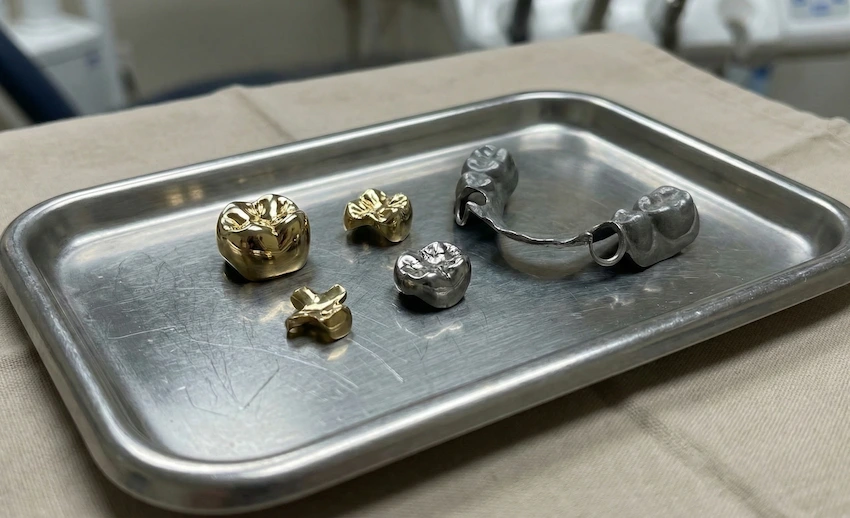
Our priority in Lema Dental Clinic is to work on your dental bite from a structural standpoint. A dental veneer can be compared to a sports car of a high caliber. Gold is the beautiful shiny exterior paint, but the medical alloys are the reinforced steel chassis that keeps the car from buckling under pressure.
The jaw can generate up to 200 pounds of force in the molar area, as per Professor Doctor Coşkun Yıldız‘s statement. This totally explains why pure gold is absolutely not capable of withstanding the daily grinding. We can harden the material so that the gold/silver/platinum that is combined with the noble and base metal alloys keeps the properties of the original metal.
The Benefits of the “Medical Blend”
- Wear Resistance: Alloys prevent the gold from thinning out over the years of brushing and eating.
- Thermal Stability: Pure metals expand and contract significantly with heat. Alloys ensure your veneer stays put whether you’re drinking hot Turkish coffee or eating ice cream.
- Marginal Integrity: A blend of metals allows Dentist Polen Akkılıç and her team to achieve a “seal” so precise it’s measured in microns, preventing bacteria from seeping under the restoration.
The Biological Connection: Biocompatibility and the Gingiva
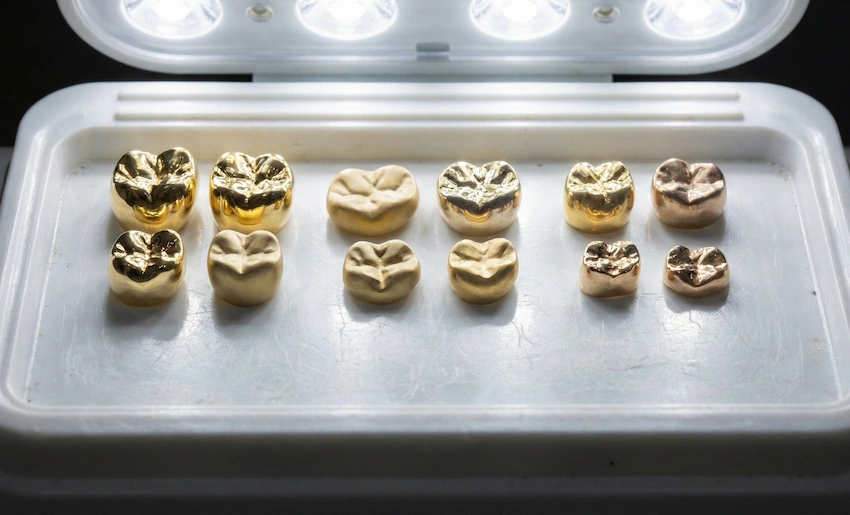
Some people associate allergies with metals, so they may wonder if adding other metals increases the risk of reacting to metals. The important thing here is medical-grade metals as specified in AM Alloys. Lema Dental Clinic has been using bio-inert, high-noble alloys for years.
Let us say that this was a dental veneer and the gum tissue was a hand in a glove, etc. If the fingers of the hand touch a rough, cheap material, the skin gets irritated. Medical-grade metal alloys at a molecular level are “smooth”. They neither corrode nor release metallic ions leading to the formation of the dreaded “dark line” at the gumly. On the contrary, they support the gingiva to be naturally seated against the restoration, therefore, maintaining a healthy, pink color.
Comparing Dental Restorations: At a Glance
The question remains: how does a gold alloy veneer stack up against other modern options? Here is what we see in the clinic when comparing materials:
| Feature | High-Noble Gold Alloy | Porcelain-Fused-to-Metal (PFM) | Full Zirconia |
| Durability | Exceptional (30+ years) | High | Very High |
| Enamel Wear | Very Low (Kind to opposing teeth) | Moderate | Moderate to High |
| Aesthetics | Unique/Luxurious | Natural | Highly Realistic |
| Precision Fit | Highest | Good | High (Digital) |
| Risk of Chipping | Zero | Moderate | Low |
Precision Craftsmanship in Turkey
One great thing about getting dental work done in Turkey is that it´s not only cheaper but you also get access to really top-tier laboratory technicians. Dentist Polen Akkılıç and her team cooperate very closely with master ceramists and metallurgists to even adjust the “recipe” of your gold alloy perfectly to your bite.
It is our firm belief that the process of creation is, in essence, a form of architectural engineering. If the foundation of a house is not laid properly, the house simply cannot stand. By using medical alloys, we guarantee that the “foundation” of your gold veneer is just as durable as Turkish limestone, which is the material used for our historic landmarks.
Frequently Asked Questions
No. We only use high-noble alloys, which means these alloys have a very high percentage of gold, platinum, and palladium. These metals are very stable. They do not oxidize or “leak,” so you will not experience a metallic tang or have your sense of taste affected.
It is ultra-rare that some people may be sensitive to base metals like nickel. At Lema Dental Clinic, we perform a detailed medical history investigation, and we have a nickel-free, high-noble alloy option to provide complete biocompatibility for each patient.
Range of high-noble gold alloys to eye the same rich warm golden color. The mixing process changes the physical (hardness, melting point) properties instead of the aesthetic luster that we love in our patients.
Gold is “iselastic”, which means that its wear patterns are very similar to natural tooth enamel. If you are a bruxer (teeth grinder), gold can be a safer option than ceramic as it will not wear down the natural teeth from the opposite jaw.
In most cases, the treatment mainly consists of two visits within 5 to 7 days. Our laboratory will have enough time to accurately cast the alloy and polish the restoration to a mirror finish before Professor Doctor Coşkun Yıldız or Dentist Polen Akkılıç does the fitting.
- Anusavice, K. J., Shen, C., & Rawls, H. R. (2012). Phillips’ Science of Dental Materials. Elsevier Health Sciences.
- Donovan, T. E., & Cho, G. C. (2001). Contemporary evaluation of dental casting alloys. Journal of the California Dental Association, 29(11), 765–771.
- Kelly, J. R., & Nishimura, I. (2008). Science-based guidelines for maximizing outcomes through regenerative medicine and cost-effective dental therapies. Journal of Prosthodontics.
- Powers, J. M., & Wataha, J. C. (2013). Dental Materials: Properties and Manipulation. Mosby.
- Wataha, J. C. (2002). Alloys for prosthodontic restorations. The Journal of Prosthetic Dentistry, 87(4), 351–363.

