


Implant prices vary due to differences in quality, materials, and reliability.
The Real Difference Between “Cheap” and “Expensive” Implant
At Lema Dental Clinic in Istanbul, one frequent question is regarding the price difference of dental implants. In many cases, an extremely cheap implant and an extremely expensive implant are two brands of the same sort. After all, both of them are made of titanium screws, so why is there such a big price difference?
Actually, the quality of titanium varies greatly.
One analogy we use with our patients at Lema Dental Clinic is that buying a dental implant is not the same as buying a ready-made product from a store; it is a construction project. The implant screw is only a small part of the total cost. You are also paying for the research and development behind it, the surgical skills implanting it, and the biological acceptance of it.
The Myth of “Titanium is Titanium”
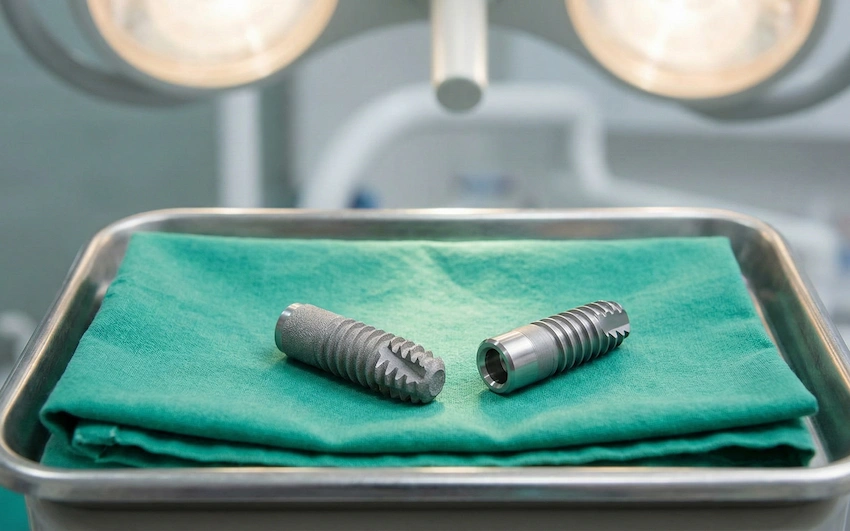
Sadly, there is a common misconception that various dental implants are just different brands of the same type of product. Most implants consist of titanium alloys, but that is usually where the similarity ends.
That’s a great analogy. The implant is the foundation of the whole building. This is why cheap implants simply place concrete in the hole, whereas better ones create a reinforced and earthquake-resistant foundation that will last for a hundred years. Usually, cheap implants use “Grade 4” commercially pure titanium or unbranded alloys that have not undergone stringent strength testing. We rely on high-quality implants, which are made of Grade 5 titanium or Roxolid® alloys, that are stronger and facilitate quicker tissue healing.
Surface Technology: The Invisible Science
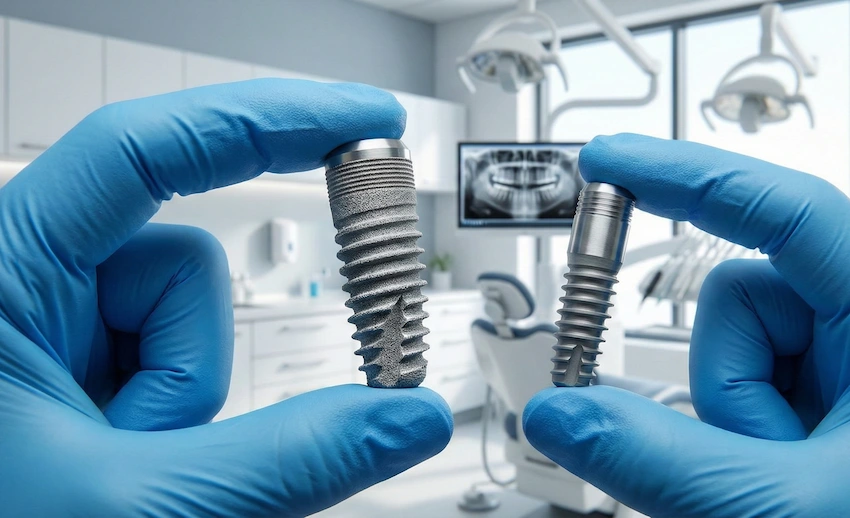
The major factor contributing to the price of a dental implant is something which you won’t even be able to notice with the unaided eye: the surface topography.
Professor Doctor Coşkun Yıldız has repeatedly stressed the point that the implant’s osseointegration—the process wherein the bone grows around the metal—is the main measure of its success.
- Economy Implants: Usually their surfaces are smooth or just brushed. Therefore, the bone cells (osteoblasts) find it difficult to attach to the implant, which then results in the loosening or failure of the implant a few years down the line.
- Premium Implants: Go through a variety of complex conditioning processes—such as blasting with sand, etching with acid, or applying hydrophilic layers. These surfaces are meant to be “sticky” to the blood and bone cells. It is planting a seed in dry sand versus planting a seed in fertile soil. The expensive implant actually signals your body to repair it faster.
The “Hidden” Costs: Expertise vs. Experimentation
If a price is ridiculously low, it’s natural to wonder where the corners might have been cut. Typically, it is either the sterilization procedures or the surgeon’s level of experience.
In the context of our experience at Lema Dental Clinic, we quite often witness the results of “cheap” dentistry. The patients bring with them wrongly angled implants, damaged nerves or sinuses—all of which had occurred because the dentist did not have the advanced 3D imaging technology necessary for high precision.
Comparing the Investment: Premium vs. Budget
To make it very clear, I want to list down the major features of a leading system (Straumann or Nobel Biocare) and a generic brand that simply imitates the design.
| Feature | Premium Implant Systems | Budget / Generic Implants |
| Scientific Backing | More than 20 years of high-quality clinical trials and longitudinal studies with peer evaluation | Hardly any long-term studies; often based on outdated patent designs |
| Material Strength | Titanium–zirconium high-performance alloys that resist microscopic fractures | Standard titanium is softer and more prone to long-term fatigue fractures |
| Availability of Parts | Worldwide availability; compatible with dentists globally | Local or unknown availability; replacement parts may become impossible |
| Failure Risk | Relatively minimal (<2–3% in healthy patients) | Higher risk of screw loosening, component breakage, or peri-implantitis |
| Warranty | Usually lifetime global warranty | Very limited or clinic-specific warranty only |
The “Cost” of Failure
When people come to the clinic, what we mostly see is that the price of repairing a failure of a cheap implant is three times more than doing it right initially.
A budget implant failing does not usually mean that the implant just falls out. It is very likely that your jawbone will be seriously affected too. In such cases, bone grafting, lengthened healing time, and visiting a surgeon twice will be necessary. Among many other points, Dentist Polen Akkılıç tells her patients that “the most expensive implant is the one you have to pay for twice.”
Why Are Prices Lower in Turkey?
Maybe you ask yourself, “How can Lema Dental Clinic in İstanbul be less expensive if you use the best brands?”
Whether the question is understood or not, the answer lies predominantly in the differentiation of the operational cost.
- Lower Overhead: The cost of lab work, rent, and insurance is significantly lower for a clinic in Turkey than in the United States or the United Kingdom.
- Volume & Expertise: Because our main area of concern is implantology, we directly purchase a large variety of top-notch materials from the manufacturers, and this is how we give you the advantage of a lower price.
Our low prices are not due to “Turkish implants” but we use global leaders like Straumann or Nobel, placed by leading Turkish experts.
Frequently Asked Questions (FAQ)
Probably not at first glance. You may not suspect that the dental crown isn’t well done; they usually look fine to most people anyway. After all, the reasons will be determined by the physical characteristics rather than the visual ones. In a year, for example, the screw might be loosened or the gum line receding because the connection between the two has not been sealed perfectly. The “appearance” is good in this case but the mechanical function is where the cheap implant fails.
Indeed, for example, you can think of a car engine. Original equipment manufacturer’s (OEM) parts of major brands are available almost everywhere in the world. On the other hand, if you have a generic implant and after five years you want to get it repaired during a holiday, then a local dentist may not have the necessary tools to help you. Here at Lema Dental Clinic, we carry major global brands to ensure that you are always protected not only in the clinic, but also worldwide.
This is really not a simple process. You can’t merely put off an implant that has biologically fused and install a new one, since the surgical procedure will involve the removal of some bone tissue along with the implant. Hence, it is not like swapping shoes. In fact, it is a permanent change to your body. Our best advice is that you get the right foundation from the beginning.
The simplest answer is that I couldn’t do to my family what I am doing to mine. Professor Doctor Coşkun Yıldız has such strict clinical standards that we won’t even consider a manufacturer that cannot show us their sterilization purity or the molecular structural stability they provide with long-term data. You must be willing to disregard your health to take such a risk.
The general method is the same but it is the accuracy that differs. Most of the time premium systems are still equipped with the “guided surgery” kit at an advanced level to enable us to place the implant with sub-millimeter precision. Freehand placement is thus the strategy employed by cheaper systems and consequently the possibility for error is increased.
- Buser, D., Janner, S. F., Wittneben, J. G., Brägger, U., Ramseier, C. A., & Salvi, G. E. (2012). 10-year survival and success rates of 511 titanium implants with a sandblasted and acid-etched surface: a retrospective study in 303 partially edentulous patients. Clinical Implant Dentistry and Related Research, 14(6), 839-851.
- Al-Nawas, B., & Kammerer, P. W. (2011). Rare earth elements in dental implants: a review. International Journal of Implant Dentistry, 3(1), 1-8.
- Lang, N. P., & Jepsen, S. (2009). Implant surfaces and design (Working Group 4). Clinical Oral Implants Research, 20(s4), 228-231.
- Derks, J., Schaller, D., Håkansson, J., Wennström, J. L., Tomasi, C., & Berglundh, T. (2016). Effectiveness of implant therapy analyzed in a Swedish population: prevalence of peri-implantitis. Journal of Dental Research, 95(1), 43-49.
- Straumman, T. (2018). Mechanical strength of Titanium-Zirconium alloy implants compared to Grade 4 Titanium. Journal of Mechanical Behavior of Biomedical Materials, 82, 12-18.

