


Exposed nerves cause sudden pain.
You may be just sipping some cold water or feeling the fresh winter air, when all of a sudden—zap. A tooth gets hit with an electric jolt. It stops you and throws you off. You couldn’t even realize it last week, but now you only think of this.
At Lema Dental Clinic, during our yearly tour experience, we gather that sudden sensitivity is very rarely random. That is a biological alarm to which your body responds. Your body is basically telling you that your teeth hav been attacked.
Most patients question us, “Why does it have to be now?” Well, the answer is mostly hidden in the microscopic structure of your tooth.
The “Insulation” Metaphor: Understanding Dentin
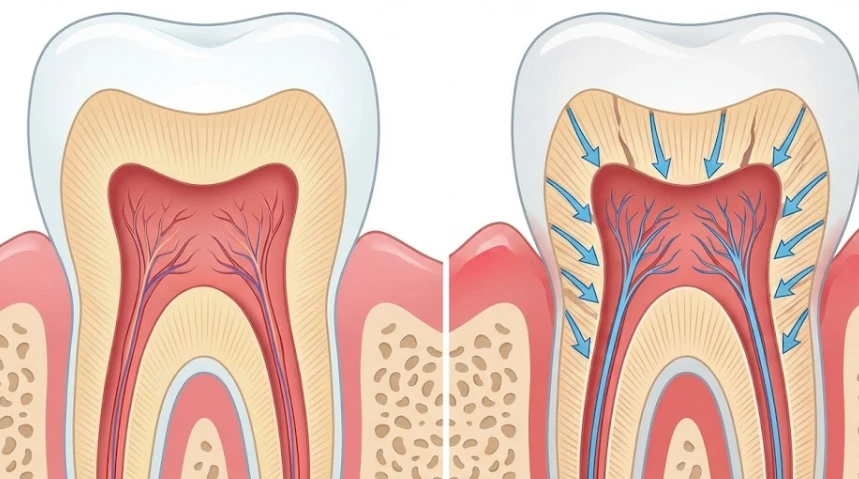
To comprehend the discomfort, think of your tooth as a house. The outer layer, enamel, is the roof and siding—the strongest material of the human body, made to withstand the weather. Beneath, there is dentin.
The dentin is a porous substance riddled with thousands of tiny tubes (tubules) that connect directly to the nerve of the tooth, the pulp.
In the case that your enamel is healthy, these tubules are closed. On the other hand, when your protective “insulation” gets stripped, cold stimuli run directly through the spots to the nerve. Professor Doctor Coşkun Yıldız constantly tells our patients that what they feel is the movement of the fluid inside the tubules by the nerve ending, which causes that sharp, sudden pain.
The Culprits: Why the Shield Fails
Well, why did your “shield” give up this week? This is what we mostly find on our Istanbul clinics.
1. The Silent Recession
Receding gums is the top contributing factor to sensitivity. Think of your gums as the protective blanket that keeps the roots of your teeth covered. Roots don’t have enamel; instead, they are covered with a much softer layer called cementum. When you brush too hard (which happens to be a very common mistake) or if you get gum disease, your gums will start to recede or pull away from the teeth. So suddenly, when you take your morning iced coffee, that extremely sensitive root will be right there exposed.
2. Micro-Cracks and Trauma
At times, you cannot see the damage with the naked eye. A “craze line” or an invisible crack when you close your mouth could flex allowing cold to reach very deep inside the tooth. This is most likely if you happen to grind your teeth during sleep—a situation Dentist Polen Akkılıç and her crew would have examined you for during consultation.
3. Acid Erosion
Your eating habits are critical. Constantly eating acidic foods (like lemons, sodas, wine) will soften your enamel. Eventually, you will wash away the shield, hence exposing the nerves.
Clinical Solutions: How We Fix It in Turkey

It is a lot of guessing to treat a tooth that is sensitive without a leak locator, so pinpointing a leak is the first step in planning a good treatment for sensitivity. The Lema Dental Clinic team practices a systematic medicine approach to the disease severity.
Simple cases may only require us to use desensitizers of clinical grade – these are like varnishes that will occlude the tubules. On the contrary, major defects lead us to planning reconstruction.
In cases where the enamel was essentially removed and the tooth loses its charm, the most economical and technically best solution would be to use veneer laminates or zirconia crowns. These restorations enhance the appearance as well as serve as a new, permanent shield, replacing the lost enamel and completely cutting off the nerve from thermal stimuli.
Comparing Sensitivity Triggers and Treatments
To make it easier for you to understand what is happening in your oral cavity, we have put together a list of the most common cases of dental sensitivity.
| Root Cause | Sensation Type | Likely Trigger | Clinical Solution |
| Gum Recession | Sharp, root-level pain | Cold air, cold drinks | Gum grafting or bonding agent |
| Enamel Erosion | All-over dull ache/sharp zaps | Acidic foods, sweets | Fluoride therapy or Veneers |
| Micro-Crack | Sharp pain on release of bite | Chewing, cold | Bonding, Inlay/Onlay, or Crown |
| Recent Whitening | “Zings” across multiple teeth | Air, room temp water | Time (transient), Desensitizing gel |
| Decay/Cavity | Lingering throb after cold | Sweets, hot/cold | Filling or Root Canal |
Critical Queries on Sudden Tooth Sensitivity
It depends entirely on the cause. If the sensitivity is due to a recent dental procedure (like a filling or bleaching), it is often transient and will settle within a few weeks as the nerve calms down. However, if the sensitivity is caused by gum recession, a crack, or decay, it will not heal itself. Tissue does not grow back. Ignoring it usually leads to the nerve dying and an eventual infection.
Not necessarily. This is a common fear, but the reality is that most cold sensitivity is treated with much less invasive measures. A root canal is reserved for irreversible pulpitis—when the nerve is damaged beyond repair and the pain lingers long after the cold stimulus is removed. Sharp, fleeting pain is usually a sign that the nerve is alive and just needs protection.
Some adjustment period is normal. When we prepare teeth for veneers, we are working near the dentin. It can take a few weeks for the tooth to settle. However, if the pain persists or is severe, it could indicate a bite imbalance. Dentist Polen Akkılıç emphasizes the importance of a “bite check” follow-up to ensure high points aren’t putting undue pressure on a specific tooth.
Yes, but patience is key. Desensitizing toothpastes contain compounds like potassium nitrate that block the transmission of pain signals from the tooth surface to the nerve. But they don’t work instantly. You typically need to use them exclusively for two weeks to build up the necessary barrier.
Absolutely. In fact, it’s a great reason to come. Many of our international patients combine their vacation with treatment to fix this exact issue. We can perform a comprehensive 3D scan to rule out infection and then proceed with bonding or veneers to permanently solve the sensitivity while upgrading your smile’s aesthetics.
- West, N. X., Lussi, A., & Seong, J. (2013). Dentin hypersensitivity: Recent advances in diagnosis, management, and treatment. Journal of Dentistry, 41(Suppl 4), S2-S3.
- Addy, M. (2002). Dentine hypersensitivity: New perspectives on an old problem. International Dental Journal, 52(S5P2), 367-375.
- Cummins, D. (2009). Dentin hypersensitivity: From diagnosis to a breakthrough therapy for everyday sensitivity relief. Journal of Clinical Dentistry, 20(1), 1-9.
- Bartold, P. M. (2006). Dentinal hypersensitivity: A review. Australian Dental Journal, 51(3), 212-218.
- Davari, A., Ataei, E., & Assarzadeh, H. (2013). Dentin hypersensitivity: Etiology, diagnosis and treatment; a literature review. Journal of Dentistry (Shiraz, Iran), 14(3), 136-145.

