


Harmless tissue peeling or plaque.
You have completed your morning routine, tasted your teeth with your tongue, and caught a strange sensation. You gaze at the mirror and draw out a long, white, stringy film. It resembles wet tissue paper or skin a bit. You start to panic. Is my gum peeling off? Am I getting an infection?
If you are worried about this, we at Lema Dental Clinic in Turkey, based on our clinical experience, would like to tell you that this is actually the most common complaint we hear but also the one that people understand the least. Even though it can be quite scary visually, the white coating is hardly ever a sign of a serious illness. Most times the white stuff is a chemical reaction, not a failure of cleaning.
Professor Doctor Coşkun Yıldız in his lectures often recalls the analogy of the mouth lining with the skin on hands. As your hands might peel if you over-wash them with a harsh detergent, your cheeks and gums can get “peeled” if oral care products give them an overkill.
Leading “Villain”: “Oral Sloughing”
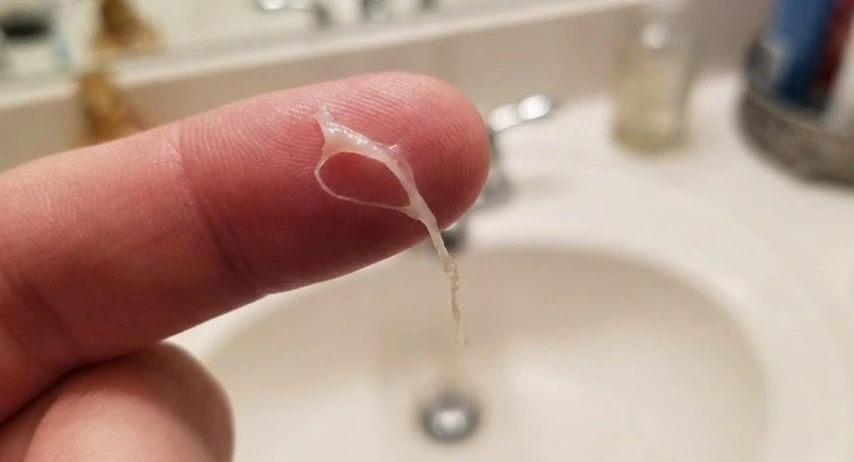
The more scientific name for that white, stringy slime is epithelial desquamation, or just “sloughing.”
Without the complicated language, the scientific explanation goes like this: The mucous membrane is what lines your mouth. Many of the modern toothpastes, especially “whitening” and “tartar control” -type ones, have in them the detergent called Sodium Lauryl Sulfate (SLS). It is this ingredient that gives the paste nice foam.
Nevertheless, for a good number of patients, SLS is way too harsh. It is capable of producing a mild chemical burn at the top layer of your cheek lining. The body reacts by getting rid of that damaged layer, just as a snake gets rid of its skin after a shed.
Dentist Polen Akkılıç along with the team always tell patients: “If you are alright and come off in thin sheets, then the first thing you should do is to open your toothpaste tube and see.” Changing the brand lately is the cause 99% of the time.
Plaque: “Fuzzy” Alternative
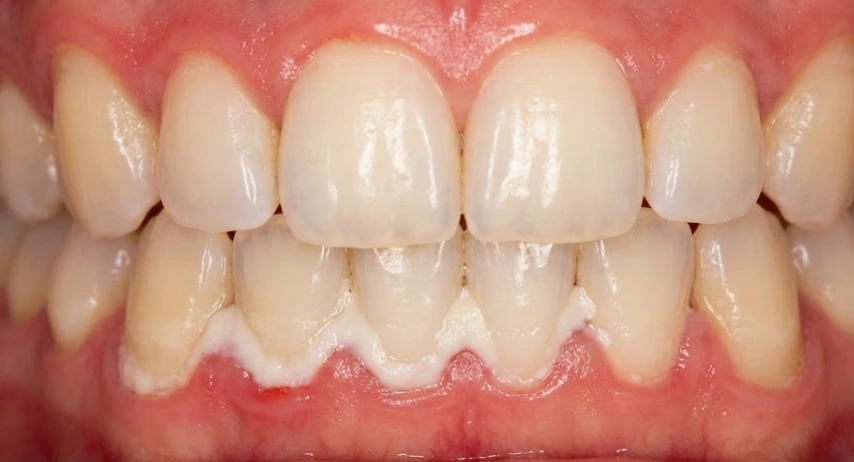
Yet another white thing that you can find adding to the confusion is the white stuff called plaque which is found on the surface of the gums.
The way to understand plaque is to think along the lines of a film( or a biofilm). It is basically bacteria and food debris that stick together in a particular pattern. When you brush and only partially brush then you miss the place where the small angle is close to the gums. This white paste is what will be left behind. Sloughing is a skin reaction that you get from the usage of a product, and plaque is a bacterial product. The biggest difference between the two is that sloughing is a piece of tissue while plaque dissolves when you rub it and is softer than sloughing.
Figuring Out the Type of Residue: A Medical Examination
In order to support you in making a decision about whether it is time to change your toothpaste or just work on your brushing technique, we have listed the differences below.
| Feature | Oral Mucosa Sloughing | Plaque Accumulation | Oral Candidiasis (Thrush) |
| Texture | Stringy, film-like, elastic. | Soft, Mushy, paste-like. | Creamy, curd-like patches. |
| Location | Inside cheeks, lips, or under the tongue. | Along the gumline and between teeth. | Tongue, roof of mouth, throat. |
| Sensation | Painless; feels like “dead skin.” | “Fuzzy” or rough teeth surface. | Often burns or bleeds if scraped. |
| Primary Cause | Reaction to SLS in toothpaste/mouthwash. | Inadequate brushing/flossing. | Fungal imbalance (yeast infection). |
| Immediate Fix | Switch to SLS-free toothpaste. | Brush and floss thoroughly. | Requires antifungal medication. |
Top Queries on Oral Residue and Hygiene
This is the number one fear we hear. The reality is that oral cancer (Leukoplakia) usually presents as a thick, white patch that cannot be wiped off. It is stuck to the tissue. If the white stuff in your mouth wipes away easily with your finger or a toothbrush and leaves normal-looking pink tissue underneath, it is highly unlikely to be cancer. However, if a white patch persists for more than two weeks, you must see a professional.
Absolutely not. If the cause is sloughing, your gums aren’t the problem—the chemical detergent is. If the cause is plaque, stopping brushing will only make it worse and lead to gingivitis. The solution is to change the tool, not the habit. Try a milder, non-whitening toothpaste and see if the peeling stops within a few days.
It often does. Many mouthwashes contain high levels of alcohol, which dries out the oral tissues (desiccation). When the tissue is dry, it becomes more fragile and prone to peeling. At Lema Dental Clinic, we often suggest alcohol-free rinses for patients with sensitive soft tissues.
While you sleep, your saliva production drops significantly. Saliva is your mouth’s natural shower; it washes away debris and keeps tissues hydrated. Without that constant flow, any irritation from your bedtime brushing sits on the tissue all night, and the dead cells accumulate rather than being swallowed naturally. This leads to that “morning film.”
Yes. Whitening strips use peroxide to bleach the teeth. If the gel leaks onto your gums or cheeks, it causes a minor chemical burn. The white stuff you see the next day is the dead tissue from that burn falling away. It is usually harmless and heals quickly, but it’s a sign you should be more careful with application.
- Hassona, Y., & Scully, C. (2013). Clinical adverse effects of sodium lauryl sulfate in toothpaste. Oral Diseases, 19(6), 544-549.
- Lippert, F. (2013). An introduction to toothpaste—its purpose, history and ingredients. Monographs in Oral Science, 23, 1-14.
- Addy, M., & Koltai, R. (1994). Control of supragingival plaque formation. Periodontology 2000, 8(1), 77-90.
- Baab, D. A., & Oberg, S. W. (1987). The effect of water pressure on oral mucosal injury. Journal of Periodontology, 58(8), 561-566.
- Herlofson, B. B., & Barkvoll, P. (1996). Oral mucosal desquamation caused by two toothpaste detergents in an experimental model. European Journal of Oral Sciences, 104(1), 21-26.

