


Once fully healed, you can eat absolutely anything without restrictions.
Daily, we meet with people presenting almost similar worries. They recount experiences of tooth decay and uncomfortable dentures or even complete tooth loss over several years. Later, they throw us a very simple question: ‘If I get this surgical treatment done, will I ever be able to enjoy eating a crisp apple? How about a steak?’
And really, it is a true yes, you will be able to eat not only those foods but also all others you love again. However, there is a very specific step we need to talk about. Lema Dental Clinic in Turkey considers the All-on-4 approach as a complete life change. It is far more than just surgery. Correctly changing your diet after surgery is very important. It is a secret to the lifetime of your new smile.
We share an honest, behind-the-scenes video about what you are allowed to eat after your implant surgery.
The First Phase: The “Wet Concrete” Stage (Weeks 1 to 8)

Taking the analogy of your jawbone to a building’s foundation, we insert titanium implants into the bone. This is just like pouring wet concrete around metal pillars. You would never drive a heavy truck on wet concrete on the same day it was poured. You have to give it time to harden.
and for which we use the technical term osseointegration. And the healing continues as the living bone physically grows to the metal implant.
While you will be in Turkey for your check-ups, Dentist Polen Akkılıç and her team will mainly monitor your progress.
We will give you a great set of temporary teeth. And they will be fixed. But they are only good for appearance and light use. Here are some food options for you to consider during the initial period of your recovery:
- Warm, blended vegetable soups and broths
- Scrambled eggs and soft omelets
- Flaky fish (such as salmon or sea bass)
- Mashed potatoes and soft squash
- Protein shakes (like smoothies–please do not use straws when having these drinks)
The Second Phase: Testing the Waters (Weeks 8 to 12)
Let’s take a closer look at the eight-week point. The bone is firming. The foundation is stabilizing. The jaw will feel a new sense of strength.
One of the things that Professor Doctor Coşkun Yıldız always remembers to mention with a smile is the fact that this is the most dangerous stage for our patients. Why? Because they feel great. They have no pain at all. Their teeth are perfect. And just picture the craving for a freshly baked baguette – the temptation is very real.
We must softly enforce the same restrictions on our patients. The range of your diet can be increased at this point. But the bone is not yet fully mature. You may enjoy:
- Pasta and soft-cooked rice
- Slow-cooked, tender meats and shredded chicken
- Vegetables cooked by steaming
- Soft breads (without the hard crust)
The Final Result: Reclaiming Your Bite (Month 4 and Beyond)
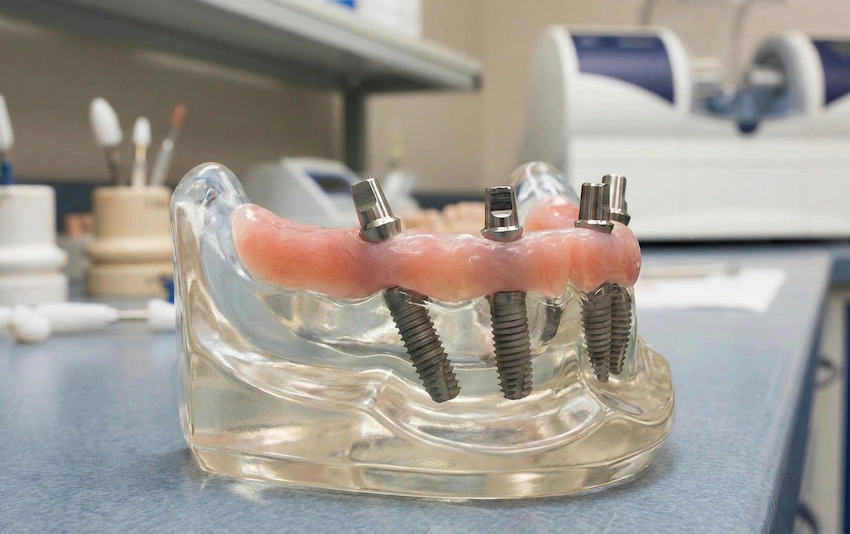
Once your healing has reached the end stage, we will move the focus to your final, permanent zirconia or porcelain bridge. From this point on, everything is different.
It is akin to concrete being fully set. So, a big wooden door will be very securely fastened with heavy-duty steel hinges. That is how firm your new teeth are as well.
Your ability to bite and chew naturally has now been restored to an estimated 95%. You can eat a crunchy, green apple; you can even chew a thick rib-eye steak; crunchy nuts and popcorn can also be added to your diet. These are just the things that keep us happy every day at the dental clinic.
The All-on-4 Dietary Recovery Timeline
| Healing Phase | Permitted Foods | Strictly Forbidden Foods | Clinical Objective |
| Weeks 1-2 | Liquids, purees, protein shakes | All solid foods | Soft tissue healing & clot protection |
| Weeks 3-8 | Flaky fish, mashed veggies, eggs | Meat, nuts, raw carrots, crusty bread | Osseointegration (bone-to-implant fusion) |
| Weeks 8-12 | Pasta, shredded chicken, soft breads | Hard crusts, ice, sticky toffee, nuts | Progressive loading and tissue maturation |
| Month 4+ | Unrestricted (steak, apples, nuts) | None (use normal common sense) | Full functional, lifelong restoration |
Frequently Asked Questions
Not at all during the first three months. Gum keeps attracting your teeth to move, so you will lose or damage the implants. However, later you may play with your implants by chewing sugar-free gum. Just don’t make it a whole day habit, so you won’t get your muscles tired.
We make sure that your final bridge has an absolutely tight fit against your gums. Large food particles rarely get trapped. However, small seeds can find their way inside. This is why we provide you with a water flosser. It will clean out your mouth in seconds.
We completely understand this craving! You must hold off on heavy meats for about 3 to 4 months. We need to confirm your bone has fully healed first. Once you have your permanent teeth, you can order your steak cooked exactly the way you prefer it.
My advice is to stay away from very hot stuff for almost one week. Heat causes the blood vessels to dilate. This leads to more swelling and bleeding. By the time it is week two, I think you are free and clear to have your morning coffee.
Don’t worry, most instances of your biting hard are likely flare-up surprise hits, none of which will break your implant. Just make sure that you monitor your mouth for changes in your bite, inflammation, or looseness of your temporary bridge after biting or chewing.
- Maló, P., de Araújo Nobre, M., Lopes, A., Moss, S. M., & Molina, G. J. (2011). A longitudinal study of the survival of All-on-4 implants in the mandible with up to 10 years of follow-up. Journal of the American Dental Association, 142(3), 310-320.
- Brånemark, P. I., Hansson, B. O., Adell, R., Breine, U., Lindström, J., Hallén, O., & Öhman, A. (1977). Osseointegrated implants in the treatment of the edentulous jaw. Experience from 10 years. Scandinavian Journal of Plastic and Reconstructive Surgery. Supplementum, 16, 1-132.
- Patzelt, S. B., Bahat, O., Reynolds, M. A., & Strub, J. R. (2014). The all-on-four treatment concept: a systematic review. Clinical Implant Dentistry and Related Research, 16(6), 836-855.
- Misch, C. E. (2007). Contemporary Implant Dentistry (3rd ed.). Mosby Elsevier.
- Buser, D., Sennerby, L., & De Bruyn, H. (2017). Modern implant dentistry based on osseointegration: 50 years of progress, current trends and open questions. Periodontology 2000, 73(1), 7-21.

