


Yes, yellow teeth can turn white again.
This is probably the most typical complaint patients raise during consultations. When you look at yourself in the mirror, you do not see the bright, youthful smile you recall, but rather a dull, yellowish shade of teeth. The question that always comes up is whether this is a permanent condition or if yellow teeth can really be whitened again.
At Lema Dental Clinic, Turkey, our clinical experience leads us to give a very positive answer in every case. However, as a matter of fact, the treatment totally depends on the reason behind the discoloration. It’s not simply about bleaching; it’s more about the biology of your only smile.
The Roadmap to Radiance: 5 Steps to White Teeth
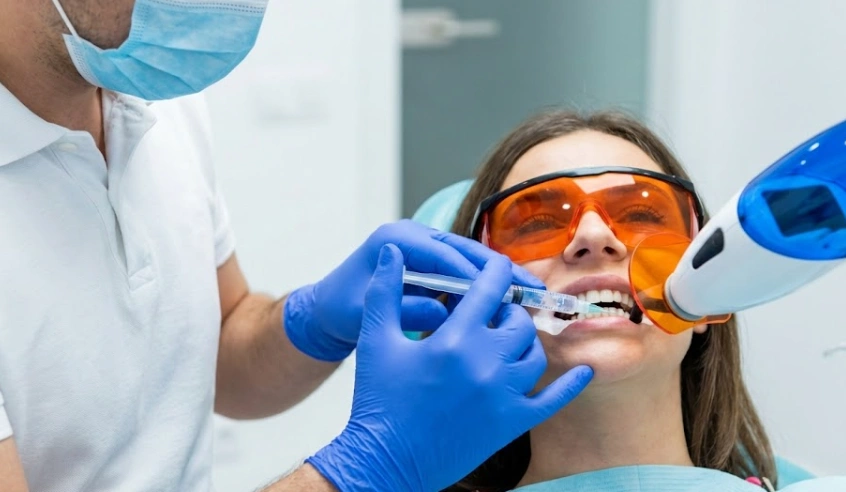
So, what really how do we make the transition from yellow teeth to white which is the most desired result? There is a general agreement between the internet and dental experts that the best solution is a systematic plan of action. The following is the exact treatment protocol that Dentist Polen Akkılıç and her team at the clinic use to achieve not only great in appearance but also totally safe results for the patients:
- Step 1: Deep Biofilm Removal: The first step before any whitening is deep cleaning to get rid of the plaque and tartar “cover” making up of biofilm. It is somewhat like preparing a wooden floor for staining an entirely new one: you have to get rid of the old dirt and debris before applying a new finish, or in the case of teeth new polish.
- Step 2: Chromatic Shade Mapping: Instead of making guesses our dental team employs the use of a digital shade guide to determine your teeth’s absolute whiteness so that the tooth colour achieved will not look like a plastic mask against your skin tone.
- Step 3: The Gingival Barrier: We seal the gums with a light-cured resin prior to applying the whitening gel to avoid overheating the gums and subsequent sensitivity after the treatment. This resin is resistant and effective at preventing the gel from contacting the gingival tissues.
- Step 4: Molecular Oxygenation: Hydrogen peroxide at a concentration level of 35% is used in our clinic for professional bleaching. Such a potent bleaching agent of course brings greater risk of side effects if not handled properly. However, the microscopic pores of the enamel allow such gel to go in and oxidize even deeply embedded stains.
- Step 5: Post-Treatment Mineralization: After the bleaching procedure is over, we apply a toothpaste containing Calcium and Phosphate minerals onto the enamel. The purpose is to close the enamel microscopic holes thus making sensitive teeth we thus the problem of teeth sensitivity and the whitening result is kept for longer.
Why Teeth Turn Yellow: The “Frosted Glass” Analogy
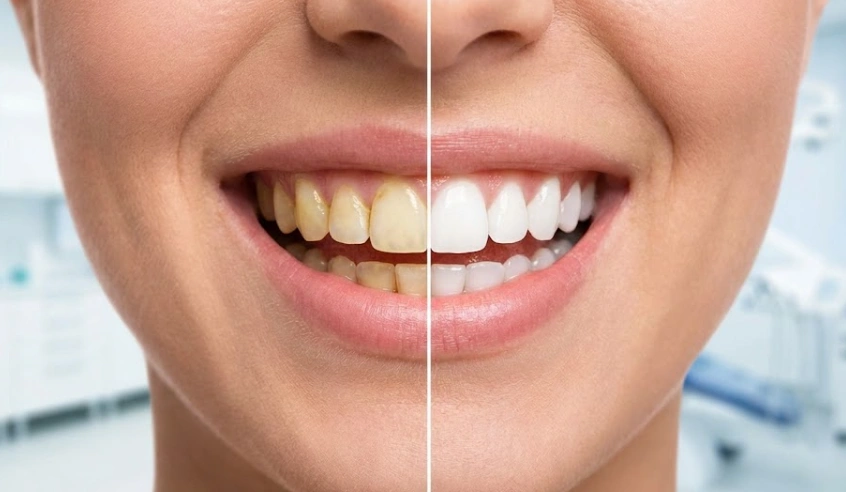
Professor Doctor Coşkun Yıldız commonly employs a creative illustration through which the concept of tooth colour is simplified. On one hand, it is a smooth and bright white (enamel) and on the other a dull yellow color (dentin) which may be compared to a window with a frosted glass pane, the tooth in this case, contaminated by a dirty wall behind it.
If the glass gets dirtied with substances such as coffee or tobacco, the light coming through is dimmed. However, when with time the glass gets worn (the physiological loss of enamel with aging) the underlying yellow comes forward more strongly thus explaining why some people find no effects from whitening toothpastes because they are only brushing away the surface staining and the real problem is the color of the dentin. it shines through more clearly. This is why some people find that whitening toothpastes do nothing; they are scrubbing the glass when the problem is actually the wall behind it.
Comparing Your Options: From Home Kits to Clinical Mastery
But let’s look closer at the different ways people try to fight the yellow. Not all paths lead to the same destination.
| Method | Effectiveness | Risk Level | Best For |
| Whitening Toothpastes | Low (Surface only) | Moderate (Abrasive) | Maintaining results after a professional clean. |
| At-Home Strips | Moderate (Slow) | High (Gum irritation) | Minor lifestyle staining in young patients. |
| In-Clinic Whitening | High (Deep change) | Low (Doctor-supervised) | Significant yellowing and aging teeth. |
| Porcelain Veneers | Maximum (Total change) | Very Low | Genetic yellowing or thinned enamel. |
FAQ: Direct Conversations from Lema Dental Clinic
Here is what we see in the clinic: almost no stain is truly permanent. Even “tetracycline stains,” which were once thought impossible to fix, can be addressed through a combination of deep bleaching or ultra-thin veneers in our Turkey facility.
The reality is that professional whitening doesn’t “strip” enamel. It simply travels through the microscopic pores to flush out stains. However, DIY kits with high acidity can cause erosion, which is why supervision is key.
Brushing removes food, but it cannot change the natural color of your dentin (the inner layer). If you have thin enamel due to genetics or acid reflux, your teeth will appear yellow regardless of how much you brush.
For standard professional whitening, the entire process takes about 60 to 90 minutes. You can walk in yellow and walk out white in a single afternoon!
We recommend the “White Diet” for the first 48 hours. Think of your teeth like a white t-shirt that just came out of the wash—they are extra absorbent right after treatment. After two days, the pores close, and you can enjoy your latte again.
- Epple, M., Meyer, F., & Enax, J. (2019). A critical review of modern concepts for teeth whitening. Dentistry Journal, 7(3), 79.
- Joiner, A. (2006). The bleaching of teeth: a review of the literature. Journal of Dentistry, 34(7), 412-419.
- Kwon, S. R., & Wertz, P. W. (2015). Review of the mechanism of tooth whitening. Journal of Esthetic and Restorative Dentistry, 27(5), 240-257.
- Carey, C. M. (2014). Tooth whitening: what we now know. Journal of Evidence-Based Dental Practice, 14, 70-76.
- Watts, A., & Addy, M. (2001). Tooth discolouration and staining: a review of the literature. British Dental Journal, 190(6), 309-316.

