


Special floss clears bridge debris.
The newdental bridge is a stunning one. You have your smile back. The space has disappeared. However, it is quite true that the hardest part is still ahead of you. A dental bridge is a wonderful feat of modern clinical engineering, yet just like any one of the complex structures, it demands a level of specialized maintenance. Normal brushing merely cleanses the ceiling and the walls. So what about the floor?
We meet this situation quite a lot in the clinic. Patients frequently try to forcibly push the regular string floss around their new prosthetics and when they get frustrated, they eventually quit. A dental bridge is like a suspension bridge that spans a river. You cannot just let down a dusting cloth from the road surface; to clear the riverbed, you have to go under the physical structure first. As far as our clinical experience is concerned, Lema Dental Clinic in Turkey, figuring out how to use dental floss for bridges is the most important one factor in preventing the hidden decay under the crowns and after that, making sure that the restoration becomes your lifetime companion.
Reasons Why Ordinary Floss Doesn’t Work
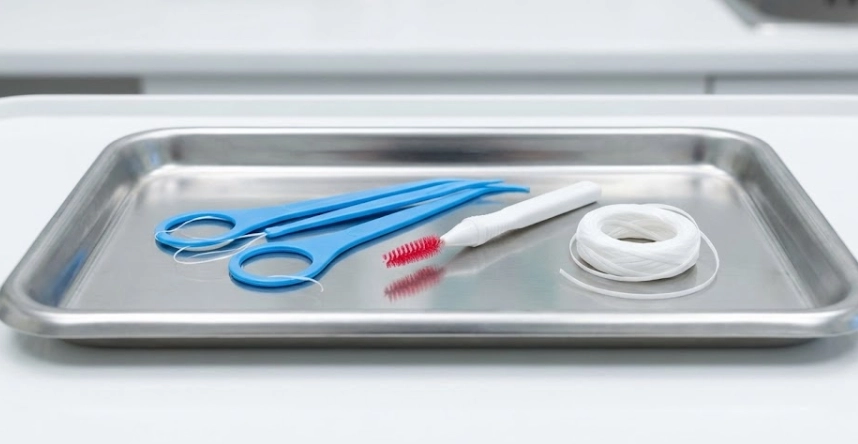
Ordinary floss has been designed with the idea in mind that it will be dropped vertically between two independent, natural teeth. However, if you look more carefully, a dental bridge is made up of two crowns holding it down (abutments) and a false tooth (pontic) that is in the middle and they are all fused. Hence, no vertical path exists between the fake tooth and the anchors.
Professor Doctor Coşkun Yıldız always points out that if we take regular floss and try to forcibly shove it into a bridge, the situation is similar to trying to get into a locked house by simply pushing the door harder with your shoulder; you will not only fail, but you may also cause damage to your gums that will hurt. Therefore, off you go with tools that have been made to slide horizontally right under the pontic.
Your toolkit: Journeying through space
But to get the right cleaning between your gums and the false tooth, specialized tools are necessary. Dentist Polen Akkılıç and her team regularly take our international patients right through these choices after their restorative procedures here in Turkey, so that they go back home fully prepared to care for their investment.
| Cleaning Tool | Mechanism of Action | Ideal User Profile | Risk of Gum Trauma if Misused |
| Floss Threader | A flexible plastic needle that pulls regular floss horizontally under the bridge. | Patients who prefer using standard waxed or unwaxed string floss. | Low to Moderate |
| Super Floss | Pre-cut strands featuring a stiff threader end, a spongy middle, and regular floss. | Patients wanting a fast, all-in-one manual solution. | Low |
| Water Flosser | Uses a pulsating stream of pressurized water to blast away plaque and debris. | Patients with limited hand dexterity or multiple complex bridges. | Very Low |
| Interdental Brush | Tiny, flexible cylindrical brushes that slide horizontally between wider gaps. | Patients with slight gum recession under the pontic area. | Moderate |
The Under-Bridge Sweep Technique
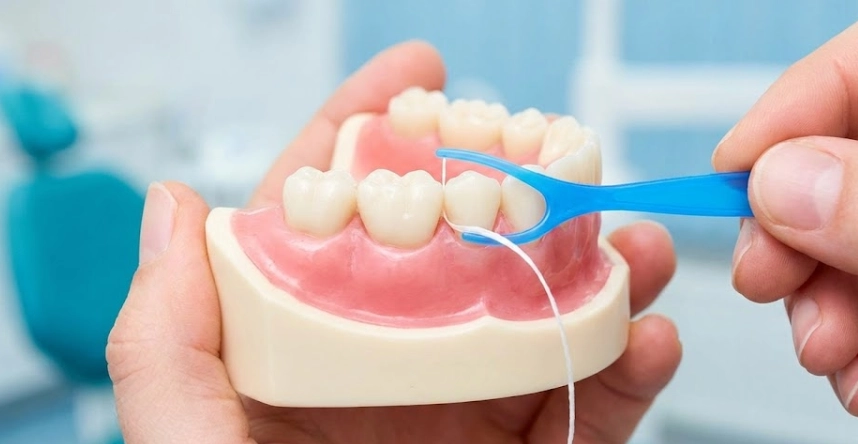
Simply having the right tool for the job is only a part of the overall equation. The question still stands: how exactly can you use it proficiently without aggravating the delicate gum tissues around your dental restoration?
- Thread the Needle: If you have a floss threader or Super Floss, please carefully lead the stiff end between the natural tooth and the false one, thus, staying as near the gumline as possible.
- The Spongy Sweep: Continue to pull the floss until the thick spongy section (or your standard floss) is directly underneath the bridge.
- The C-Shape Hug: Form the “C” with the floss against the surface of the natural anchoring tooth. Use the floss to move bacteria from the hidden spaces by sliding it up and down.
- The Pontic Glide: Sliding the floss back and forth under the false tooth will help to remove food particles and sticky plaque that are trapped.
- Pull Through: Do not forcibly pull the floss back up through the top of the bridge. Gently pull it all the way out through the side to safely remove it.
Maintaining your soft tissue health not only benefits you but also the supporting teeth that will remain strong enough to hold your bridge securely for years and decades.
Essential Queries on Maintaining Your Dental Restorations
You should clean under your dental bridge at least once a day, preferably before bedtime. This critical step prevents plaque from hardening into destructive tartar overnight, which can lead to periodontal disease and compromise the teeth acting as your abutments.
A water flosser is a fantastic addition to your daily routine and is highly recommended by our surgical team. However, it should not entirely replace the mechanical wiping action of string floss or interdental brushes. Water pressure flushes out loose debris, but physical friction is required to scrub sticky bacterial biofilm off the ceramic and root surfaces.
Mild bleeding when you first initiate a new flossing routine can be expected. Stick with it gently for a week. If the bleeding persists or is accompanied by swelling, it may be a sign of underlying gingivitis or an ill-fitting restoration, and you should schedule a prompt consultation with your clinical team.
Neither is objectively better; it comes down to anatomical fit and personal handling preference. Super Floss offers a highly convenient design with a spongy middle that expands to fill the space, which many patients find superior for aggressively cleaning wider gaps beneath the pontic.
No. A properly bonded and structurally sound dental bridge will not be dislodged by normal, gentle flossing. Keeping the gums and anchoring teeth vibrantly healthy with daily flossing is actually the absolute best way to ensure your bridge stays firmly and safely in place.
- Garg, N., & Garg, A. (2015). Textbook of Operative Dentistry (3rd ed.). Jaypee Brothers Medical Publishers.
- Rosenstiel, S. F., Land, M. F., & Fujimoto, J. (2015). Contemporary Fixed Prosthodontics (5th ed.). Mosby.
- Shillingburg, H. T., Sather, D. A., Wilson, E. L., Cain, J. R., Mitchell, D. L., Blanco, L. J., & Kessler, J. C. (2012). Fundamentals of Fixed Prosthodontics (4th ed.). Quintessence Publishing.
- Sälzer, S., Slot, D. E., Van der Weijden, F. A., & Dörfer, C. E. (2015). Efficacy of inter-dental mechanical plaque control in managing gingivitis—a meta-review. Journal of Clinical Periodontology, 42(S16), S92-S105.

