


Safe with expert surgical planning.
For many of our patients, the prospect of waiting six months for a new smile is more than just an inconvenience—it is an emotional hurdle. The idea that you can walk into Lema Dental Clinic in Turkey with missing teeth and walk out a few hours later with a functional, beautiful set of “Teeth in a Day” sounds like magic.
But as clinical partners to surgeons, we don’t believe in magic; we believe in biology. The question remains: is the speed of immediate loading implants sacrificing long-term safety?
During our practice in Lema Dental Clinic, we conveyed through our clinical experience that immediate loading is not only safe but can in fact enhance patient’s psychological restoration if the right technology is combined with the right surgical expertise. Nevertheless, it is not a “one-size-fits-all” solution.
What Does “Immediate Loading” Actually Mean?
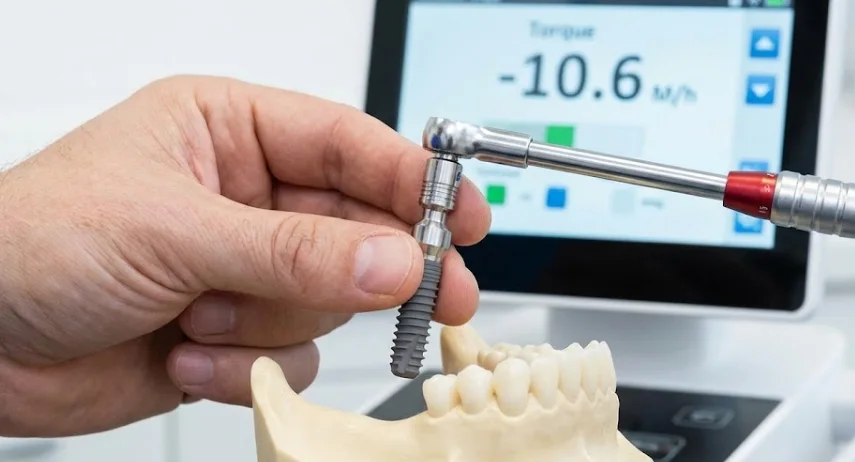
In a traditional implant procedure, we place the titanium post (the “root”) and wait three to six months for osseointegration—the process where your jawbone literally fuses to the metal. Only then do we place the crown.
Professor Doctor Coşkun Yıldız often uses a simple analogy: think of a traditional implant like a sapling planted in a garden; you wait for the roots to take hold before you hang a swing from its branches. Immediate loading, or “Teeth in a Day,” is more like using a heavy-duty anchor bolt in a solid stone wall. If the wall (your bone) is strong enough and the bolt is tightened to the perfect torque, it can support weight immediately.
The Reality of Primary Stability: The Secret to Safety
The question of safety hinges entirely on something we call primary stability.
During the surgical phase, Dentist Polen Akkılıç and her team utilize advanced 3D imaging and torque-measuring handpieces. When the implant is inserted, we measure the “bite” it has in the bone in Newton-centimeters (Ncm). If the stability reaches a specific threshold—usually above 35 Ncm—the implant is safe to be loaded with a temporary prosthetic immediately.
But let’s look closer at the “why.” If the implant is even slightly loose, the micro-movements caused by chewing will prevent the bone from fusing. Instead of a permanent tooth, you end up with a failed implant. This is why we are incredibly selective. At Lema Dental Clinic, we only proceed with immediate loading when the patient’s bone density is optimal.
Immediate vs. Traditional Loading: A Clinical Comparison
| Feature | Traditional Implants | Teeth in a Day (Immediate) |
| Treatment Time | 3–6 Months | 24 Hours |
| Bone Requirement | Standard | High Bone Density Required |
| Success Rate | 95-98% | 94-97% (When criteria are met) |
| Aesthetics | Temporary denture used | Fixed temporary bridge |
| Diet | Normal diet after 1 week | Soft food diet for 8-12 weeks |
| Cost in Turkey | Standard | Slightly higher due to specialized components |
How We Ensure Your Safety in Turkey
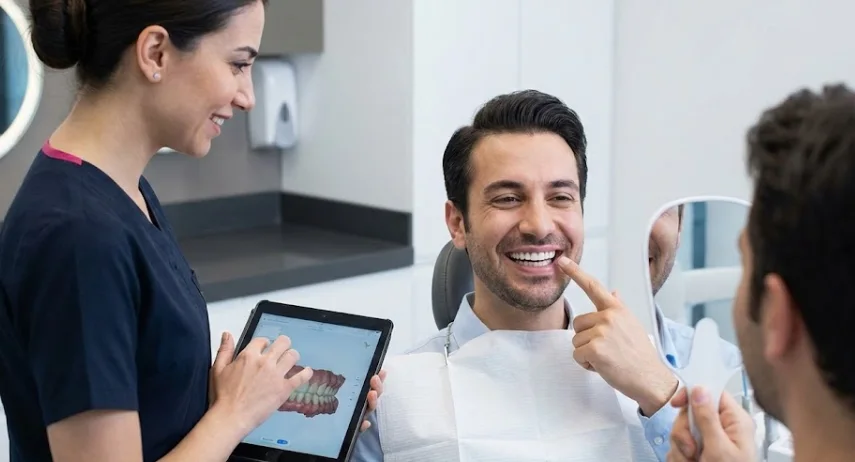
The reality is that many clinics offer “Teeth in a Day,” but few have the surgical rigor required to do it right. Professor Doctor Coşkun Yıldız emphasizes that the safety of immediate loading is built in the planning stage, not the operating room.
- Digital Workflow: We use 3D surgical guides. This is like having a GPS for your jaw, ensuring the implant is placed in the densest part of the bone.
- High-Grade Titanium: We only use premium implant systems that are specifically designed with “aggressive” threads to maximize initial grip.
- Cross-Arch Stabilization: By connecting four or six implants with a rigid bridge, we create a “splinting” effect. This prevents any single implant from taking too much pressure, much like a four-legged chair is more stable than a one-legged stool.
The Question of Nutrition
Here is what we see in the clinic: patients think “immediate loading” means they can walk out and eat a steak. This is the biggest safety risk. Even though the teeth are fixed, the bone is still “soft” around the implant for the first few months. We require our “Teeth in a Day” patients to maintain a soft-food diet while the biological fusion happens in the background.
FAQ: Your “Teeth in a Day” Concerns Answered
Actually, it’s the opposite. Because we often use flapless surgery and digital guides, there is often less swelling and trauma to the gums. Most of our patients at Lema Dental Clinic report only mild discomfort that is easily managed with standard pain relief.
The question remains whether we prioritize speed or success. If we find during surgery that your bone density doesn’t meet our strict safety threshold, we will not load the implants immediately. We will place a comfortable temporary denture instead. Your safety and the long-term life of the implant always come first.
Usually, no. The ‘Teeth in a Day’ are high-quality temporary prosthetics. They are lighter to allow the bone to heal. Once osseointegration is complete—usually in about 4 months—Dentist Polen Akkılıç will replace them with your final, permanent zirconia or porcelain bridge.
In our clinical experience, the risk of infection is identical to traditional implants. Because we perform the surgery in a sterile, state-of-the-art environment here in Turkey and provide a strict antibiotic protocol, your risk is kept to an absolute minimum.
It depends on your bone volume. If you have suffered significant bone loss, we might need to perform a bone graft first. In those cases, a traditional ‘delayed’ approach is often the safer, more predictable route to a successful result.
- Degidi, M., & Piattelli, A. (2005). Immediate functional loading of edentulous maxilla and mandible. Journal of Oral and Maxillofacial Surgery.
- Malo, P., et al. (2011). “All-on-4” immediate-function concept with Brånemark System implants for completely edentulous mandibles: A retrospective clinical study. Clinical Implant Dentistry and Related Research.
- Tarnow, D. P., et al. (1997). Immediate loading of threaded implants at stage 1 surgery in edentulous arches: Ten consecutive case reports with 1- to 5-year data. International Journal of Oral & Maxillofacial Implants.
- Esposito, M., et al. (2013). Immediate, early and conventional loading of dental implants: a Cochrane systematic review of randomised controlled clinical trials. European Journal of Oral Implantology.
- Javed, F., & Romanos, G. E. (2010). The role of primary stability for successful osseointegration of dental implants. Journal of Dentistry.

