


Severe, lingering pain requires attention
We all respond to pain differently because it is such a personal thing. However, the pain experienced from a toothache is one of the few pains that manages to penetrate our defenses and command our full attention.
It is probable that you are already in discomfort if you are going through this article. Perhaps, in a state of unease, you nervously sip cold water just to see if you can endure it while being afraid of the pain. Or your jaw could have been hurting so much last night that you were not able to sleep at all. We often use the words “root canal” to scare people, which is really unnecessary. But if you ask us at Lema Dental Clinic in Turkey, we’ll tell you that a root canal is not something to fear. In fact, it is the only procedure that will get rid of the pain that you can’t bear anymore and still allow you to keep your natural tooth.
What are the signs that it is no longer just a small cavity that needs filling but the infection is so severe that it requires root canal (endodontic) treatment?
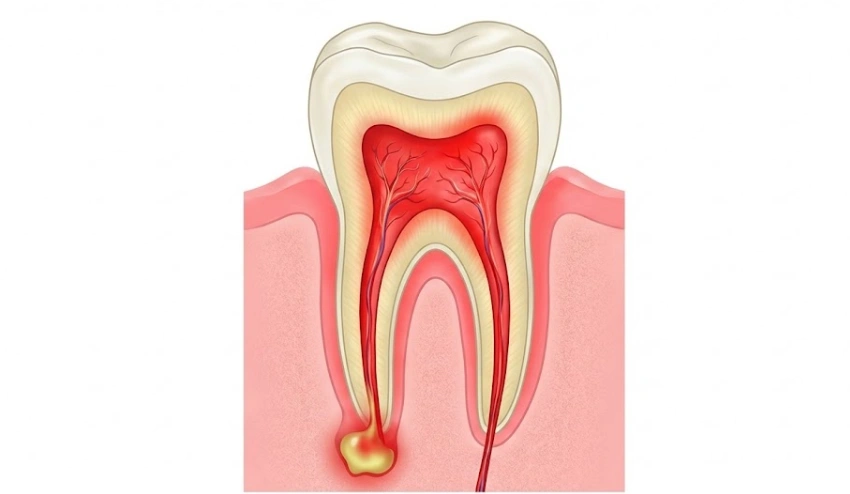
The team can share from its experience that a tooth gets infected severely once bacteria get inside the pulp chamber of the tooth. To help comprehend better, a tooth can be compared to a house. The enamel would be the roof and the walls. Inside, there is a “safe room”—the pulp chamber—filled with nerves and blood vessels. It is the tissue inside that room that gets inflamed when the bacteria break in.
Is it really the same as an inflamed knee which can get swollen? Not exactly. Since the pulp is enclosed tightly by dentin and enamel walls, an inflamed pulp chamber cannot expand and therefore pressure rapidly builds up, and pain is experienced.
Then without delay, you use the following telltale signs to recognize that the safety of your tooth has been breached and your “safe room” is now your “danger zone.” Only then, can you call a dentist for help.
1. The Pain That Lingers (Thermal Sensitivity)
Many people have sensitive teeth. You bite into ice cream, you get a quick zing, and it’s gone in seconds. That is usually okay.
Major red flag number one is when the sensitivity lasts for a long time.
Just imagine, you take a sip of very hot coffee or very cold water. But the sharp pain persists for 10 seconds, 30 seconds, or even a few minutes after you have assimilated, then you are imbalanced profoundly. In fact, this symptom is called by the professionals irreversible pulpitis and it essentially means that the nerve can no longer be saved. It is not capable of repairing itself. According to Professor Doctor Coşkun Yıldız, this type of persistent pain is very specific and it is the body’s alarm signal that the injury cannot be healed naturally and the only way is through intervention.
2. Spontaneous, Unprovoked Pain
Can you imagine that your tooth is so inflamed that it starts hurting when you are just sitting and watching TV or trying to sleep?
If there is pain inside a tooth and that tooth pain is experienced when no one is doing anything to cause the pain (i.e. when you have not been chewing, eating anything cold or hot, etc.), then it is a sure case of necrosis of the pulp inside the tooth. In fact, our patients have often described that they can feel the pain as a deep, slow heartbeat in their tooth or jaw going on and on, although the pain keeps changing in intensity. If dental pain gets you out of your bed at night then it is not something that simply goes away by taking over-the-counter pain relievers. You must go and make an appointment with your dentist.
3. The “Pimple” on Your Gums (Dental Fistula)
At times, the terrible pain drops completely without any clear reason. Thus, you could be fooled to think “It’s better, what a relief!”
However, this can be just the calm before the storm. The nerve could have died already. The infection now comes out of the tooth via the root tip, reaching the bone of the jaw and the gum tissue.
The body tries to give vent to that pressure and create a way for that pus to get out. You will most likely have a tiny bump somewhere on your gums close to the tooth with the most pain. There may be a bad taste if it drains. That is a dental abscess. A dental abscess is a serious infection that, if not treated, can spread to the jaw, the neck, or other parts of the body.
4. Tenderness to Touch and Chewing
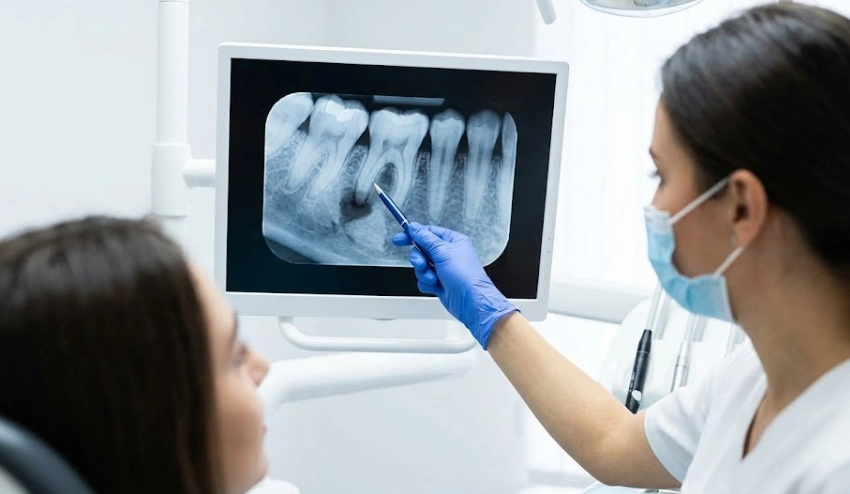
Once the infection escapes from the root tip and gets into the surrounding bone, the whole area turns red and tender.
In the case that the pain is so intense that you cannot chew on the affected side or that the pain is unbearable simply after tapping the tooth with a fingernail, then the infection has definitely advanced beyond the tooth itself.
The Risks of Waiting vs. Timely Treatment
At Lema Dental Clinic, we see the consequences of delaying treatment. Patients often arrive in Istanbul only after trying to “wait it out” for weeks. Waiting never works when the nerve is involved.
Here is a breakdown of the reality:
| Feature | Ignoring Symptoms & Delaying | Timely Root Canal Therapy at Lema |
| Pain Progression | Worsens from intermittent to constant; may temporarily cease if nerve dies, followed by abscess pain. | Immediate relief from acute nerve pain once the procedure begins. |
| Infection Status | Localized inflammation spreads to jawbone, potentially leading to systemic infection (sepsis). | Infection is mechanically removed and the area sterilized. |
| Tooth Outcome | High likelihood of needing extraction (losing the tooth completely). | The natural tooth is saved and restored to full function. |
| Treatment Complexity | Becomes more difficult to treat due to extensive infection and bone loss. | Routine, predictable procedure performed with microscopic precision. |
| Cost Implication | Higher long-term costs (extraction followed by implant or bridge). | Most cost-effective way to retain natural dentition. |
How We Handle Emergencies in Turkey
When you arrive at our clinic in urgent pain, Dentist Polen Akkılıç and her team prioritize diagnostics. We don’t guess. We use 3D CBCT scanning to see exactly how far the infection has spread.
The actual procedure is far less dramatic than its reputation. Cleaning out the infected canals is made so easy for the patient with modern anesthetics— and that’s exactly what we want. We sterilize the inside of the tooth and then seal it off to prevent another infection, generally finishing the job in only one or two visits depending on how severe the infection is.
FAQ: Your Questions Answered by the Experts
The reality is, the procedure itself should be completely painless. The pain you fear is the pain caused by the infection before you get in the chair. At Lema Dental Clinic, we use advanced local anesthesia techniques. Most patients report that having a root canal feels no different than getting a regular filling—it just takes a little longer.
Yes, and urgently. This is the most dangerous misconception in dentistry. If severe pain suddenly ceases, it usually means the nerve inside the tooth has completely died. The pain signal is gone, but the bacteria are not. The infection will now move silently into your jawbone, leading to a larger abscess. Do not cancel your appointment if the pain stops.
Nothing is as good as your natural tooth. It has a natural cushioning system in your jawbone that implants cannot perfectly replicate. Saving your natural tooth with a root canal is generally less expensive and less invasive in the long run than extracting it and replacing it with a dental implant or bridge. We always fight to save the tooth whenever possible.
We understand our international patients are on a tight schedule. Typically, a root canal treatment requires one or two visits over a period of 3 to 5 days. The first visit is to remove the infection and relieve pain. Sometimes we place a medication inside and wait a few days to ensure the infection is gone before sealing it permanently on the second visit. We integrate this seamlessly into your smile makeover timeline.
In the past, teeth sometimes darkened after older root canal techniques due to medication left inside or incomplete cleaning. Today, with modern techniques used by Dentist Polen Akkılıç’s team, this is rare. Furthermore, nearly all root-canal-treated teeth (especially back teeth) require a dental crown afterward to strengthen them. This crown will be perfectly color-matched to your other teeth, so aesthetically, there will be no issue.
- American Association of Endodontists. (2023). Endodontic Diagnosis. AAE Colleagues for Excellence.
- Glickman, G. N., & Schweitzer, J. L. (2016). Universal classification in endodontic diagnosis. Journal of Multidisciplinary Care, 1-15.
- Holland, R., et al. (2017). Factors affecting the periapical healing process of endodontically treated teeth. Journal of Applied Oral Science, 25(5), 465-476.
- Ricucci, D., & Siqueira Jr, J. F. (2010). Biofilms and apical periodontitis: study of prevalence and association with clinical and histopathologic findings. Journal of Endodontics, 36(8), 1277-1288.
- Segura-Egea, J. J., et al. (2015). Systemic diseases and apical periodontitis: an association study. International Endodontic Journal, 48(3), 211-224.

