


Yellow for warm, white for cool, rose for most skin tones.
Custom dental jewelry is not only about style. It’s also a way of showing your inner self through your outward features. Often when patients come in, they are very clear about the design they want. But choosing the metal makes them hesitate.
Simply picking the patient’s favorite color is rarely how we distinguish rose, white, and yellow gold at Lema Dental Clinic. Actually, your selection of metal will have a direct impact on your skin undertones, natural tooth color, and the overall harmony of your face.
Breaking down the clinical and aesthetic aspects of each option will help you decide which one is the best for your custom piece in Turkey.
The Timeless Standard: Yellow Gold
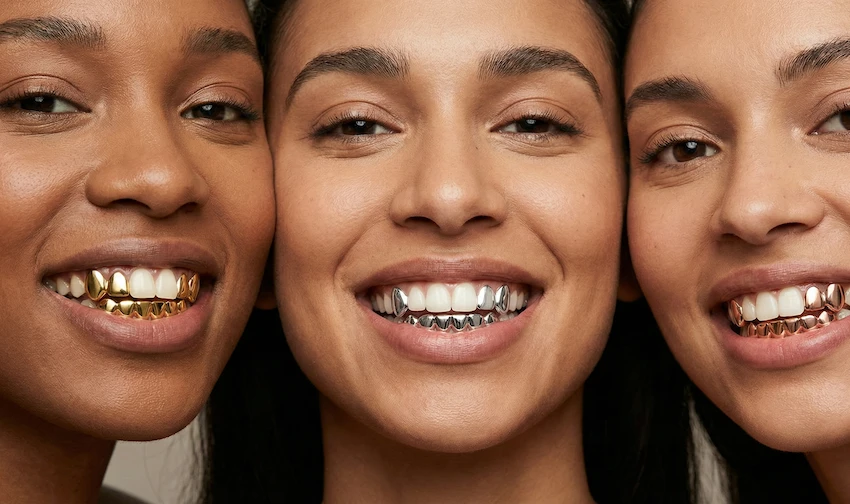
Yellow gold is simply the classic choice. When someone says ‘a grill,’ this is probably the shiny, warm metal that comes to their mind.
Pure 24k gold cannot be practically used in dentistry as it is too soft to withstand the force of the human bite. Thus, to make it durable, gold is alloyed with silver, copper and zinc. This combination produces a metal with a higher strength. However, let us think about the appearance. Yellow gold has a very strong color. It contrasts sharply and becomes very eye-catching against the natural white of human enamel.
If yellow gold were a building, it would be a grand, classical building with heavy doors made of oak—bold, traditional, and obvious in every sense of the word. The complexion of people with warm, olive, or darker skin undertones gets the most out of yellow gold as it highlights the golden tones that are naturally there.
The Sleek Modernist: White Gold
What if you want an expensive metal but just a simpler look? White gold can be your answer.
To get the crystal-clear ice effect, the yellow gold is mixed with white metals such as palladium, silver, or nickel, and is often rhodium-plated for that super-bright finish. Dentist Polen Akkılıç and her team frequently design white gold pieces for patients who want a sleek, modern edge. A white gold piece is like a silver suit that fits perfectly instead of a spotlight.
Because of its cold color, white gold would look great on people with a light complexion and cool undertones (people whose skin has pink or bluish hints). Besides that, it will probably match the person’s natural teeth more, thus only giving a slight brightening effect instead of a very bright one.
The Warm Trendsetter: Rose Gold

Rose gold is the style changer. The metal then acquires a noticeably warm pinkish color by just increasing the percentage of copper in the alloy.
Professor Doctor Coşkun Yıldız often says that rose gold is like a visual chameleon in the oral cavity. It not only harmonizes with the soft tissues of the gums and lips but also contrasts less. It is like a gentle sunset reflecting on the water – warm, inviting, and very different in a good way.
Rose gold has a great many uses. It is a wonderful color for most of the shades of human skin as it is also a point between the loud statement of yellow gold and one of the cool white gold tones.
Comparing the Alloys
Here is a summary of the core differences we explain to our patients after a thorough discussion of their needs:
| Type of Gold Alloy | Primary Metal Additives | Style | Best Skin Undertone Match | Durability |
| Yellow Gold | Copper, Silver, Zinc | Traditional, bold, high-contrast | Warm, olive, dark | Very good (depends on karat) |
| White Gold | Palladium, Silver, Nickel | Modern, sleek, cool | Cool, fair | Very good (may require rhodium re-plating) |
| Rose Gold | Higher copper ratio, Silver | Unique, warm, balanced | Nearly all undertones | Extremely high (copper increases strength) |
The Engineering Behind the Fit
Whatever color you opt for, a well-fitted piece is a medical-grade one, not a novelty to be afraid of. Your teeth are the major support for a healthy bite. You can’t just fit a metal piece over them without spatial engineering. One that is badly fitted will provide a breeding ground for bacteria and thereby will cause your teeth to decay faster.
This is why our patients come to our highly equipped clinics in Turkey. With the help of intraoral scanning, we make a map of the microenvironment of your teeth, which later allows us to precisely fit a yellow, white, or rose gold piece on your mouth.
Frequently Asked Questions
I usually tell them that chemically the gold dental metal of high karat value allegedly doesn’t have to cause any damage to teeth. However, the greatest danger to your teeth is a grill that is poorly fitted or for which therapy is totally neglected. If you get a custom piece that really copies your dental anatomy along with keeping good oral hygiene, your tooth enamel will still be perfectly safe.
Basically, our most common suggestion is 14k or 18k gold. 10k contains so many base metals that it can discolor and even cause gum irritation, but 22k or 24k is just too soft and will be deformed under the pressure of the bite.
Yes, that is right. White gold is generally rhodium-plated in order to get that very white and shiny surface. The acid in your mouth could slowly wear off this layer and then the yellowish color of the alloy underneath will show. So you may need to have a new plating done.
Not at all! In fact, you should think of your custom grill as a piece of fine jewelry, unlike a dental crown which is a prosthetic and is functional. Eating with a grill on causes too much wear and tear on the soft gold and your teeth, besides food particles get trapped against your enamel.
Since we do our digital impressions and milling in Turkey, the turnaround time is super fast. As soon as we get your accurate scans and you have decided on the metal, we will usually be able to make and install the final product within a couple of days.
- Anusavice, K. J., Shen, C., & Rawls, H. R. (2013). Phillips’ Science of Dental Materials (12th ed.). Elsevier Saunders.
- Wataha, J. C. (2002). Alloys for prosthodontic restorations. The Journal of Prosthetic Dentistry, 87(4), 351-363.
- Manappallil, J. J. (2015). Basic Dental Materials (4th ed.). Jaypee Brothers Medical Publishers.
- Craig, R. G., & Powers, J. M. (2002). Restorative Dental Materials (11th ed.). Mosby.
- Roberts, H. W., Charlton, D. G., & Murchison, D. F. (2009). The current state of dental alloys. Journal of the American Dental Association, 140(9), 1146-1153.

