


Minimal risk, maximum safety for kids.
It is a conversation we have almost daily at Lema Dental Clinic. A parent sits in the chair, eyes filled with a mix of concern and protective instinct, and asks: “Is this really necessary? Is the radiation safe for my child?“
We cherish this very defensiveness in our patients. Honestly, as parents, we strive to lessen every risk to the tiniest bit. Yet, dental imaging has gone through quite a revolution lately. Professor Doctor Coşkun Yıldız is frequently emphasizes that switching from conventional film to digital sensors might be the most significant improvement in safety that modern pediatric dentistry has achieved.
The “Banana” Comparison: Understanding Radiation Levels
If we are to determine how safe digital X-rays are, we need to compare them to something. It just so happens that we are all exposed to a certain amount of “background radiation” every day, which comes from the sun, the earth, and even the food that we consume.
Think of it this way: a single digital dental X-ray exposes your child to about the same amount of radiation they would get from eating two bananas or spending a few minutes outside on a sunny day in Turkey. But let’s look closer at the mechanics. Digital sensors are incredibly sensitive to light. Because they “catch” the image almost instantly, they require up to 80% to 90% less radiation than the old-fashioned film X-rays many of us grew up with.
The ALARA Principle: Our Vow at Lema Dental Clinic
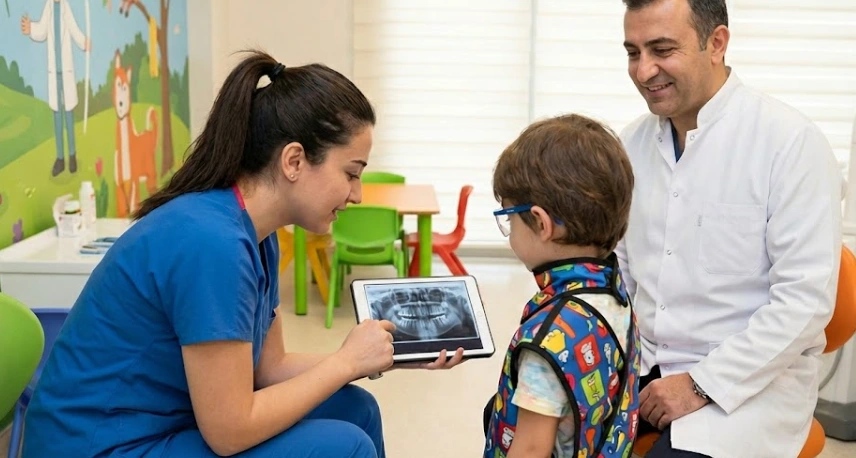
In our Istanbul clinic, Dentist Polen Akkılıç and her team are very mindful of the radiation that is required for the diagnosis of any patient, and especially children. They put into practice the ALARA protocol, As Low As Reasonably Achievable. This is not just a regulation, but a pledge to the safety of the pediatric patients.
- Lead Aprons & Thyroid Collars: To be sure that no unnecessary exposure happens, we give the patient “lead shields” to protect the rest of the body from the scan even if it is only a small amount of radiation.
- Precision Targeting: We don’t take “routine” X-rays. We only recommend them when there is a clinical need, such as checking for hidden decay between tight teeth or monitoring the development of permanent teeth.
- Instant Feedback: Because the images appear on our screens in seconds, there is no “re-taking” due to development errors, which was common with film.
Why We Can’t Always Skip the Scan
The question remains: why take the risk at all? In our clinical experience at Lema Dental Clinic, the risk of not taking an X-ray is often much higher. A small, invisible cavity between two baby teeth can turn into a painful abscess or lead to premature tooth loss in just a few months. Digital X-rays act as our “superhero vision,” allowing us to catch problems while they are small, easy to fix, and painless for the child.
Radiation Exposure Comparison Table
| Source of Radiation | Approximate Dose (mSv) | Safety Context |
| Digital Dental X-ray (Single) | 0.002 | Less than a short 1-hour flight. |
| Traditional Film X-ray | 0.010 | Significantly higher than digital. |
| Daily Background Radiation | 0.008 | Natural exposure from the environment. |
| Eating a Banana | 0.0001 | Natural potassium radiation. |
| Chest X-ray (Medical) | 0.100 | $50x$ more than a single dental digital X-ray. |
FAQ: Expert Perspectives- A Conversation with Our Team
The reality is that baby teeth are much thinner than adult teeth,” says Professor Doctor Coşkun Yıldız. “Decay travels through them like a wildfire. An X-ray helps us stop the fire before it reaches the nerve, saving the child from pain and expensive treatments later.
Not at all,” explains Dentist Polen Akkılıç. “At Lema Dental Clinic, we treat the X-ray machine like a ‘magic camera.’ Children in Turkey are usually fascinated by seeing their own bones on the screen. It becomes an educational moment rather than a scary one.
That is the beauty of digital technology,” the team notes. “The exposure time is less than a second—faster than a camera flash. Even if a child is a bit wiggly, we can usually get a perfect diagnostic image without having to repeat the process.
There is no ‘one size fits all’ answer,” says Professor Doctor Coşkun Yıldız. “A child with a high risk of cavities might need them every six months, while a child with perfect oral health might go two years without one. We customize the schedule for every patient.
Based on current scientific data, the dose is so incredibly low that there are no documented long-term health risks from occasional digital dental imaging,” the team reassures. “It is one of the safest diagnostic tools in all of medicine.
- American Academy of Pediatric Dentistry. (2019). Guideline on Prescribing Dental Radiographs for Infants, Children, Adolescents, and Persons with Special Health Care Needs.
- White, S. C., & Pharoah, M. J. (2014). Oral Radiology: Principles and Interpretation. Elsevier Health Sciences.
- International Commission on Radiological Protection (ICRP). (2007). The 2007 Recommendations of the International Commission on Radiological Protection.
- Ludlow, J. B., & Ivanovic, M. (2008). Comparative dosimetry of dental CBCT devices and 2D panoramic units for pediatric patients. Dentomaxillofacial Radiology.
- Cho, S. Y., & Cheng, A. C. (2005). A review of dental radiography in children. Hong Kong Dental Journal.

