


Aligners suit mild cases, braces handle complex ones.
The mirror might not be lying to you, but it could be quite unforgiving. Perhaps you have seen a misaligned midline, the crowding that seems to have gotten worse since your twenties, or a bite that just feels “off.” That initial doubt is perfectly normal. Braces, after all, are just some teenage thing according to the stereotype and only high school students walk their hallsweare them. However, the reality is quite different.
Clinically speaking, Lema Dental Clinic in Istanbul is experiencing an amazing surge in adult orthodontics. Patients over 30 years old now make up a large part of our patient base. Of course, you can always get your teeth fixed, but the real question should be: what kind of treatment is compatible with your lifestyle and biological needs?
The Biology of Moving “Set” Bone
Knowing your options means knowing the terrain first. A teenager’s jawbone can be compared to wet cement—it is pliable, forgiving, and the movement through it is relatively quick. By 30 years of age, that cement has hardened. It’s like hard concrete now.
Professor Doctor Coşkun Yıldız often illustrates to our patients that relocating teeth of an adult is a bit less like sliding a bead on the string and more like pulling a plow through hard earth. Consistent, controlled force is used. Due to the denser bone and lower metabolic rate, adult treatment may take a little longer than teenage treatment. However, if the right mechanics are utilized, not only are the results stable but they can also be aesthetically very pleasing.
Option 1: Clear Aligners (The “Invisible” Route)
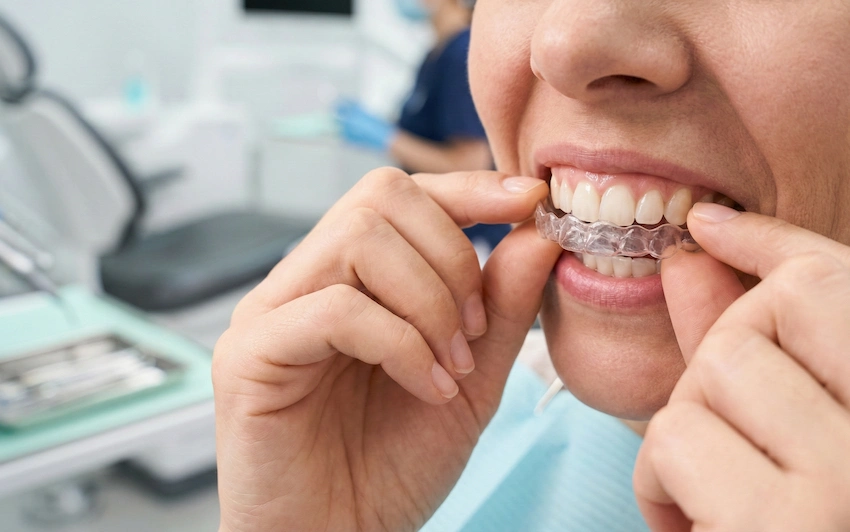
Each one of us must have gone through that moment when the thought of getting metal braces was quite repulsive to us. Anyway, everyone has to go out to meet people, attend meetings or have Zoom calls. That is indeed the big selling point of clear aligners (like Invisalign).
It is a precise mechanism. Aligners change the position of the teeth by exerting a push on them rather than a pull. They are wonderful for teeth that are packed to some extent or that have little gaps between them.
Reasons why Lema patients are so fond of them:
- Hygiene: You can take them out when flossing. This is very important because the condition of the gums tends to become more delicate as we age.
- Aesthetics: They are so inconspicuous that you won’t even notice them in selfies or video calls.
Nevertheless, Dentist Polen Akkılıç and her staff are always ready to facilitate the process with a little help from clear communication.
Aligners need strong will from the patients – they should be worn for 22 hours daily. After a long dinner, if they forget to put them back, the teeth will not start moving right away.
Option 2: Fixed Braces (The Precision Mechanics)
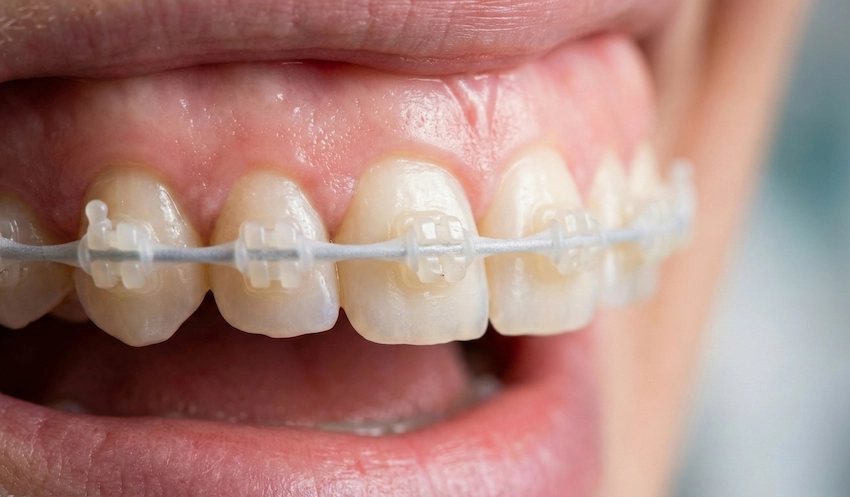
It is often incorrectly assumed that braces are obsolete. However, nothing could be further from the truth. The engineering of modern fixed appliances, especially ceramic or “tooth-colored” braces, is nothing short of amazing.
Aligners push teeth, but braces pull. This “pulling” action offers a degree of three-dimensional control that is sometimes essential in complicated cases, such as when cylindrical teeth need to be rotated (like premolars) or when malocclusion is so severe that it needs to be corrected.
You can imagine trying to steer a car with only your knees as compared to using a precision steering wheel. Aligners are like knees – they can be used on the highway. Braces are like the steering wheel – you need them to drive through narrow, winding streets.
Comparing the Clinical Reality
In order to help you better understand the compromises involved, we have made a comparison based on thousands of cases treated here in Turkey.
| Feature | Clear Aligners | Ceramic / Fixed Braces |
| Visibility | Nearly invisible clear trays | Tooth-colored ceramic brackets |
| Compliance | Requires 22 hours/day wear | Fixed; cannot be removed |
| Hygiene | Excellent; removable for brushing | Moderate; special flossing needed |
| Comfort | Mild pressure; no wire pokes | Initial rubbing and adjustment soreness |
| Best For | Mild–moderate crowding, spacing, relapse | Complex rotations, vertical moves, severe bite issues |
| Clinical Cost | Usually higher lab fees | Often more cost-effective |
The “Gum Health” Factor
One thing often overlooked in general advice articles is additional detail about Periodontal health.
As time passes, our gum tissues slightly recede and the bone levels may fluctuate. The risk of tooth loss will increase if the teeth are moved while gum disease is present. This is precisely why Dentist Polen Akkılıç advocates a “periodontics-first” approach. Before we put a single bracket or scan for a single tray, we make sure that the foundation is solid – your gums. If you have had bone loss before, we might opt for aligners because the forces they exert are gentler and more compartmentalized than continuous archwires.
Why Choose Turkey for Adult Orthodontics?
You might wonder why someone would fly to Istanbul to get orthodontic treatment that usually requires monthly adjustments.
At Lema Dental Clinic, we do things a little differently. For international patients, we often come up with hybrid treatment plans. We can do top-notch diagnostics, imaging, and the initial fitting here in Turkey – Prof. Dr. Coşkun Yıldız, the surgeon, can do any necessary pre-orthodontic extractions or surgical exposures – and then control the progress digitally from abroad.
Besides that, many of our clients are getting veneers or crowns done concurrently with minor orthodontic alignment. This “ortho-restorative” hybrid lets us rectify the root positions before the final porcelain application, thus maximizing your natural tooth structures.
Frequently Asked Questions
Definitely not. It is possible to move teeth at any age provided the jawbone and gums are healthy. There have even been cases of patients in their sixties who were treated successfully. The biological mechanism remains unchanged; however, it necessitates gentler treatment and a little more patience.
It is the most common concern. Brackets alone don’t really cause any damage to the enamel of the teeth. The issue is that if you let plaque accumulate around the bracket and don’t clean it, then it is enamel damage which is the formation of “white spots” (decalcification). Therefore, if you keep up good oral hygiene, your enamel will be totally safe.
It depends, but usually the treatment can be expected to last about 10-20% longer than that of a teenager. The logic behind this is that an adult has a slower metabolism and as a result, the bone remodeling is less rapid. Attempting to speed up this process may cause damage to the roots, which is why we always choose safety over speed.
Certainly, most of the time. If your alignment is small, we can sometimes mask a small misalignment by using high-grade laminates or veneers. You can compare it to “instant orthodontics,” if you want. But, if the teeth are badly overlapped, doing a short alignment treatment will most probably be the advice of Dentist Polen Akkılıç to you so that you can keep your natural tooth structure intact.
Yes. It is hard to accept, but it’s the truth. Teeth have a memory. As soon as the braces are removed, the fibers in your gums will try to return your teeth to their previous chaotic state. Retention is a lifetime commitment for anyone (whether 15 or 50) who wants to hold on to that perfect smile.
- Proffit, W. R., Fields, H. W., & Sarver, D. M. (2018). Contemporary Orthodontics. Elsevier Health Sciences. (Standard text on biological limits of tooth movement).
- Melsen, B. (2012). Adult Orthodontics. John Wiley & Sons. (Focus on tissue reaction in adult patients).
- Boyd, R. L. (2008). Esthetic orthodontic treatment using the Invisalign appliance for moderate to complex malocclusions. Journal of Dental Education, 72(8), 948-967.
- Ong, M. A., & Wang, H. L. (2002). Periodontic and orthodontic interrelationships. Journal of Periodontology, 73(5), 585-600.
- Krishnan, V., & Davidovitch, Z. (2006). Cellular, molecular, and tissue-level reactions to orthodontic force. American Journal of Orthodontics and Dentofacial Orthopedics, 129(4), 469-e1.

