


Yes, minor nosebleeding is completely normal after a sinus lift.
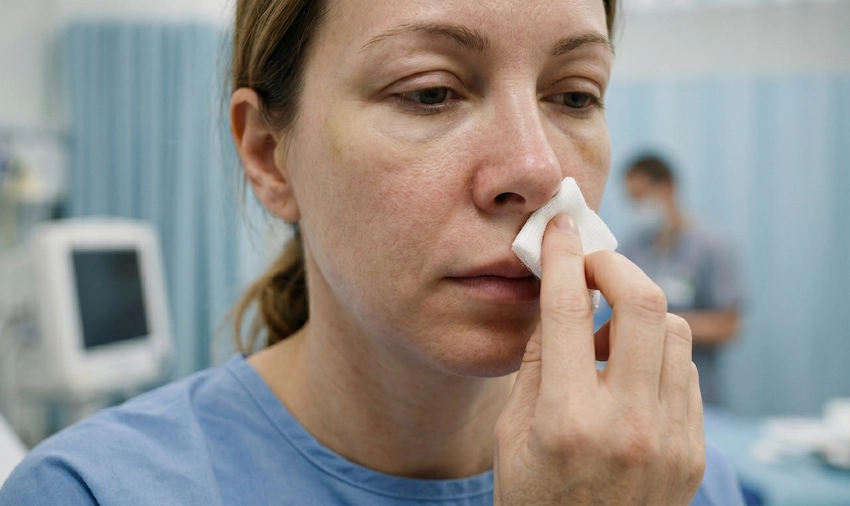
It can be quite scary to see blood on your pillow after a dental operation, but a slight bleed from the nose after a sinus lift is one of the symptoms of normal recovery. Besides being very frightening, it is also quite simple to control.
There is a very thin layer of bone separating your upper jaw and your sinus. Because they are nearly touching, a surgery on your jaw can very easily influence your sinus. Here you will read about why this occurs and what exactly you need to do.
Why Sinus Lift Leads to Nosebleeds?
First of all, let’s have a look at your facial skeleton and bone structures. Missing your front upper teeth, for example, the bone in your upper jaw or maxilla, will decrease gradually in volume and density. This will, in turn, cause the height of the sinus cavity to be lowered. To be able to install properly and stably functioning dental implants, this bone must be rebuilt; in other words, the procedure of sinus lift must be performed.
In a sinus lift or sinus augmentation, the inside of the sinus, or more precisely the sinus membrane, which is very thin like the thin skin (membrane) of an egg, will be lifted. A bone graft is then placed under the membrane to serve as the new strong base.
Since sinuses and the nose share blood vessels, minor bleeding and swelling are quite normal conditions that may occur. Because of gravity, blood drains down, and since the nose is the easiest route for blood, it usually comes out of the nose.
At Lema Dental Clinic, Professor Doctor Coşkun Yıldız states that a patient who is experiencing a little bleeding should keep in mind that this is the body releasing the pressure and is not a serious problem. In fact, bleeding or hemorrhage is a normal part of the healing process and should not be viewed as a failure of your operation.
Bleeding After Sinus Lift and Healing
Your blood changes in color and quantity as you heal. Having a vague idea of what is going to take place can be a source of calmness. We offer this timeline as your roadmap to recovery:
| Time Period | Possible Observations | Expected Actions |
| 0-24 Hours | Blood that is fresh or stale coming from either nostril. Air-tinged saliva. | Rest with your head lifted. Lightly blot your nose with a tissue. |
| Days 2-3 | Minimal bleeding, mainly noticed during bending. | Do not blow your nose. Sleep with your head elevated. |
| Days 4-7 | No bleeding. Mucus may be brown. | Use only the saline drops that your doctor gave you. |
| Beyond 7 Days | Unexpected flow of bright red blood. | Contact your surgical team right away. |
Recovering Safely in Turkey

Turkey attracts a lot of patients who want the smile of their dream, basically due to two major reasons: The first is that they believe in the highly experienced and qualified dentists, and the second is that prices are very low. However, going home after the operation may not be a good idea at all because the body is healing and needs some help and guidance so that the healing process can be successful. This is the reason why Dentist Polen Akkılıç, together with her team, explains the recovery period in detail and guides patients through each step. The way you care for and pamper yourself during the first few days can significantly affect your outcome.
If you expect your bone graft to heal well and the results continue, it is best for you to avoid situations that can lead to an increase in pressure in your head. Check out some of the rules that you need to follow very strictly:
- Do not use a straw when drinking.
- Do not perform heavy physical work.
- Under no circumstances blow your nose.
- If you have to sneeze, make sure to keep your mouth wide open.
Frequently Asked Questions
Please take a deep breath; your graft is absolutely fine. Your body is simply doing a bit of cleaning, getting rid of the old blood, and that is the source of the small bleeding on day two. Even if you have a few drops of blood, it means that your bone remains safe and secure at 100%.
Two to three days at most. After which, you might come across some brown mucus that has dried blood. There is nothing to be concerned about, as it is part of the process.
No way. The surgery site can be compared to a fragile balloon. Blowing your nose exerts an intense pressure that can result in either the tearing of your stitches or your bone graft being displaced.
Only the medications provided by our clinic should be used. Regular nasal sprays will make your nose dry to a great extent and also slow down the healing process.
If the bright red blood keeps dripping, you cannot stop it after 20 minutes of rest with a cold pack, then call us straight away. Also, a high fever and unbearable pain are other symptoms that require you to contact us.
- Misch, C. E. (2015). Contemporary Implant Dentistry (3rd ed.). Elsevier Mosby.
- Pjetursson, B. E., Tan, W. C., Zwahlen, M., & Lang, N. P. (2008). A systematic review of the success of sinus floor elevation and survival of implants inserted in combination with sinus floor elevation. Journal of Clinical Periodontology, 35(8 Suppl), 216-240.
- Testori, T., Wallace, S. S., Del Fabbro, M., & Weinstein, R. L. (2012). Management of complications in sinus grafting procedures. International Journal of Periodontics & Restorative Dentistry, 32(1).
- Urban, I. A., Lozada, J. L., & Jovanovic, S. A. (2012). Maxillary sinus floor elevation: a review of anatomy and surgical techniques. Journal of Clinical Periodontology, 39(11), 1083-1094.
- Wallace, S. S., & Froum, S. J. (2003). Effect of maxillary sinus elevation and survival of dental implants. Annals of Periodontology, 8(1), 328-343.

