


Yes, it is safe and vital.
There is an old, lingering myth in many cultures that says, “Gain a child, lose a tooth.” It’s a frightening thought for any expectant mother. However, the modern clinical reality is quite the opposite. At Lema Dental Clinic in Turkey, we find that maintaining your oral health is not just “safe” during pregnancy—it is actually a fundamental part of prenatal care.
The hesitation is quite reasonable. A pregnant woman can barely breathe without feeling that everything is suddenly so important. One even questions every pill, every meal, and definitely every medical procedure of choice. Still, a biological point persists: The mouth is the body’s gateway that, during pregnancy, experiences a major hormonal upheaval. Trying to cure a dental problem blindly is not a way of protecting the baby. It can even lead to systemic inflammation, which may affect your pregnancy.
Professor Doctor Coşkun Yıldız keeps telling our patients that “pregnancy gingivitis” is not just a dental term; it’s a vascular response. Bacteria attack your more sensitive gums, they are just like a garden which is suddenly given too much fertilizer, so the plants grow very fast and there is inflammation.
The Trimester Timeline: When to Visit the Clinic
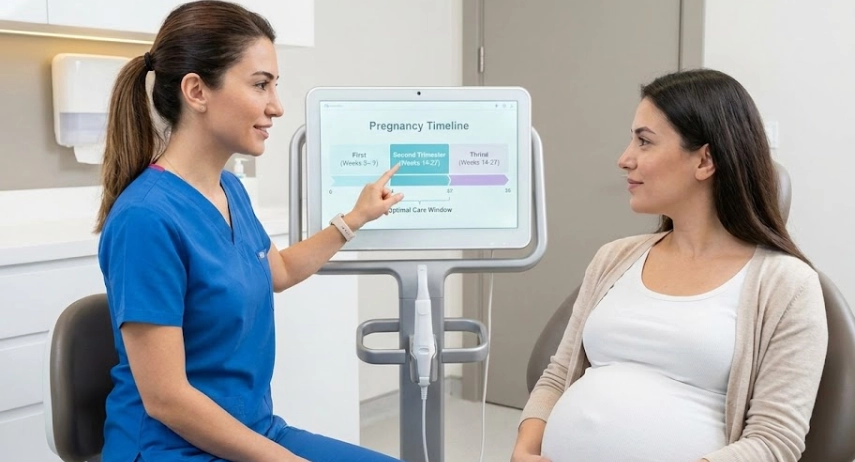
In our clinical experience at Lema Dental Clinic, timing is everything. While emergency care can be performed at any stage, we generally aim for a specific “sweet spot” for routine treatments.
During the first trimester, the majority of the baby’s organs are developed which means it’s a very bright time to embryogenesis. At the same time, it’s the time when many mothers find morning sickness difficult to cope with. So, the question is: is it advisable to wait? If it is about cleanings and exams, yes, it is better to wait until the second trimester if it is possible. Nevertheless, the truth is that the second trimester (weeks 14 through 28) is the best time. By then, the baby’s development is pretty much done, and the mother is usually more comfortable being in a dental chair.
Addressing the “Big Three” Concerns: X-rays, Anesthesia, and Meds
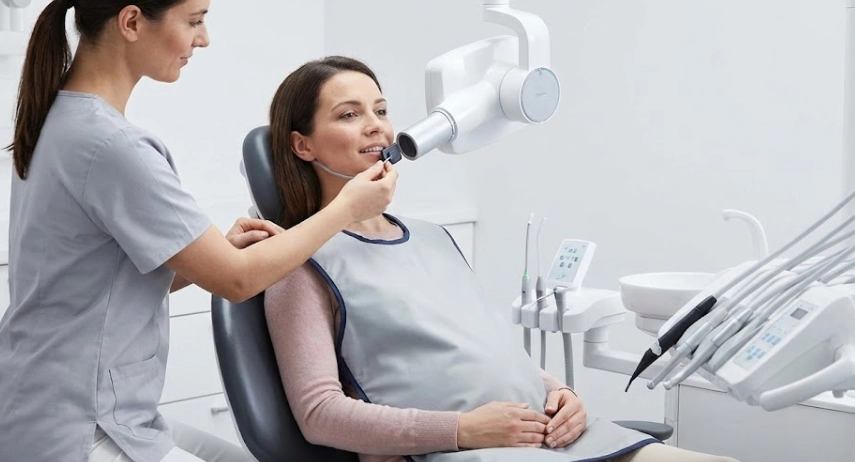
We hear the same concerns from almost every mother visiting us in Turkey. Let’s break down the clinical facts:
- Dental X-rays: Modern digital X-rays used by Dentist Polen Akkılıç and her team emit extremely low doses of radiation. When combined with a leaded apron and thyroid collar, the exposure to the abdomen is virtually non-existent. We only take them when necessary for diagnosis.
- Local Anesthesia: Studies have confirmed that lidocaine and other common local anesthetics do not pose a risk to the developing fetus. We employ the least amount of medication that will still keep you comfortable because high levels of your stress hormones (cortisol) can be more harmful to the baby than the anesthetic.
- Antibiotics: If you have an infection, it must be treated immediately with antibiotics. If dental infections are left untreated, they can increase the risk of preterm birth. We exclusively prescribe only “Category B” or safe antibiotics during pregnancy, e.g., penicillin or clindamycin that have been both proven safe and effective.
Dental Care Safety Comparison by Trimester
| Trimester | Recommended Care | Risk Level | Clinical Focus |
| First (Weeks 1-13) | Emergency care only; Routine exams. | Low/Moderate | Focus on home care; Manage morning sickness acidity. |
| Second (Weeks 14-27) | Optimal time for fillings, crowns, and cleanings. | Lowest | “The Sweet Spot”; Patient comfort is highest. |
| Third (Weeks 28-Birth) | Urgent care only; Routine cleanings. | Low/Moderate | Avoiding long periods lying flat on the back. |
The Dangers of “Waiting it Out.”
There is still the question of what if you don’t go to the dentist until after the baby is born? It is a fact that gum disease causes pre-eclampsia and low birth weight. Consider a dental infection as a fire burning in a building’s basement. Although you might not see the smoke on the top floor, the heat is already affecting the whole building.
Professor Doctor Coşkun Yıldız notes that “pregnancy tumors” (pyogenic granulomas)—which are non-cancerous but painful gum swellings—can often be prevented with simple, regular professional cleanings.
FAQ: Your Pregnancy Concerns Answered
This is a total myth. Your baby gets the calcium they need from your diet, not your teeth. However, hormonal changes can make your gums bleed more easily, which can lead to tooth loss if ignored. It’s a gum issue, not a calcium heist!
Actually, no. The reality is that stomach acid softens your enamel. If you brush right away, you’re essentially scrubbing that acid into your teeth. Rinse with water and a pinch of baking soda first, then wait 30 minutes to brush.
At Lema Dental Clinic, we advise waiting. Implants are elective surgery. While we could do it, we prefer to wait until after the baby is born to avoid unnecessary surgical stress and the need for post-operative medications.
This is often ‘pregnancy gingivitis.’ Your body is overreacting to plaque due to high progesterone levels. Dentist Polen Akkılıç and her team can provide a gentle professional cleaning that will calm the inflammation almost immediately.
Yes, but we adjust for your comfort. We avoid lying you flat on your back to prevent ‘supine hypotensive syndrome.’ We keep you at a slight incline and tilted to the left to keep your circulation—and the baby’s—clear.
- American Dental Association (ADA). (2021). Oral Health During Pregnancy: FAQ for Patients.
- American College of Obstetricians and Gynecologists (ACOG). (2013). Oral Health Care During Pregnancy and Through the Lifespan.
- Hagai, A., et al. (2015). Pregnancy outcome after first-trimester exposure to local anesthetics in dental treatment. The Journal of the American Dental Association.
- Silk, H., et al. (2008). Oral Health During Pregnancy. American Family Physician.
- Newnham, J. P., et al. (2009). A randomized controlled trial of periodontal treatment to prevent preterm birth. Journal of Periodontology.

