


Removal is quick, safe, painless
Trends come and go. What felt like the perfect sparkle a year ago might not fit your professional vibe today. Or perhaps you simply want a change. But as you look in the mirror at that small crystal bonded to your incisor, a single worry grips you: Is getting this thing off going to hurt?
We can put your mind at ease immediately. Removing a tooth gem is completely painless. In fact, it is one of the least invasive procedures we perform at Lema Dental Clinic. There are no needles, no numbing agents, and absolutely no drilling into your natural tooth structure.
But let’s look closer at why it is painless, and the specific technique Dentist Polen Akkılıç uses to ensure your enamel stays pristine.
It Is Not Extraction; It Is “Debonding”
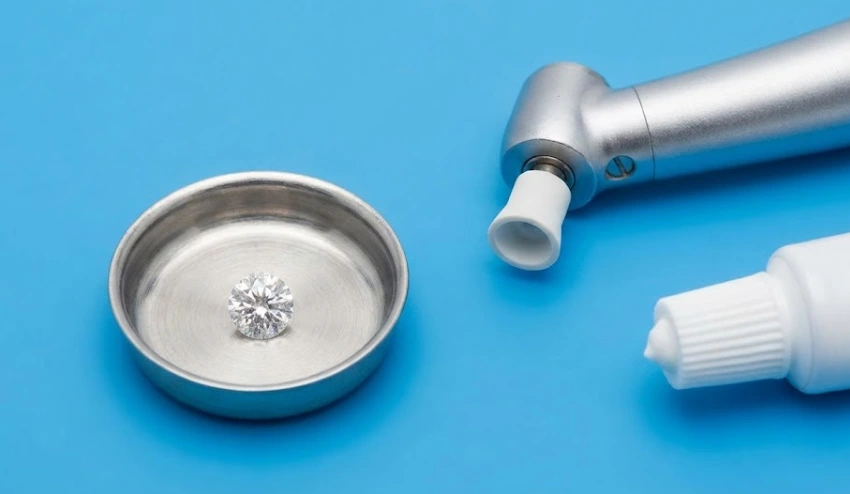
To understand how it was removed, you first have to recall how the jewel was fixed. We didn’t make a hole to set the stone; we simply stuck it on the surface with a flowable composite—a material that is also used for orthodontic braces.
Hence, removing a tooth gem is basically the same thing as taking off braces.
Imagine your tooth as if it were a glass window and the gem as a sticker glued on with superglue. To remove it, we don’t have to break the glass. We just have to carefully interrupt the glue layer.
Professor Doctor Coşkun Yıldız often explains it to patients this way: “We are not treating the tooth; we are treating the surface.” Since the nerve of your tooth is buried deep inside the pulp chamber and we are working only on the outer enamel shell, there is no pathway for pain signals to travel. You will feel vibration, a little pressure, and the cool spray of water, but sharp pain is biologically impossible during this procedure.
The Professional Removal Process
When you visit our clinic in Turkey for this procedure, the steps are swift—usually taking less than 15 minutes.
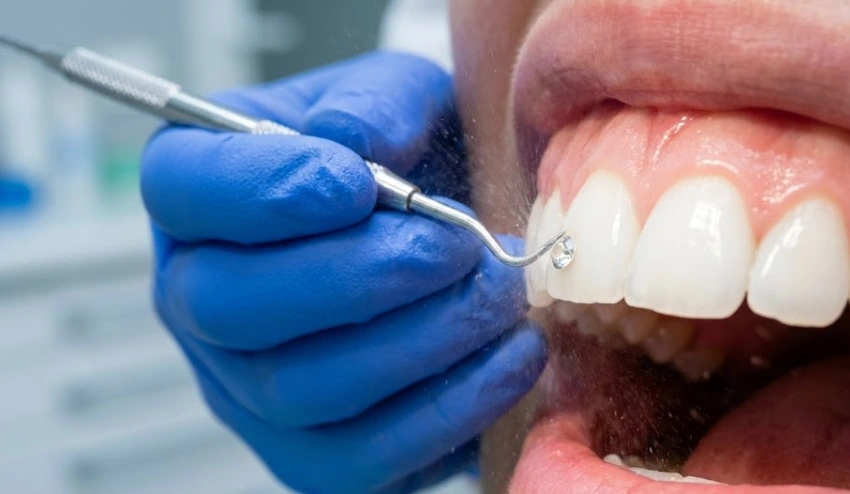
- The “Pop”: Using a specialized scaler, we apply gentle pressure to the base of the gem. In most cases, the bond weakens, and the stone pops off in one piece.
- The Cleanup: This is the most critical step. Once the stone is gone, a rough patch of adhesive remains.
- Polishing: We use a soft polishing disc to buff away the remaining resin. This restores the glass-like smoothness of your enamel.
Why You Should Never “DIY” This
Here is what we see in the clinic far too often: Patients who tried to pry the gem off at home with tweezers or, worse, nail clippers.
While the professional procedure is safe, the DIY version is dangerous. Although you can pry the gem open forcibly, you run the risk of fracturing the enamel prism—so in other words, you may chip your tooth together with the glue.
In addition, it is impossible to polish off the adhesive by yourself. As a result, the tooth will have a rough and sticky spot that will attract the plaque, become stained very quickly, and feel irritating for the tongue.
Comparison: Professional vs. At-Home Removal
| Feature | Professional Removal at Lema | DIY / At-Home Attempt |
| Pain Level | Zero (Pain-free) | High Risk (Potential for slip/injury) |
| Enamel Safety | Protected via controlled polishing | High risk of chipping or scratching enamel |
| Residue | Completely removed; surface restored | Rough glue remains; attracts yellow stains |
| Tools Used | Ultrasonic scaler & polishing cups | Tweezers, files, or sharp household items |
| Time Required | 10–15 Minutes | Unpredictable |
FAQ: Your Questions Answered by the Experts
No. Because we do not drill into the tooth to place the gem, there is no hole to fill when we remove it. Once Dentist Polen Akkılıç polishes the residual adhesive, your tooth will look exactly as it did before the gem was placed—smooth and white.
Yes! In fact, we often recommend it. Sometimes, the area under the gem is slightly lighter than the rest of the tooth because it has been shielded from coffee and wine stains. A quick whitening session helps blend the tone perfectly, ensuring a uniform color across your smile.
Don’t panic. The gems used (usually Swarovski crystals or small gold pieces) are non-toxic and have rounded edges. They will pass through your digestive system naturally without causing harm. However, you should still visit the dentist to have the leftover rough glue polished off your tooth.
It is generally a very affordable procedure. If you are already coming to Turkey for a check-up or cleaning, we often include it as part of the hygiene session. It is significantly cheaper than a filling or cosmetic bonding because it requires no expensive materials, only skill and time.
If the gem is made of gold or a genuine diamond, it can usually be preserved. We handle these removals with extra care to ensure the stone isn’t lost in the suction. However, crystal or glass gems may chip during removal, as they are more fragile. If you intend to keep the jewelry, please tell us before we begin.
- Moraes, R. R., et al. (2018). Polishing methods of residual resin after bracket removal: a systematic review. General Dentistry, 66(1), 48-53.
- Gurel, G. (2003). The Science and Art of Porcelain Laminate Veneers. Quintessence Publishing. (Context on bonding protocols).
- Summit, J. B., et al. (2006). Fundamentals of Operative Dentistry: A Contemporary Approach. Quintessence Publishing.
- Bishara, S. E., & Trulove, T. S. (1990). Comparisons of different debonding techniques for ceramic brackets: an in vitro study. American Journal of Orthodontics and Dentofacial Orthopedics, 98(2), 145-153.
- Van Waes, H., et al. (2010). Tooth jewelry: a review of the literature. Deutsche Zahnärztliche Zeitschrift, 65, 290-297.

