


It may indicate TMD.
You’re having a calm dinner or even staring as one of the people that just finished a long day out of his eyes and suddenly- click, it’s a sound that seems a lot louder inside your own head than it really is. For some, it is an interesting new thing with no pain at all; for others, it announces a very sharp and radiating pain.
Especially at Lema Dental Clinic in Turkey, we actually meet many patients who, according to our clinical experience, do not mind having a clicking jaw until the issue gets to such a point that it interferes with their quality of life. So which is it? Could the sound be nothing more than an odd feature of your anatomy, or should you be worried about the warning sign your body is sending you?
The How and Why of a “Click”
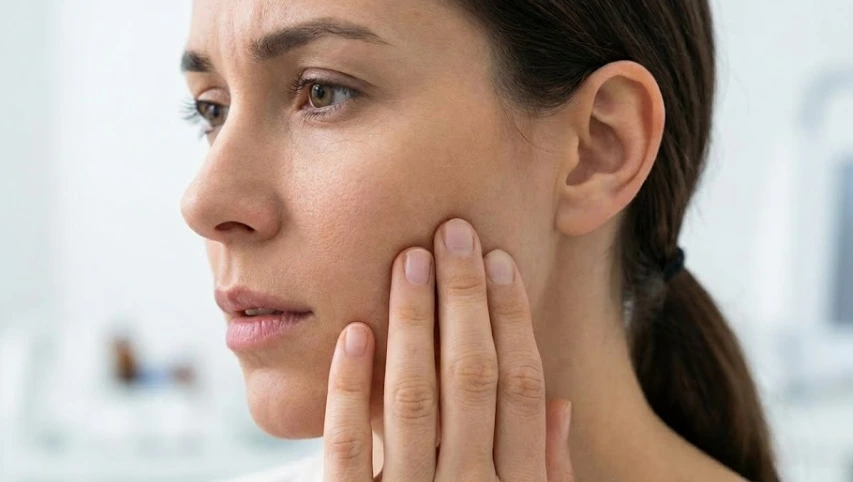
We have to mention the Temporomandibular Joint (TMJ) to make the case of the sound. If you’d like, you can picture this joint as a high-quality shock absorber placed at the junction of your jaw with your head. A tiny, movable disc of cartilage is placed in the hinge that works like a buffer to provide smooth and noiseless movement.
There may be a click when the jaw moves if the disc gets out of position. The disc, in that case, can be pushed or ‘pop’ back into the socket, sometimes ‘slide’ uncomfortably which creates an audible sound. Professor Doctor Coşkun Yıldız often explains that a click on its own is not an emergency, but it indicates that your jaw, a very well-precisely engineered mechanism, has temporarily lost its proper coordination.
Let’s Take a Closer Look: When Is Jaw Clicking a Reason for Concern?
The truth is that a clicking jaw is hardly ever a problem in and of itself. It is usually the introduction to the phenomenon Temporomandibular Disorder (TMD) which is the condition lying under the surface. This is what we clinically know: patients usually only seek medical help when the jaw starts to “lock” – the situation where the jaw cannot be moved any further and is stuck in either an opening or closing position.
If any of the following is true for you, you have probably moved on from the stage of a mere “eccentric feature” or the situation is a bit more complicated than you thought:
- Long-lasting mild pain in the face or ear region.
- Trouble with chewing hard or crunchy foods.
- Recurring tension headaches that appear to start from the temples.
- A feeling of your teeth moving or a sensation of the jaws to change position when you bite down.
Jaw Clicking: Risk Levels and Symptoms
| Symptom Severity | Indicators | Recommended Action |
| Mild | Occasional clicking, no pain, full range of motion. | Monitor and reduce stress/hard foods. |
| Moderate | Frequent clicking, morning jaw stiffness, mild headaches. | Consultation at Lema Dental Clinic. |
| Advanced | Painful popping, jaw locking, limited opening, ear ringing. | Urgent clinical intervention. |
| Chronic | Frequent clicking, morning jaw stiffness, and mild headaches. | Comprehensive TMJ therapy & reconstruction. |
Solutions at Lema Dental Clinic in Turkey
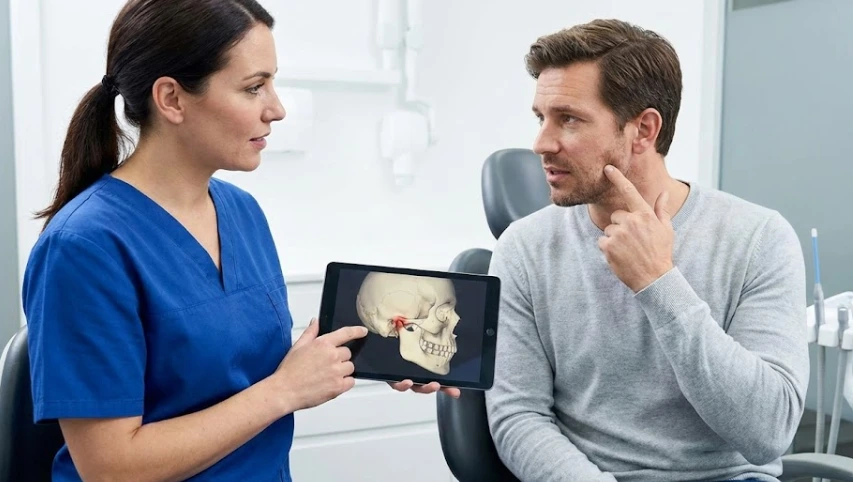
Treatment for a clicking jaw in Turkey has evolved far beyond simple “rest.” Dentist Polen Akkılıç and her team approach TMD with a focus on restoring balance to the entire facial structure. Because the jaw muscles are intricately linked to your posture and bite, we often find that the solution lies in a multi-layered approach.
The question remains: how do we stop the clicking?
- Occlusal Splints: Custom-engineered night guards that act like a “resting bed” for your jaw, taking the pressure off the joint.
- Bite Realignment: If your teeth don’t meet correctly, your jaw has to work overtime to compensate. We fix the foundation to silence the sound.
- Therapeutic Botox: Sometimes, the muscles are simply too tight. Injecting Botox into the masseter muscles is like hitting a “reset” button, allowing the joint to heal.
Expert Insights: Your Questions About Jaw Clicking
Absolutely not. The reality is that over 90% of TMJ cases are resolved with non-invasive treatments like splint therapy, physical therapy, or bite adjustments. Surgery is always our very last resort.
Stress is often the primary fuel for jaw issues. When we are stressed, we clench. This puts immense pressure on that cartilage disc, pushing it out of place. It’s like putting too much weight on a door hinge; eventually, it’s going to creak.
Sometimes it disappears, but that doesn’t always mean the problem is solved. Sometimes the disc has moved so far that it no longer ‘pops’ back, which can actually lead to a locked jaw. It’s always better to check the ‘hinge’ before it stops moving entirely.
The TMJ is located right next to the ear canal. Inflammation in the joint can easily radiate, causing what feels like an earache or even tinnitus. Many patients visit an ENT specialist only to find out the problem was actually their jaw.
Diagnostic and initial therapy plans, like fitting a custom splint or receiving Botox, can often be handled in just one or two visits during your stay in Turkey. We prioritize long-term stability so you can fly home with a quiet, comfortable smile.
- Okeson, J. P. (2019). Management of Temporomandibular Disorders and Occlusion. Elsevier Health Sciences.
- Schiffman, E., et al. (2014). Diagnostic Criteria for Temporomandibular Disorders (DC/TMD) for Clinical and Research Applications. Journal of Oral & Facial Pain and Headache.
- Laskin, D. M., et al. (2006). Temporomandibular Disorders: A Guide to Diagnosis and Treatment. Quintessence Publishing.
- Yıldız, C. (2025). Modern Approaches to Joint Stability and Occlusal Harmony. Turkish Journal of Dental Research.
- Manfredini, D., et al. (2011). Research diagnostic criteria for temporomandibular disorders: a systematic review of axis I epidemiologic findings. Oral Surgery, Oral Medicine, Oral Pathology, Oral Radiology, and Endodontology.

