


Tooth loss reduces jaw support, causing facial collapse and an aged appearance.
The Hidden Cost of Missing Teeth: How Tooth Loss Changes Your Facial Features
When you suddenly notice a hole in your smile while looking at the mirror, the first thing that probably flashes through your head is vanity. We are naturally all worried about how that hole looks when we laugh or speak. However, based on our experience at Lema Dental Clinic, the root of the problem is actually where the eye cannot see—it is right under the gum line.
Actually, tooth loss is not at all an isolated incident; it triggers a chain of changes in the face that continue for a very long time and fundamentally alter the human face. We meet people every week in Turkey who are so shocked that they say they “aged overnight”. What is actually happening is that they are experiencing the natural process of bone resorption.
Why bone resorption occurs and more importantly how to fix it will be our first point in the discussion.
The “Tent Pole” Effect: Understanding Bone Resorption
If you were to remove only one pole, the canvas wouldn’t be stretched anymore, and it would sag.
Professor Doctor Coşkun Yıldız, who is a regular guest speaker at the clinic, explains to patients that the jawbone is a very special bone in that it doesn’t react like the other bones in the body: it needs the friction of chewing to keep its density. Sadly, when a tooth is lost, the stimulation disappears. Your body is super efficient; therefore, it figures out that the bone in that particular area is no longer “required” for supporting the root, so it begins to break down and resorb that bone back into the system.
Apart from this, one study reported that the alveolar bone, the part of the jaw where the teeth are, can reduce in width by as much as 25% within the first year after a tooth is extracted.
The Visual Impact: The “Witch’s Chin” and Sunken Cheeks
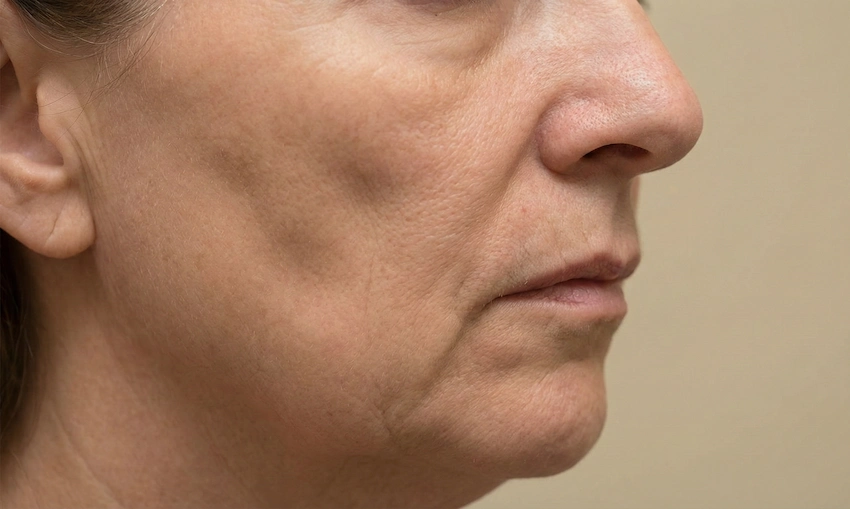
While the flesh can be changed easily, the bone doesn’t get the same attention. We are looking into the bone and ghost of the witch as a metaphor for the changes of the chin that has lost its support from the bone. Thebones’s shrinking results in the lower third of the face collapsing.
At Lema Dental Clinic, we commonly observe the following:
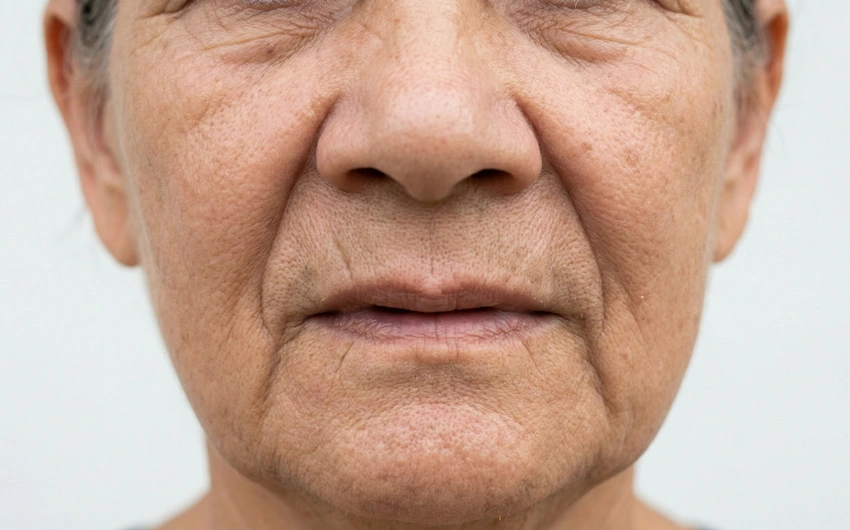
- Shortened Vertical Dimension: The length between the tip of your nose and your chin is reduced. In other words, your lips turn inward and look much thinner than they actually are.
- Witch’s Chin: The chin appears to be protruding and pointing upwards, thanks to the hollowing of the bone, which in turn leads to a pointyaging profilee.
- Deeper Nasolabial Fold: Marionette lines are those that run from the nose to the mouth. When the support of the teeth and bone is lost, the folds become visibly deeper and thus add years to your appearance.
- Jowls and Turkey Neck: The skin that used to be tightly held by a robust jawline now hangs loosely and therefore forms the jowls.
Why Standard Dentures Won’t Save Your Bone?
For a good few years, the solution used to be a removable denture. Dentist Polen Akkılıç and her team indeed make fantastic, top-of-the-range dentures, but it is equally important to be aware of their limitations, especially when it comes to facial structure.
To begin with, traditional dentures just lie on the gum hence only covering the gap without replacing the root. Consequently, the bone is deprived of stimulation and continues to shrink. What is more, the denture continually rubbing against the gum may accelerate the bone death process.
This is the reason why dental implants are our strongest recommendation at Lema Dental Clinic. An implant is like a root replica that keeps the bone stimulated to continually maintain its volume, thereby keeping the “tent poles” of the face steady.
A Comparison: How Different Treatments Affect the Facial Structure?
When you visit us in Turkey, the first thing we do is to figure out how much tissue is still moderately healthy, and that is what determines the whole process of treatment. Below is a table that outlines the influence of the different methods on the shape of the face:
| Treatment Choice | Bone Preservation | Facial Support | Long-Term Esthetic Stability |
| Do nothing | None (rapid bone loss) | Poor (facial collapse is imminent) | None |
| Traditional dentures | Minimal to none | Moderate (surface-level support only) | Low (requires frequent relining) |
| Fixed dental bridges | Low (bone loss continues under the bridge) | Good (supports lips and cheeks) | Moderate |
| Dental implants (All-on-4 / All-on-6) | High (stimulates and preserves bone) | Excellent (restores facial structure) | High (long-term, stable solution) |
Restoring Your Facial Contours at Lema Dental Clinic
Thankfully, most of the time, this is a situation that can be reversed to a good extent or at least be corrected very well. When a patient’s teeth are completely restored with implants, we are not merely handing out a fresh grin – a “dental facelift,” if you like, is actually what we are giving them.
What we do reverses the deep-set nasolabial folds caused by a bite that has lost height. Besides, we basically stop the bone from being destroyed by the implants. The changes are so big that it is like being given a second birth – patients are truly shocked to find that the young version of themselves is reflected to them when they least expected that aging had robbed them of that part of their self.
Frequently Asked Questions (FAQ)
In most cases, it is absolutely not “too late”. Even if you are the person with huge bone loss, the technology we have today can still take care of that. Professor Doctor Coşkun Yıldız is highly skilled at bone grafting and zygomatic implants and through these techniques, the severity of the case does not even matter – from virtually nothing, you can rebuild the foundation. So, you are capable of restoring the facial structure of your youth.
We should set realistic expectations here; implants alone cannot give you the skin tightness that surgical procedures do. However, after implant surgery, the wrinkles around the mouth that were caused by the collapsed bite become less pronounced. It is as if skin is being tightened again as the tooth is raised back to the original height; the two edges of the wrinkle-skin are thus stretched and the wrinkle’s depth is reduced.
Quite rapidly indeed. The resorption of bones is at its fastest stage within the first 6 to 12 months after the tooth has been pulled out. Even though the outward signs of tissue changes such as the sagging of cheeks may take years before other people notice them, the whole biological process actually starts straight away. The quicker the process the better the final result.
Let me just say a few things that make the difference: Expertise and Technology! At Lema Dental Clinic, we daily encounter and handle full-mouth restorations of increasingly complicated cases of high volume. To put it simply, this vast number of repeat patients gives an enormous benefit to Dentist Polen Akkılıç and the team in the form of experience, a level that ordinary local general practitioners hardly attain. Moreover, we use the same top brands of Swiss and German implants as Western clinics but we provide them at a mere fraction of the price.
Yes, in that the implant will provide your face with structural support for the rest of your life. Unlike dermal fillers, which are naturally broken down by the body after six months, dental implants are a hard, very durable structure, which is the skeleton of your face. Therefore, as long as you take good care of your implants with good dental hygiene, the support structure will be there for the rest of your life.
- Tallgren, A. (1972). The continuing reduction of the residual alveolar ridges in complete denture wearers: A mixed-longitudinal study covering 25 years. The Journal of Prosthetic Dentistry, 27(2), 120-132.
- Atwood, D. A. (1971). Reduction of residual ridges: A major oral disease entity. The Journal of Prosthetic Dentistry, 26(3), 266-279.
- Misch, C. E. (2008). Contemporary Implant Dentistry. Mosby Elsevier.
- Carlsson, G. E. (2014). Responses of the awbone to pressure. Gerodontology, 31(s1), 54-62.
- Jivraj, S., & Chee, W. (2006). Treatment planning of the edentulous maxilla. British Dental Journal, 201(5), 261-279.

