


A dark tooth after a root canal can be lightened with internal bleaching.
It happens slowly. One morning, you look in the mirror and notice that the tooth which was root canal treated a few years ago, doesn’t quite go with the rest of the teeth anymore. Although the rest of your smile is still quite bright, this one particular tooth has become a bit of a grayish-purple stain. You keep looking at it, and it appears to you exactly as a “bruised apple” in a bowl of perfectly good fruit.
At our dental office in Istanbul, we have lots of similar cases. People come to us really disappointed since they have already tried traditional whitening treatments or over-the-counter gels which work great on surface stains, but do not affect the root canal discoloration.
However, the truth is the darkness is not on the surface; it is from the very “heart” of the tooth.
Why Do Root Canal Teeth Become Consistently Dark?
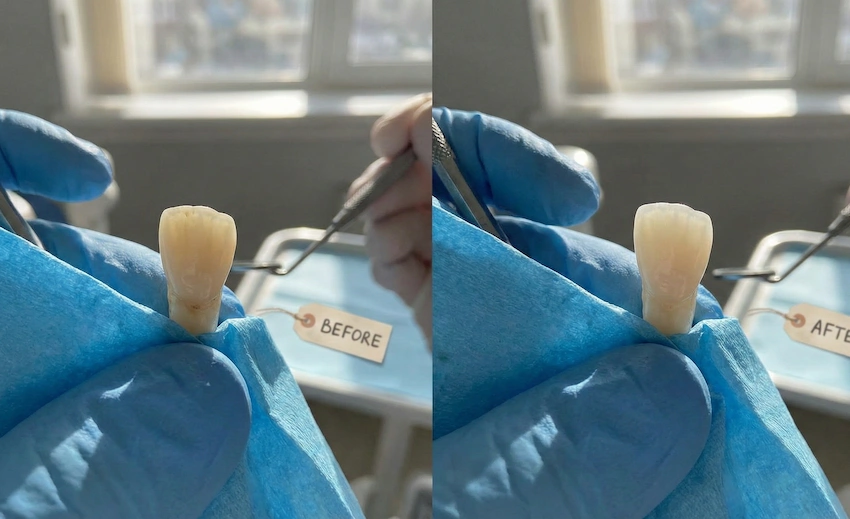
Imagine a tooth as a house. Normal whitening is similar to painting the outer part of a house. However, if a tooth goes dark after a root canal, it is as if a fire has occurred inside the house and the soot is now on the windows.
Once the root canal is done, the living pulp is taken out. Occasionally, microscopic particles of blood or medicaments may be left behind in the dentin. Gradually, these organic materials degrade, releasing pigments that travel into the tooth’s structure from the inside. Professor Doctor Coşkun Yıldız consistently reminds us that the durability of these teeth is very important; we are not only dealing with the problem of discoloration but also the challenge of a tooth that has become increasingly brittle over time.
The Answer: Internal Bleaching (“Walking Bleach” Method)
The question that arises is: if external gels do not help, how to get to the stain? The solution is internal bleaching.
This is what happens in the clinic: instead of putting bleach on the surface of the tooth, Dentist Polen Akkılıç and her team carefully make a small opening at the back of the tooth (through the older root canal access). A certain medical-grade whitening agent is then directly placed into the empty pulp chamber.
- Seal it: The bleaching agent is sealed in the tooth.
- Hang on: You continue with your daily routine while the agent is getting rid of the internal stains.
- Outcome: After 3 to 7 days, we check the color. If it is the same as your other teeth, the agent is taken out and a fresh permanent composite filling is placed.
When Bleaching Isn’t Enough: Aesthetic Masking
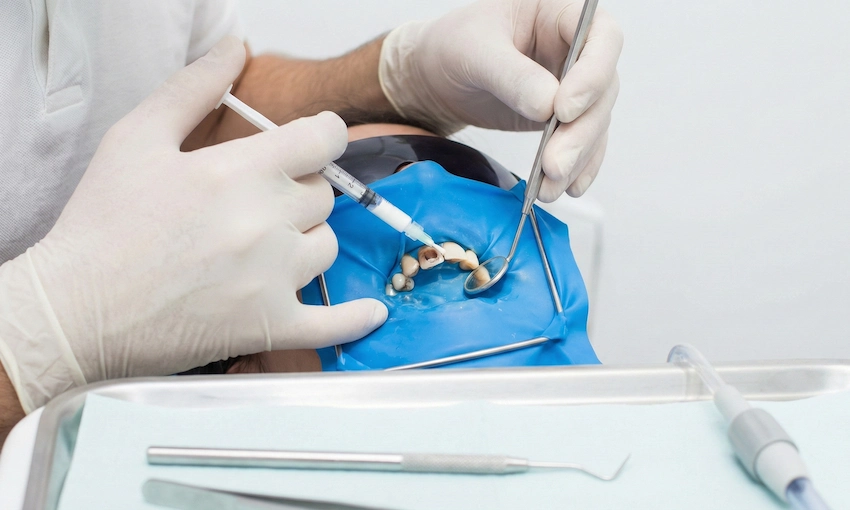
Sometimes, we are dealing with a kind of staining that is so deep or the tooth itself is so fragile that we cannot resort to bleaching as an option. Based on our very own clinical experiences at Lema Dental Clinic, we focus on tooth survival first. If the tooth is already heavily filled or extremely weak, then we are talking about a “protective cover.”
- E-Max Veneers: Extremely thin ceramic shells that replicate the natural enamel.
- Zirconium Crowns: A full-crown “helmet” for the tooth that offers both great strength and a block for the dark color of the underlying tooth.
Comparing Your Options
| Feature | Internal Bleaching | Porcelain Veneer | Dental Crown |
| Primary Goal | Remove internal stain | Mask stain & reshape | Restore strength & color |
| Invasiveness | Low (uses existing hole) | Moderate (shaving enamel) | Higher (360° preparation) |
| Longevity | 1–5 years (may need touch-up) | 10–15 years | 15+ years |
| Time in Turkey | 3–5 days | 5–7 days | 5–7 days |
| Best For | Structurally sound teeth | Minor chips + discoloration | Brittle or broken teeth |
The Lema Experience in Turkey
Choosing to treat a discolored tooth in Turkey at Lema Dental Clinic means blending advanced clinical technology with a deep understanding of facial aesthetics. We don’t just want the tooth to be white; we want it to have the “vitality” of a living tooth. Dentist Polen Akkılıç emphasizes that the “dead” look of a root canal tooth can only be fixed by understanding how light passes through porcelain and dentin.
FAQ: Insights from Our Doctors
Not at all. The nerve has been removed during the original root canal so the tooth no longer feels anything. There might be pressure you feel when the procedure is done, but the “walking bleach” method is absolutely painless.
The short answer is no. Normal whitening tends to affect only the enamel. It is the discoloration of a root canal tooth that occurs in the dentin, which is pretty deep inside. If the whitening is only on the outside, the rest of the teeth will look brighter and so the dark tooth will stand out even more, in most cases.
Teeth that have had a root canal are naturally more brittle because they lose the blood flow. However, expert internal bleaching is very safe. If the tooth’s walls are very thin, Prof. Dr. Coşkun Yıldız will probably suggest a crown that will allow the tooth to be used without fear of fracture while also addressing the discoloration.
Who knows? In some cases, it stays for years. In other cases, after 2 or 3 years, the pigments might gradually come back. You know that with Lema, if you want, it is easy to do a “top-up” treatment or change over to a permanent veneer at any point.
Most patients take the opportunity to get the full “Hollywood Smile” or the professional cleaning together with the single tooth treatment. Besides that, the extraordinary materials and the perfection of the experts of our Turkish team can be enjoyed at only a small fraction of the price which is in the UK or the US, and the quality is that of premium, not compromised.
- Plotino, G., Buono, L., Grande, N. M., Pameijer, C. H., & Somma, F. (2008). Nonvital tooth bleaching: a review of the literature and clinical procedures. Journal of Endodontics.
- Dietschi, D. (2006). Nonvital bleaching: self-acting paste vs. in-office technique. European Journal of Esthetic Dentistry.
- Zimmerli, B., Jeger, F., & Lussi, A. (2010). Bleaching of non-vital teeth: A review. Schweizer Monatsschrift für Zahnmedizin.
- Attin, T., Paqué, F., Ajam, F., & Lennon, A. M. (2003). Review of the current status of tooth whitening with the walking bleach technique. International Endodontic Journal.
- Dahl, J. E., & Pallesen, U. (2003). Tooth bleaching—a critical review of the biological aspects. Critical Reviews in Oral Biology & Medicine.

