


A failed root canal may cause pain, swelling, sensitivity, bad taste, or a recurring gum bump.
You endured the procedure. You adhered to the post-treatment care guidelines. You assumed your tooth was finally secured.
It turns out, biology doesn’t always stick to the plan. In fact, there are cases where a root canal just doesn’t work. And the sudden unbearable pain in a tooth you considered “dead” can be quite scary. It’s as if the tooth that you trusted has turned against you. However, let’s examine this a bit more. A failed root canal doesn’t necessarily mean that the tooth is doomed. All you need to do is recognize the symptoms and act swiftly.
According to what is seen by us in our dental practice in Turkey, the first step to saving your natural smile is finding out these signs early.
Root Canals Fail Due to What Reason: Secret Anatomy
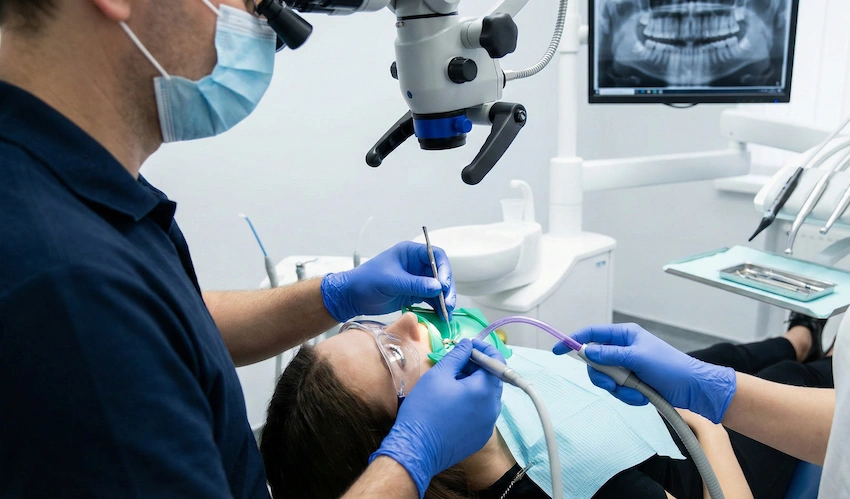
When we talk about failure, we decide to explore the interior aspect of the tooth. You can compare a treated tooth to a sealed submarine. There must be a complete absence of bacteria inside. The tooth must be hermetically isolated from the bacteria in the mouth. Bacteria will invade if cracks are found on the hull, even at a microscopic level. If the cleaning phase lacked a tiny spot the first time a dentist worked on it, problems start.
As Professor Doctor Coşkun Yıldız always emphasizes, a tooth’s root structure is very much like a fingerprint. Straight roots are a rarity.
Sometimes the roots have branches that lead to hidden and curved canals. Without the presence of a 3D powerful microscope,e which allows one to see these canals, clinics usually overlook the bacteria that remain behind. They continue to increase in number. They cause great tension. Ultimately, they result in tooth failure.
Warning Signs: Is Your Tooth Sending an SOS?
It is quite normal to experience a dull ache after a root canal. Your jawbone is bruised. Your tissues are healing. That being said, a real failure usually becomes apparent weeks, months, or even years later.
We are seeing these features in the clinic when the tooth is trying to communicate:
- Coming Back Pain: One shouldn’t experience sharp pain after hot drinks or biting an apple if a root canal was effective in removing the nerve. If such instances occur, the bacteria have reached the bone.
- The “Gum Pimple” (Fistula): You may feel a small, red bump on your gums intermittently. Additionally, it may leak a fluid. Basically, this is a pressure valve of sorts. The bone infection is releasing built-up gas and pus.
- Facial Swelling: Besides the raised cheek or jawline swelling, there is no other major red flag. This means the infection is not only in the tooth, but also it is spreading through your face and neck.
- Tooth Discoloration: When a tooth’s shade changes drastically to dark gray or black, then it definitely signals that tissue breakdown is in progress inside the tooth.
- Sinus Problems: The roots of your upper back teeth are adjacent to the sinus floor. The membrane of the sinus is as thin as the skin of an eggshell. A tooth infection can easily break this barrier, leading to chronic sinus pressure or a running nose on only one side.
Normal Healing vs. A Failed Root Canal
Our patients use this guide to get clues for telling normal healing apart from a dental emergency.
| Symptom | Normal Healing (First 1-2 Weeks) | Signs of Failure (Months/Years Later) |
| Pain Level | Very mild soreness. Easily controlled through the use of painkillers. | Severe pain that is sharp and throbbing, and can even disturb sleep. |
| Swelling | Minor puffiness in the mouth area. Disappears within 48 hours. | Persistent swelling of the face or gums that does not subside on its own. |
| Gum Look | Healthy pink gums. Sometimes they can be a bit sore in the immediate area. | The presence of a red bump, deep redness, or the presence of pus. |
| Chewing | Some discomfort may be felt if you are eating hard foods. | Suddenly, sharp pain when biting down. |
What to Do Next: Tidying up Your Smile in Turkey
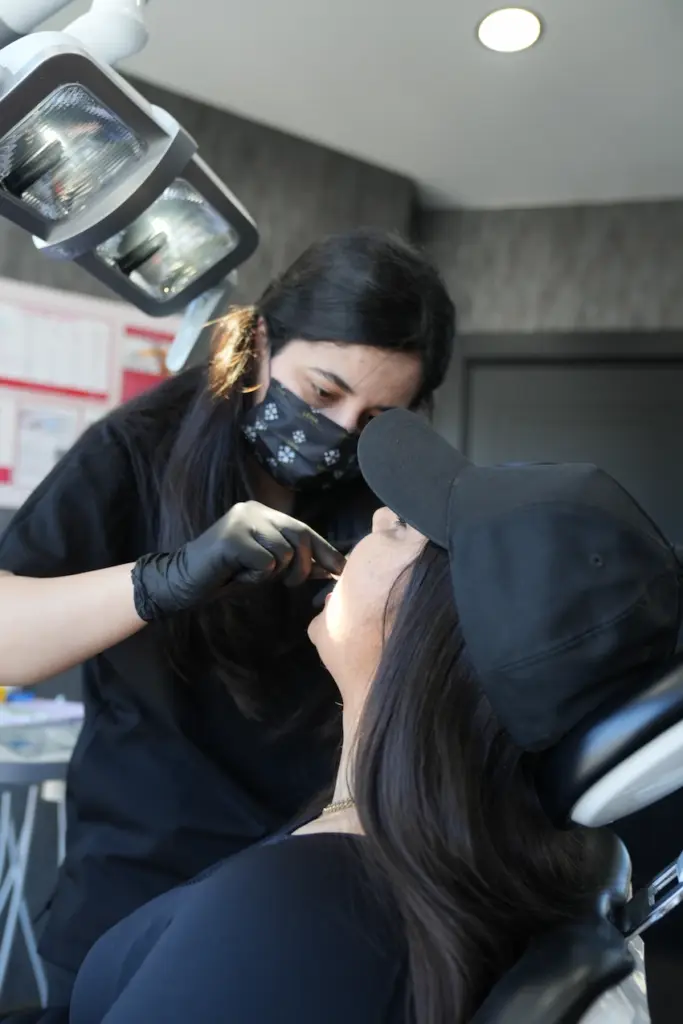
So, what is next? The instinct to panic is understandable, but it is quite unnecessary. Endodontic failure is a pretty common problem in the clinic. When done by specialists, the procedures fix the problems very effectively.
Dr. Polen Akkılıç and her team are well acquainted with situations like these as they deal with them daily. Our initial step comprises 3D scanning in order to locate the area of infection perfectly. After this, the filling is removed, and the tooth is thoroughly cleaned. Using an intense surgical microscope,s we identify those secret, overlooked canals. Eventually, we seal the “submarine” again.
It is not always possible to clear the infection with the above methods. Sometimes the infection is so deep that only the tip of the root is infected. At times like this, we dan o apicoectomy, which is a minor surgery where the infected tip is gently taken out. If the tooth is too badly broken for repair, we have to extract it. We then immediately give a premium dental implant so that you will always have a perfect smile without any gaps.
Frequently Asked Questions (Doctor to Patient)
Unfortunately, no. The tooth is without a blood supply, and thus the immune system can’t get to the bacteria to fight against them. Only the infection will continue growing and eventually harm your jawbone.
No. We first and foremost want to keep your natural tooth. If the root is still good, then a second operation will likely work. It is only when the tooth is destroyed that the removal is necessary.
You should be painless during the operation. Anesthesia is done very well, and painkillers are very effective. Actually, most are finding that the visit was a lot easier than their first root canal because the nerve is already dead.
Exactly fixing a root canal fault demands master skills, surgical microscopes, and 3D imaging. In addition, Turkey has very advanced dental care services at very affordable prices. So you can get experts at the top of their field without spending a fortune.
Generally, just one or two clinic visits will suffice for us to clean and seal the tooth. We will keep an eye on the bone healing by means of X-rays and, eventually, fit the crown that is custom-made for you so that your smile can stay protected for a very long time.
- Siqueira, J. F., & Rôças, I. N. (2008). Clinical implications and microbiology of bacterial persistence after treatment procedures. Journal of Endodontics, 34(11), 1291-1301.
- Nair, P. N. R. (2006). On the causes of persistent apical periodontitis: a review. International Endodontic Journal, 39(4), 249-281.
- Ng, Y. L., Mann, V., & Gulabivala, K. (2011). Tooth survival following non-surgical root canal treatment: a systematic review of the literature. International Endodontic Journal, 44(8), 610-625.
- Tabassum, S., & Khan, F. R. (2016). Failure of endodontic treatment: The usual suspects. European Journal of Dentistry, 10(1), 144-147.
- Salehrabi, R., & Rotstein, I. (2004). Endodontic treatment outcomes in a large patient population in the USA: an epidemiological study. Journal of Endodontics, 30(12), 846-850.

